
Most business owners assume that if an AI model were unsure about their company, it would say so.
It usually does not.
AI uncertainty rarely arrives as an admission. It almost never says “I could not find enough information about this business.” What it does instead is write a smooth, organized, professional sounding description that quietly stops being about your company and starts being about your industry.
That is what uncertainty looks like. Not doubt. Generality.
Once you know that, you can read an AI description of your business very differently. The signal is not in the tone of the answer. It is in the structure of the answer.
Why Uncertainty Does Not Sound Uncertain
A language model is built to produce a fluent response. Fluency is not connected to how much it actually knows about you.
When the model has strong, consistent, specific information about a company, it writes specific sentences. When it has thin or scattered information, it does not stop writing. It reaches for the next most reliable thing available, which is the general pattern of businesses that look like yours.
The sentence structure stays confident because sentence structure is not where the knowledge lives.
This is why judging an answer by how sure it sounds leads people wrong, a point I have written about in why AI sometimes sounds certain when its understanding is incomplete. Confidence is a writing style. It is not a measure of comprehension.
But that does not mean there is nothing to read. There is. It just is not tone.
The Tells
Here is what actually shows up in the language when a model is working from a weak understanding of a business.
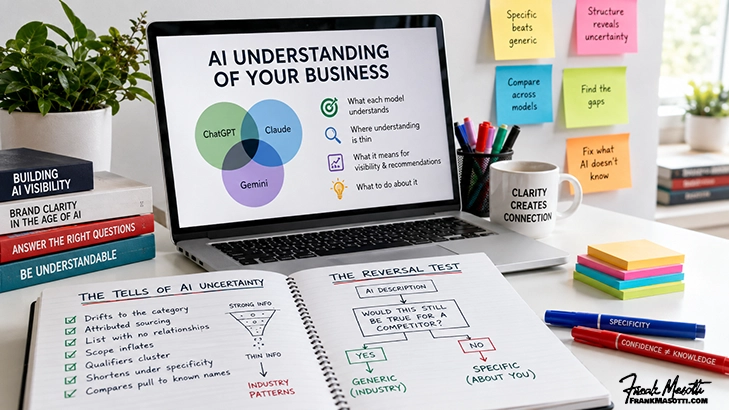
The description drifts from the company to the category. The answer opens with your name and then, sentence by sentence, becomes a description of what firms in your field generally do. By the third paragraph you could swap in any competitor’s name and nothing would need to change. The model has quietly moved from reporting to describing a type.
Sourcing gets attributed rather than stated. Watch for phrases that hand responsibility back to the source. According to their website. The company states that. They appear to offer. This is the model telling you it found a claim but has nothing else corroborating it. A well understood business gets described directly, because the same information showed up in several independent places.
Services appear as a list with no relationships between them. The model can name what you do but cannot explain how the pieces fit, which one is primary, or who each one is for. A list is what remains when the connective understanding is missing. It is the difference between knowing the parts and knowing the business.
Scope inflates. You serve one region and get described as nationally available. You focus on one narrow client type and get described as serving businesses of all sizes. Inflation is not flattery. It is what happens when the model cannot find a boundary, so it does not draw one.
Qualifiers cluster around the important parts. Notice where the hedging sits. If the location and the founder are stated plainly but the specialty arrives wrapped in “likely” and “may include,” the model is telling you exactly which part of your business it is least sure about. The hedge is a map.
The answer gets shorter as the question gets more specific. Ask what the company does and you get four paragraphs. Ask who it serves best, or how it differs from the two firms down the street, and you get three thin sentences. Volume collapsing under specificity is one of the clearest signals there is.
Comparisons pull toward better known names. When asked to position you against competitors, the model spends most of its answer on the companies it knows well and returns to you only briefly. That imbalance reflects the depth of information available on each entity, not the quality of the businesses.
The Reversal Test
There is a simple way to apply all of this without any special knowledge.
Take the AI description of your business, sentence by sentence, and ask whether that sentence would still be true if you pasted a competitor’s name into it.
If it would, the sentence carries no information about your company. It carries information about your industry.
Run the whole description this way and count what survives. Sometimes almost nothing does. The answer looked detailed and accurate, and it was accurate, and it was also describing a category rather than a company. Accuracy and specificity are separate problems, which is part of why AI can recognize a business but misunderstand its specialty.
What survives the reversal test is what the model actually knows about you. Everything else is filler drawn from the shape of your industry.
What These Signals Do Not Prove
These tells indicate where a model’s footing is uncertain. They do not tell you that the model is wrong.
A hedged sentence can be perfectly accurate. A generic description can be a fair summary of a genuinely generalist firm. A short answer to a hard question is sometimes just a short answer.
What the signals reliably identify is where the ground is soft. They mark the places where the model is filling gaps with pattern rather than reporting from information. Whether that filling happens to be correct is a separate question, and one you answer by knowing your own business and comparing what several models say against each other.
Confidence tells you nothing. These structural tells tell you where to look. Neither one, on its own, tells you the truth.
Why One Answer Cannot Show You This
Uncertainty is not stable. It moves depending on what you ask and which model you ask.
A model may be specific and grounded when describing your services and immediately go generic when asked about your customers. Another model may reverse that entirely. The gaps sit in different places because each system built its picture from a different mix of sources, which is why asking one question cannot show you how AI understands your business.
The pattern worth finding is the one that repeats. When ChatGPT, Claude, and Gemini all get vague at the same point, in the same way, that convergence means something. It usually means the underlying information about that part of your business is thin, inconsistent, or buried everywhere online, not just in one model’s view of you. That is the value in what agreement between the three models can tell you.
One vague answer is an anecdote. The same vagueness in three places is a finding.
Why It Costs You
A generic description does not fail visibly. It fails quietly, at the moment of recommendation.
When a prospect asks a broad question about your industry, a generic profile is fine. You may well get mentioned. When that prospect asks the question that actually matters, the one about their specific situation, the model has to decide whether you are the right fit. It cannot make that call from a description that fits everyone in your field equally.
So it recommends the businesses it understands specifically. Not because they are better. Because the model has something to match against.
You never see this happen. There is no error, no complaint, no bounce. Just an introduction that never occurred. This is the mechanism behind the question of why AI recommends competitors and not you, and it starts with a description that reads perfectly well and says almost nothing.
Where the Report Comes In
The AI Business Understanding Report is built to find these patterns deliberately rather than by chance.
I ask ChatGPT, Claude, and Gemini a structured set of questions about your business, from several angles, and I read the answers for exactly what this post describes. Where each model gets specific. Where it retreats to the category. Where the hedging clusters. Where an answer shrinks under a harder question. Where all three go quiet in the same spot.
Then I write up what each model appears to believe, where its understanding is thin, and what that means for how you are described and recommended.
You can do a version of this yourself, and I would encourage you to run the reversal test on your own business this afternoon. It takes ten minutes and it is often uncomfortable. What is hard to do alone is the comparison across three systems, with enough questions to separate a real gap from a single odd answer.
If you want that comparison done properly, order the AI Business Understanding Report. You will get a written record of what all three models currently understand about your business, where that understanding runs out, and what it is costing you when the description stops being about you.