
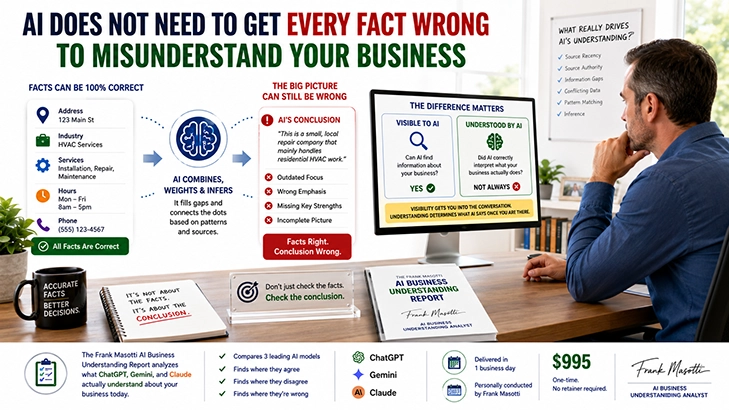
If you searched for this, you have probably already had the AI check your business, seen that the facts look mostly right, and still felt like something was off. The address is correct. The industry is correct. The services are listed correctly. And yet the picture that comes back does not feel like your business. That feeling is not paranoia. It is accurate. AI can get every individual fact right and still misunderstand what you actually do.
This matters because most business owners judge AI accuracy the way they would judge a fact checker. Did it get the name right? The location? The hours? If those check out, the assumption is that the understanding underneath must be sound too. But understanding a business is not the same task as listing facts about it. It is the task of combining those facts into a conclusion, and that is where things quietly go wrong.
Why This Problem Stays Hidden
The reason most business owners never notice this is that they are checking the wrong thing. When you ask an AI model about your business, you are naturally scanning for errors. Is that true? Is that true? Is that true? If every sentence passes that test, the conversation feels resolved. You close the tab satisfied.
But a conclusion is not one sentence. It is what the model does after it has gathered several true sentences and decided what they mean together. Two businesses can share identical facts, correct pricing, correct location, correct service list, and still end up with completely different characterizations, because the model weighted those facts differently, or filled a gap between them with an assumption you never stated.
This is the same idea covered in How AI Can Combine Accurate Facts Into an Inaccurate Conclusion, and it is worth sitting with, because it changes what you should actually be checking for. frankmasotti
How Accurate Facts Turn Into an Inaccurate Picture
Think about how a person forms an impression of a stranger. They do not just collect facts about them. They connect those facts into a story, and the story fills in gaps the facts never covered. AI does something structurally similar. It is not simply retrieving your information. It is synthesizing a description from many sources, weighing which details matter more, and resolving conflicts or gaps by inference.
That inference step is where a technically correct summary can still miss the point of your business. Say your business shifted from mostly residential work to primarily commercial contracts two years ago. If older sources that described your residential focus are more numerous, more frequently cited, or simply older and therefore more established in training data, the model may lean toward that framing even while accurately quoting your current address and phone number. Every fact stated is true. The conclusion, that you are primarily a residential company, is not.
This is also why AI can sound so confident while being incomplete. It is not lying and it is not guessing wildly. It is filling reasonable gaps with the most available pattern, and that pattern does not always match your current reality. That confidence, even when the underlying picture is thin, is explored further in Why AI Sometimes Sounds Certain When Its Understanding Is Incomplete. frankmasotti
The Business Consequence of a Technically Correct Description
Here is where this stops being a curiosity and becomes a business problem. A prospective customer does not ask AI for a list of facts about you. They ask a question with intent behind it. Who handles emergency repairs. Who works with businesses my size. Who specializes in the specific problem I have. The AI answers based on its assembled understanding of you, not a checklist of your correct details.
If that assembled understanding leans on an outdated framing, or over weights one part of your business and underweights another, you can be technically described correctly and still be recommended for the wrong reason, or passed over for a competitor whose picture happens to be better assembled. The customer never sees the gap. They just see an answer that did not include you, or included you in a way that did not match what they were actually looking for.
This is a quieter version of the problem than an outright factual error. A wrong phone number gets noticed and corrected quickly. A conclusion that subtly misframes your business can run for months without anyone realizing it is costing you customers, simply because nothing about it looks broken from the outside.
Why One Conversation With AI Will Not Reveal This
The instinct at this point is usually to go ask ChatGPT directly and see what it says. That will tell you something, but not enough. One question captures one framing, from one model, on one day. It will not show you whether the conclusion holds up under different phrasing, whether other models draw a similar picture, or whether the underlying reasoning is consistent or coincidental.
That is the same limitation covered in One AI Question Cannot Show You How AI Understands Your Business. A single answer is a sample, not a diagnosis. frankmasotti
What Actually Needs to Be Checked
The right question is not did AI get the facts right. It is did AI draw the right conclusion from those facts. That requires looking at how a business is framed across multiple questions and multiple models, where the framing lines up with reality and where it quietly drifts, and why the drift is happening in the first place. That is a different kind of review than checking a listing for errors, and it is the actual work behind the AI Business Understanding Report.
The report does not just confirm whether ChatGPT, Claude and Gemini have your facts straight. It looks at the conclusions each one is drawing, compares them against each other, and identifies where the story being told about your business no longer matches the business you actually run. If you are curious what is involved in that process, What Am I Actually Buying answers that directly.
Getting the facts right was never the hard part. Getting the conclusion right is the part worth checking.