
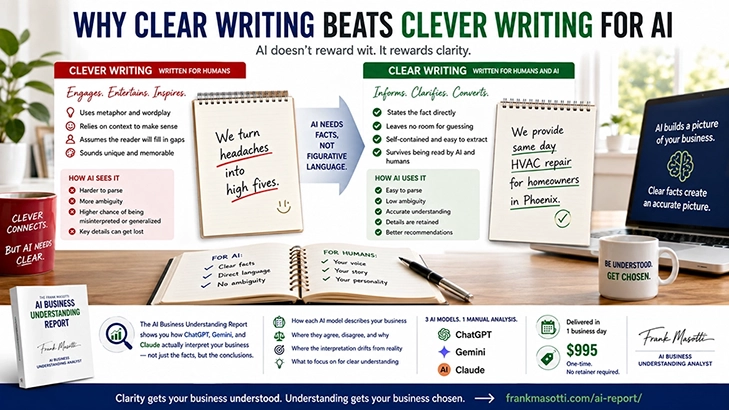
If you are asking this, you have probably already noticed something is off. Your website has personality. Your taglines land with people. Your copy sounds like you, not like a template. And yet when you ask an AI model what your business does, it comes back flat, generic, or slightly wrong. That gap is not a coincidence, and it is not a sign that your writing is bad. It is a sign that clever and clear are doing two different jobs, and AI only rewards one of them.
The short answer to the question you came in with is this. Clever writing is built to win over a human reader who brings context, patience, and curiosity to the page. Clear writing is built to survive being read by a system that has none of those things. AI does not reward wit. It rewards the absence of ambiguity, because ambiguity is exactly where its understanding of your business breaks down.
The Hidden Problem: Cleverness Was Never Written for a Machine
Every instinct in good marketing writing points toward cleverness. Say it differently than the competitor. Use a metaphor instead of a plain description. Let personality carry the message instead of spelling everything out. This works, and it has worked for a long time, because it is written for humans, who fill in gaps naturally and enjoy the effort of decoding a clever line.
The problem is that this same writing now has a second reader that was never part of the plan. AI models are reading your site to build an internal picture of what you do, and that picture gets handed to prospects who ask an AI assistant about you before they ever see your website. That second reader does not experience delight when it decodes a metaphor. It experiences uncertainty, and uncertainty is the raw material of a wrong or generic answer.
This is why the problem stays hidden. Your human visitors still love the copy. Your bounce rate has not changed. Nothing about the page looks broken. The damage is happening somewhere you cannot see it, in the gap between the clever line you wrote and the plain fact an AI model needed to extract from it.
Why This Stays Invisible to Most Business Owners
There is no dashboard that shows you how an AI model interpreted your homepage. You can reread your own copy as many times as you like and it will always make sense to you, because you already know what it means. That is the trap. Familiarity with your own writing makes it impossible to judge how ambiguous it actually is to a reader with zero outside context.
AI is that reader. It has no memory of your brand from a previous visit, no sense of your industry reputation, no ability to call and ask a clarifying question. It has only the words on the page, and it has to turn those words into an answer, and that answer can sound certain even when the underlying understanding is incomplete. When the words require decoding, the model either decodes them correctly, decodes them incorrectly, or gives up and defaults to something generic. None of those outcomes are visible to you unless you go looking for them directly.
The Mechanism: How AI Actually Processes Language
It helps to understand what is actually happening when an AI model reads a sentence. Language models work by predicting meaning from patterns, and they are genuinely capable of handling figurative language in isolation. The trouble is not that AI cannot understand a metaphor at all. The trouble is what happens when that metaphor is the only source of a fact the model needs.
Take a real example. A tagline that says “We turn headaches into high fives” is fine writing. A human reader understands instantly that this is a service business that resolves frustrating problems and leaves customers satisfied. But an AI model trying to extract a concrete fact, what does this business actually do, has to work through two layers of figurative language just to arrive at a vague conclusion. Compare that to a sentence like “We provide same day HVAC repair for homeowners in Phoenix.” There is nothing to decode. The fact is stated once, directly, and it survives being read by anything.
This matters even more once you understand how AI systems often process a page, and why AI crawling a page is not the same thing as AI understanding it. Long form content frequently gets broken into smaller sections for retrieval, meaning a clever line that depends on a sentence three paragraphs earlier for its punchline may be read completely on its own, stripped of the setup that made it make sense. A literal, self contained sentence keeps its meaning no matter where it gets read. A clever sentence often does not.
Why This Costs You the Differentiation You Were Trying to Create
Here is the part that should actually concern a business owner who prides themselves on strong writing. Cleverness usually exists to differentiate you from a competitor. It is supposed to be the thing that makes your business sound distinct, memorable, worth choosing. But when AI cannot parse that cleverness into a specific fact, it does not describe you as distinct. It falls back to the most generic category it can confidently assign, which puts you in exactly the same bucket as every competitor you were trying to stand apart from.
A boutique renovation company that only handles historic homes, described entirely through personality driven copy, can easily get flattened by an AI model into “a general contractor.” A specialized consulting practice with a sharp, witty voice can get summarized as “a business consultant,” indistinguishable from a hundred others. The writing was working exactly as intended for a human audience, and it is quietly failing at the one job that increasingly determines whether AI recommends you at all.
The Business Consequence
When your writing is clever but not clear, three outcomes tend to follow. AI describes you in terms so generic that a prospect asking about your specific niche never gets steered toward you at all. AI occasionally combines accurate facts into an inaccurate conclusion, because it filled a gap with its best guess rather than a stated fact. Or AI simply omits a distinguishing detail entirely, because that detail only ever existed inside a metaphor it could not confidently translate.
None of this shows up as a drop in engagement or a complaint from a reader. It shows up as a conversation that never starts, because the AI model a prospect consulted never understood what actually made you the right choice.
Where Clarity and Cleverness Both Belong
None of this means you should strip your writing of personality. It means clarity and cleverness need to do separate jobs on the same page instead of being blended into every sentence. State the plain fact once, directly, in language that requires no decoding. Then let your voice, your wit, and your personality build the case around that fact for the human reader. AI gets the fact it needs. Your reader still gets the writing that made them choose you over a competitor who sounded like everyone else.
This is also exactly why more information about your business does not always create better AI understanding. Volume does not solve ambiguity. Only clarity does. And it is worth reading how AI reads your website, but that does not mean it knows what your business does, because reading and understanding are not the same event.
If you want to know how AI currently interprets your own writing, rather than guessing which lines are landing and which ones are getting lost, the AI Business Understanding Report will show you exactly that.