
If you have already cleaned the metaphors out of your website copy and an AI model still describes your business vaguely, the problem is probably not your tone. It is your sentence structure.
Here is the direct answer to the question that brought you here. A sentence can be completely literal, completely honest, and still be readable in more than one way. When an AI model hits a sentence like that, it does not stop and flag the confusion. It picks one reading, moves on, and builds the rest of its understanding of your business on top of that choice. You never see the fork in the road. You only see the answer that came out the other side.
This is a different problem from writing that is too clever. That issue is covered separately in the post on why AI takes your words literally. This one is about the sentences you would swear are already clear.
The Hidden Problem: You Cannot Read Your Own Sentences
Read this line the way a stranger would.
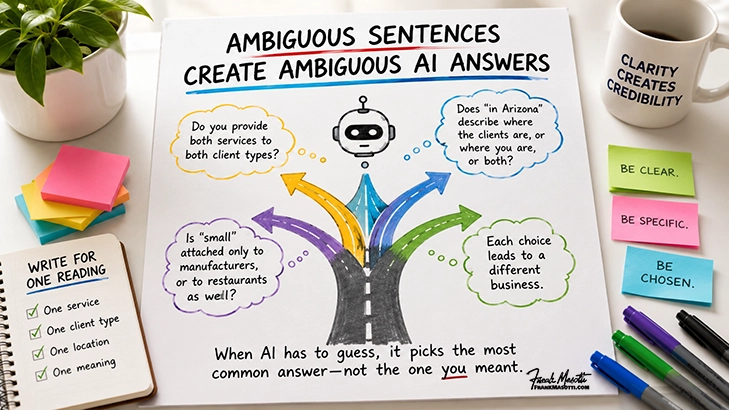
“We provide accounting and payroll services for restaurants and small manufacturers in Arizona.”
You know exactly what it means, because you wrote it. But a reader with no outside context has to make at least three decisions before it means anything specific. Do you provide both services to both client types, or accounting to one and payroll to the other? Does “in Arizona” describe where the clients are, or where you are, or both? Is “small” attached only to manufacturers, or to restaurants as well?
There is no metaphor here. Nothing is exaggerated. Every word is true. The sentence is still ambiguous, and you cannot detect that by rereading it, because you already hold the answer in your head. Familiarity is the reason this problem survives every proofread.
Why AI Does Not Ask You to Clarify
A human reader who hits an ambiguous sentence has three options. Ask a question. Guess and stay a little uncertain. Or keep reading and let the rest of the page settle it.
An AI model producing an answer for a prospect has effectively one option. It has to resolve the ambiguity to say anything at all, so it resolves it silently, and it resolves it toward whatever reading is most common in the language it has learned from. That default is almost never the specific thing you meant. It is the average version of your industry.
So the accounting firm that serves two named niches gets resolved into a general accounting firm. The manufacturer that builds one specialized product line gets resolved into a manufacturer. Ambiguity does not produce a blank in the answer. It produces the most ordinary reading available, which is exactly the description that makes you interchangeable with your competitors.
This is also why the resulting answer sounds so confident. The uncertainty existed for a fraction of a second inside the model and then disappeared, which is the same reason AI can sound certain when its understanding is incomplete. Nothing in the output tells the reader that a coin was flipped.
The Four Ambiguities That Do the Most Damage
Most business copy fails in a small number of predictable ways.
Lists joined by “and.” “Commercial and residential roofing and window installation.” That is either two services or four, and the model has to choose. If it chooses wrong, half your revenue disappears from your description.
Modifiers with more than one possible home. “Emergency plumbing repair for property managers in Scottsdale.” The location could attach to the repair, the managers, or the company. Only one of those readings gets you recommended when someone asks for a plumber in Scottsdale.
Relationships without direction. “We work with contractors and homeowners.” Are contractors your customers, your partners, or people you hire? The sentence does not say. A model deciding you serve contractors will describe you as a business to business supplier. A model deciding you hire them will describe you as a general contractor. Same sentence, two different businesses.
Time with no anchor. “Recently expanded our service area.” Recently as of when? A page written in 2023 and read in 2026 still says recently. The word carries no date, so it carries no information, and the model fills the gap with whatever older material it already holds.
Why One Ambiguous Sentence Becomes a Wrong Conclusion
A single unclear sentence rarely breaks anything on its own. The damage happens because these choices stack.
AI models frequently read pages in sections rather than start to finish, which means the sentence that would have clarified the earlier one may never be read alongside it. Each ambiguous sentence gets resolved independently, and then those separately resolved readings get assembled into one description of your business. The result can be a profile where every individual fact traces back to something you actually published, but the combination describes a company that does not exist. That is the same failure pattern covered in the post on how AI can combine accurate facts into an inaccurate conclusion.
This is also why writing more does not fix it. Adding three paragraphs of context around an ambiguous sentence gives the model more material to resolve, not less, which is one reason more content does not automatically make your business easier for AI to understand. Volume adds surface area. Precision removes the fork.
The Business Consequence
The cost here is quiet and specific. It is not that AI says something false about you and a customer calls to complain. It is that a prospect asks an AI assistant a narrow question, the kind of question you would win every time, and the answer never includes you, because the sentence that established your specialty was resolved into something broader three steps earlier.
Increasingly your prospect asks AI about you before they contact you, and the description they receive is the one built from these resolutions. You do not lose that conversation. You never enter it.
What Actually Fixes It
The fix is structural, not stylistic. Give every fact exactly one possible reading, and give it in one sentence rather than across two.
Instead of the accounting example above, three shorter sentences do the work no cleverness can. Name the service. Name the client type. Name the location. Separately. It reads slightly plainer to a human and it removes every fork for the machine.
Structured data helps here too, but only after the writing is fixed, because schema can only restate what the page already says clearly. It cannot resolve a sentence you left open.
Where the Report Fits
The hard part is not rewriting an ambiguous sentence once you know it is ambiguous. The hard part is finding it, because your own memory of what you meant will hide it from you every single time you read the page.
The AI Business Understanding Report is built to show you the resolutions rather than the sentences. It shows you what ChatGPT, Claude, and Gemini currently say your business does, in their own words. Where those three descriptions quietly disagree with each other, you have found an ambiguous sentence, because that is exactly what an unresolved fork looks like from the outside. This is part of why three models are checked rather than one.
Clear writing is not about sounding simple. It is about leaving nothing for a reader to decide on your behalf.