
AI Search Report
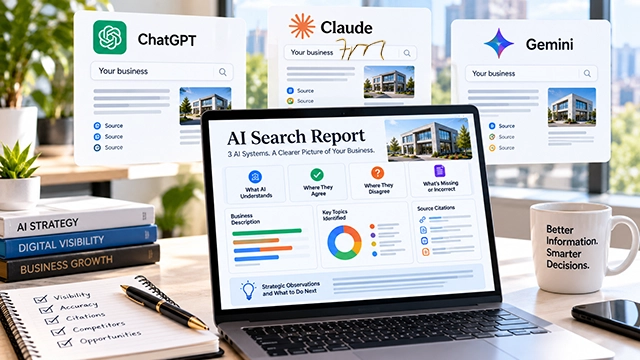
AI Search Report
| How I Score AI Search Performance in my AI Business Understanding Report | |
| Does AI understand what your business is? | 20 Points |
| Does AI understand what you actually sell or provide? | 20 Points |
| Does AI understand who your business is for? | 15 Points |
| Does AI understand what makes your business different? | 15 Points |
| Does AI know when your business belongs in the conversation? | 15 Points |
| What does AI have wrong, missing, or confused? | 10 Points |
| Do ChatGPT, Claude, and Gemini understand your business the same way? | 5 Points |
| Total points available 100 points | |
An AI Search Report documents what happens when a business, brand, product, or service is examined across artificial intelligence search systems.
That can include whether the business appears in AI generated answers, which sources are cited, how often the business is mentioned, which competitors appear alongside it, and how its visibility changes across different questions and AI platforms.
But there is another part of AI search reporting that deserves just as much attention:
What does the AI system actually understand about the business it is describing?
A business can appear in an AI answer and still be described incorrectly.
It can be cited while an important service is missing.
It can be recognized while being associated with the wrong type of customer.
It can appear in one AI system and be understood very differently by another.
That is why an AI Search Report can be more useful when it looks beyond whether a business appeared and examines the interpretation behind the appearance.
What Is an AI Search Report?
An AI Search Report is a documented analysis of how a business or other entity appears and is represented within AI search and answer systems.
There is not one universal format for an AI Search Report.
Some reports concentrate on measurable visibility signals such as mentions, citations, prompts, competitors, share of voice, or traffic attributed to AI platforms.
Others can examine the answers themselves.
That second layer asks questions such as:
Does AI recognize the correct business?
Does it understand what the company actually does?
Does it understand the products or services offered?
Does it associate the business with the right customers and use cases?
Does it understand what makes the company different?
Does it know when the business belongs in a recommendation?
What information does it have wrong, missing, outdated, or confused?
Do different AI systems understand the business the same way?
Those questions move an AI Search Report from simply measuring presence toward examining what that presence actually means.
AI Search Reporting Is Not the Same as Traditional Search Reporting
Traditional search reporting has well established measurements.
A business can monitor rankings, impressions, clicks, traffic, conversions, backlinks, and other search performance data.
AI search behaves differently.
Someone can ask an AI system a question and receive a direct answer without seeing a traditional list of search results.
The AI system may mention several businesses.
It may recommend one.
It may describe a company without linking to its website.
It may cite a source without prominently identifying the business behind that source.
It may combine information from multiple sources into its own description.
It may also decide that a particular business does not belong in the answer at all.
An AI Search Report therefore needs to account for a search environment in which the answer itself can influence the customer before a website visit ever happens.
Visibility Is Only One Part of an AI Search Report
Visibility matters.
If a business never appears when people ask relevant AI systems for providers, products, services, comparisons, or recommendations, that is useful information.
But appearance alone does not tell the whole story.
Suppose an AI system mentions a company in response to a relevant question.
That sounds positive.
Now suppose the same answer describes the company as providing a service it stopped offering three years ago.
Or leaves out the specialty that makes the company relevant to the customer.
Or associates the business with consumers when it primarily serves commercial clients.
Or places it in a category that sounds similar but represents a substantially different type of operation.
The business was visible.
The business was also misunderstood.
That is why being visible to AI is not the same as being understood by AI.
An AI Search Report should make that distinction clear.
What Should an AI Search Report Examine?
The answer depends on what the report is intended to measure.
A visibility focused report may examine mentions, citations, competitors, prompt coverage, share of voice, and changes over time.
A business understanding focused report needs to examine the substance of the AI answers.
That includes business identity, category, products, services, customer fit, attributes, differentiation, recommendation behavior, misunderstandings, omissions, and differences between AI systems.
Neither approach answers every possible question about AI search.
They measure different parts of the same environment.
The important thing is knowing what the report actually measured before drawing conclusions from it.
An AI Search Report Should Preserve Context
A number without context can create false confidence.
If a report says a business has a particular AI visibility percentage, the obvious next question is:
Visibility for what?
Which questions were tested?
Which AI systems were included?
What counted as an appearance?
Were citations measured separately from mentions?
Were competitors included?
Were the answers examined for accuracy?
When was the analysis performed?
AI generated answers can change depending on the model, the question, available information, and the date of the evaluation.
A useful AI Search Report should make its scope understandable.
Otherwise a precise looking number can hide a very imprecise conclusion.
AI Search Reports Should Look at More Than One AI System
There is no single AI interpretation of a business.
ChatGPT can understand a company one way while Claude understands it another way and Gemini produces something different again.
One model may recognize an important specialty.
Another may miss it.
One may associate the business with the correct customer.
Another may understand the services but place the company in the wrong category.
The disagreement itself is information.
That is why ChatGPT, Claude, and Gemini can know three different versions of the same business.
An AI Search Report based on one system can document that system.
A multi model report can reveal whether the understanding is consistent across systems.
One Question Is Not an AI Search Report
Typing a business name into ChatGPT can be useful.
It is not the same as systematically examining how AI understands the business.
One question tests one formulation at one moment.
Change the question and a different part of the model’s understanding may become visible.
Ask what the company does.
Ask who it serves.
Ask what it is known for.
Ask what makes it different.
Ask when it should be recommended.
Ask about a particular product, service, specialty, location, or customer need.
Then ask comparable questions across different AI systems.
Patterns begin to emerge.
That is why asking ChatGPT about your business once is not an AI search audit.
An AI Search Report should document a pattern rather than treat one answer as the complete picture.
AI Search Reports Can Reveal Missing Information Without Finding an Error
AI does not have to say something false to present an inaccurate picture of a business.
Sometimes the problem is what never appears.
Imagine that an AI system correctly identifies the business, correctly describes its general category, and correctly states where it is located.
Everything in the answer may be factually accurate.
But if it consistently omits the company’s most important specialty, the resulting description can still be commercially incomplete.
The same applies to customer types, products, capabilities, service areas, qualifications, attributes, or other distinctions that affect whether the business belongs in a particular conversation.
An AI Search Report can therefore reveal two very different problems:
Incorrect information and missing information.
Both can affect how a business is represented.
The Important Questions Change by Business Type
An AI Search Report should not assume that every business needs to be evaluated in exactly the same way.
The distinctions that matter depend on the industry.
For an abattoir, meaningful questions can involve inspection status, livestock species handled, custom slaughter, further processing capabilities, and who can legally purchase the resulting meat.
For a consulting firm, the important distinctions may involve the type of consulting provided, the problems the firm addresses, the organizations it serves, and whether AI confuses advisory work with implementation or another professional service.
For a manufacturer, product categories, materials, specifications, applications, industries served, and manufacturing capabilities may matter more.
For a local service business, geography, service scope, specialties, customer types, and recommendation context may become central.
The purpose is not to force every business into the same generic checklist.
The purpose is to determine whether AI understands the distinctions that matter for that particular business.
AI Search Report vs. AI Visibility Report
The terms can overlap, but they do not have to mean exactly the same thing.
An AI visibility report is generally concerned with whether and how prominently a business appears across AI generated answers.
That can include mentions, citations, prompt coverage, competitors, share of voice, and other visibility measurements.
An AI Search Report can include those signals while also examining the actual representation produced by the AI system.
That creates two different questions:
Did the business appear?
and
What did AI communicate about the business when it appeared?
A business owner may reasonably want answers to both.
You can read more about the visibility side in my AI Visibility Audit explanation.
AI Search Report vs. Traditional SEO Audit
A traditional SEO audit examines a website and the factors that can affect its performance in conventional search engines.
That may include technical issues, crawling, indexing, page structure, content, links, metadata, structured data, performance, and other search optimization factors.
An AI Search Report asks a different question.
It examines the result of AI interpretation.
The business website can be part of the information environment AI systems encounter, but it is not necessarily the only source shaping the answer.
AI systems may encounter information about a company across websites, directories, publications, reviews, databases, profiles, historical material, and other public sources.
That is why a technically sound website does not automatically guarantee an accurate AI interpretation.
The two forms of analysis can complement each other, but they should not be treated as interchangeable.
An AI Search Report Is a Diagnosis
Before deciding how to improve something, it helps to establish what is actually happening.
That principle matters in AI search.
If AI already understands the business correctly but rarely recommends it, that is one problem.
If AI regularly mentions the business but misunderstands what it does, that is another.
If ChatGPT understands the company accurately while Claude and Gemini do not, that is another.
If all three systems repeat the same outdated information, that is another.
Those situations should not automatically receive the same prescription.
The report comes first because the evidence should determine what happens next.
Diagnosis before prescription.
The Frank Masotti Approach to an AI Search Report
My approach focuses specifically on the interpretation layer of AI search.
The Frank Masotti AI Business Understanding Report is a manual analysis of what ChatGPT, Claude, and Gemini currently understand about one business.
Each model is evaluated independently.
The analysis examines whether the models understand the business identity, category, products or services, customers and use cases, differentiation, recommendation context, important attributes, and other aspects of the company.
It also looks for misunderstandings, omissions, conflicting interpretations, and disagreements between the three models.
The original responses become the evidence used in the analysis.
I then compare those responses manually and document what the patterns reveal.
This is not an automated AI visibility scanner.
It is not a traditional SEO audit.
It does not assume that a mention means the business is understood correctly.
And it does not assume that ChatGPT, Claude, and Gemini know the same things.
You can read the complete methodology to see how the evaluation is performed.
AI Search Reports by Business Type
The general concept of an AI Search Report becomes much more useful when applied to a specific type of business.
Different industries have different distinctions that AI needs to understand.
That is why I also examine what AI search understanding can mean for individual business types.
An AI Search Report for a particular business type looks at the categories, capabilities, customers, services, attributes, regulatory distinctions, recommendation situations, or other industry realities that could affect whether an AI system understands and represents that kind of business correctly.
The framework stays consistent.
The industry questions do not.
That difference matters.
What an AI Search Report Ultimately Needs to Tell You
An AI Search Report should leave you knowing more than whether your company appeared.
It should help establish what the AI systems examined actually know about the business.
What do they understand correctly?
What do they misunderstand?
What important information is missing?
What attributes do they associate with the company?
When do they consider the business relevant?
Where do different AI systems agree?
Where do they disagree?
And what should you address first based on what the evidence shows?
Those are the questions that turn AI search reporting from a collection of measurements into something a business owner can actually use.
Find Out What AI Search Systems Understand About Your Business
You already know what your business does.
The question is whether the AI systems your customers increasingly use to research businesses understand the same thing.
The Frank Masotti AI Business Understanding Report examines your business across ChatGPT, Claude, and Gemini and documents what each system understands, misunderstands, omits, and associates with your company.
The report costs $495 and is completed manually, one business at a time.
3 models. 1 analyst. 1 report.