
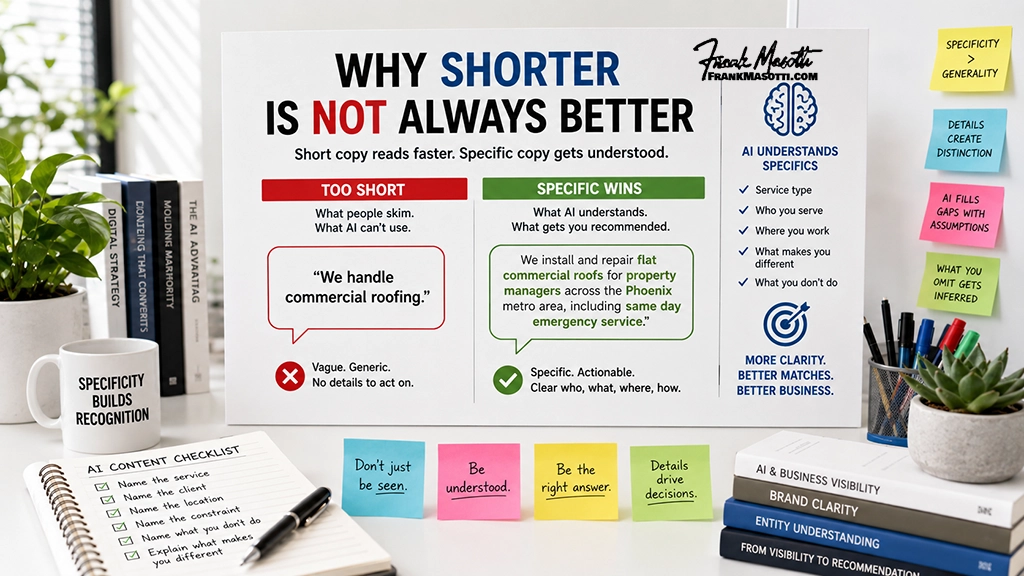
If you have been trimming your website copy, cutting paragraphs into single lines, replacing a full service description with three confident words, you were following good advice. Modern web design rewards brevity. Visitors skim. Short copy converts. Every editor you have ever worked with told you to cut the unnecessary words, and they were right to.
Here is the direct answer to the question that brought you here. Shorter copy is easier for a person to read and frequently harder for AI to use. Not because AI prefers long pages, and not because word count is something a language model rewards. It is because the first thing that gets cut when you shorten a sentence is almost always the qualifying detail, and qualifying detail is the entire substance of what AI knows about your business.
Consider two versions of the same claim. “We handle commercial roofing.” And “We install and repair flat commercial roofs for property managers across the Phoenix metro area, including same day emergency service.” Both are true. The first is cleaner, faster to read, and looks better in a hero section. The second is the only one that gives an AI model something specific enough to act on. When a prospect asks an assistant for a company that repairs flat commercial roofing on short notice, only one of those sentences puts you in the answer.
The Words You Cut Are the Words That Define You
Editing for brevity follows a predictable order. The verb stays. The noun stays. What disappears is the modifier: who you serve, where you work, what type of the thing you do, what you deliberately do not do, what makes the work different from the version a competitor sells.
Those modifiers are not decoration. They are the attributes that separate your business from the category it belongs to. AI does not understand businesses as blocks of prose. It builds a structured picture of an entity and attaches properties to it, which is why it helps to understand what an entity actually is and why AI treats it as one coherent thing rather than a collection of pages. Strip the modifiers and you have not made the entity leaner. You have removed most of its properties and left behind a category label.
This is a different failure from the one caused by figurative writing. Clever writing hides a fact inside a metaphor and asks the model to decode it. Compressed writing does not hide the fact. It deletes it. The sentence that remains is perfectly clear and almost entirely empty, and because AI takes your words literally, a short accurate sentence gets read as a complete statement of what you do rather than a summary of it.
Why This Stays Invisible
A shortened page looks like an improvement to everyone who reviews it. It reads faster. It looks more modern. It tests well with human visitors. Nothing about the edit feels like a loss, because you still know everything the page no longer says.
That is the trap. You cannot read your own site as a stranger with no context, and AI is exactly that stranger. It has no memory of your earlier drafts, no sense of your reputation in your market, and no ability to ask a follow up question. It works only from the words that survived the edit. This is also why AI reading your website does not mean it knows what your business does, and why being visible to AI is not the same thing as being understood by it.
Silence Is Not Neutral
Business owners tend to assume that anything left unsaid is simply absent from the model’s picture. It is not. When your published material omits a detail, AI does not leave a blank space. It fills the gap with whatever is typical for a business of your apparent type, drawing on industry averages, competitor language, and directory categories.
So the page that no longer specifies that you work exclusively with property managers does not produce a model that is uncertain about your clientele. It produces a model that quietly assumes you serve whoever a roofing company usually serves. The assumption reads as fact, and AI often sounds completely certain when its underlying understanding is incomplete. Nothing in the answer signals that a detail was inferred rather than found.
This Is Not an Argument for Longer Pages
It is worth being precise here, because the opposite mistake is just as common. Publishing more content does not automatically make your business easier for AI to understand, and more information does not reliably produce better AI understanding either. Both remain true.
Length was never the variable. Specificity per sentence is. A four hundred word page where every sentence names a service, a client type, a location, and a constraint gives AI far more to work with than four thousand words of narrative that never commits to a concrete claim. The question to ask of any sentence you are about to cut is not whether the page can survive without it, but whether a specific fact about your business disappears when it goes. If it does, the sentence was carrying weight that nothing else on the site is carrying.
Compression Gets Worse Under Retrieval
There is a second mechanism at work. AI systems frequently break pages into smaller sections and retrieve them independently rather than reading a page start to finish, which is part of why crawling a page is not the same as understanding it.
A long sentence that carries its own context survives that process intact. A three word headline that only makes sense because of the image beside it, the nav label above it, or the paragraph two screens down does not. Compressed copy tends to lean heavily on surrounding context to complete its meaning, and surrounding context is exactly what gets stripped away when a fragment is retrieved on its own. Structured data helps here, though only within limits, because schema labels what already exists on your pages rather than inventing anything new. If the detail was cut from the copy, there is nothing for the markup to describe.
The Business Consequence
The cost of over compression is not a wrong answer. It is a vague one, and vagueness is commercially worse than error. A model that describes you incorrectly can at least be caught and corrected. A model that describes you accurately but generically simply files you under the broadest category available, where you compete against everyone else in that category on nothing in particular.
That is usually the real reason behind the question of why AI recommends competitors instead of you. The competitor is not better known. Their published material committed to specifics yours no longer states. And because your prospect may ask AI about you before ever contacting you, the conversation you lose is one you never learn about. There is no bounce rate for a prospect who was never pointed toward you.
Where This Gets Fixed
You cannot judge this from the inside. Reading your own copy will always feel sufficient, because you supply the missing detail automatically. The only way to know what survived the edit is to look at what the models actually produce.
That is what the AI Business Understanding Report is for. It documents how ChatGPT, Claude, and Gemini currently describe your business, where their descriptions go specific and where they fall back to category defaults, and which details your own copy stopped supplying. You can see how the process works before deciding, and the findings tell you whether those interpretations can realistically be changed.
If you want to know which specifics your site is still stating and which ones quietly disappeared in the name of cleaner copy, you can order the AI Business Understanding Report here.