
Something important has changed in how customers research businesses.
They are not only searching Google, opening websites, reading reviews, and comparing businesses themselves. A growing number are asking AI systems to do part of that work for them.
That is not speculation. There is now research showing how significant the change has become.
What the Research Found
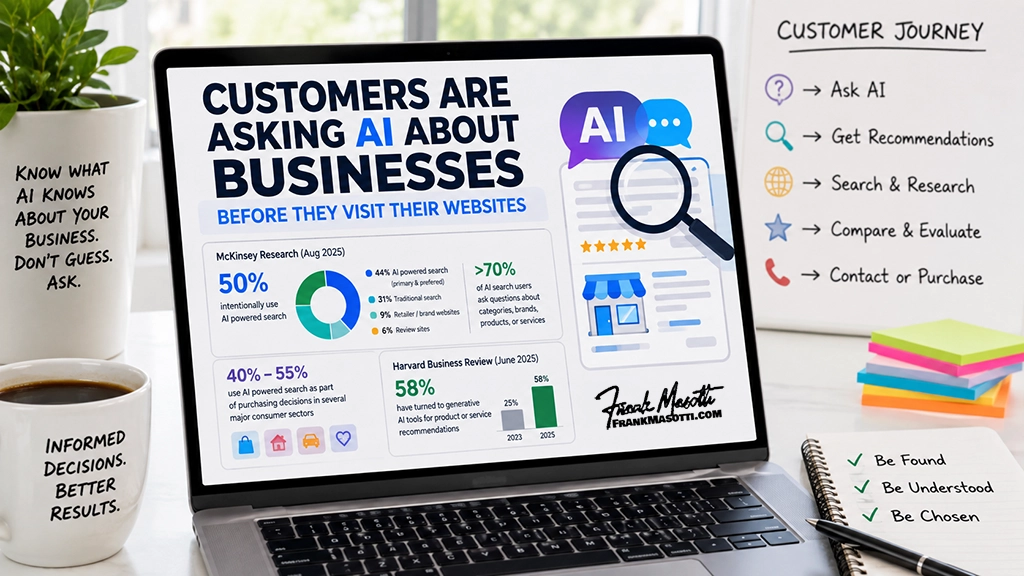
In August 2025, McKinsey surveyed a representative panel of 1,927 U.S. consumers. Half of the consumers surveyed said they intentionally use AI powered search.
More importantly, among people using AI powered search, 44% said it was their primary and preferred source of insight. Traditional search came in at 31%, retailer or brand websites at 9%, and review sites at 6%.
McKinsey also found that more than 70% of AI powered search users ask questions about categories, brands, products, or services. In several major consumer sectors, roughly 40% to 55% were using AI powered search as part of purchasing decisions.
You can read the McKinsey research here:
McKinsey: New front door to the internet: Winning in the age of AI search
Harvard Business Review reported another significant finding in June 2025.
Citing a survey of 12,000 consumers, Harvard Business Review reported that 58% had turned to generative AI tools for product or service recommendations. In 2023, that number had been 25%.
You can read the Harvard Business Review article here:
Harvard Business Review: Forget What You Know About Search. Optimize Your Brand for LLMs.
These studies measured different groups and asked different questions, so the percentages should not be treated as if they came from one study. But they point in the same direction.
Customers are using AI to help them discover, research, compare, and evaluate products, services, brands, and businesses.
Why This Matters to a Business Owner
Think about how people traditionally researched a business.
Someone needed a service. They searched for it. They looked through the results. They opened several websites. They checked reviews. They compared their options. Eventually, they decided which businesses deserved serious consideration.
AI can compress a large part of that process into a conversation.
A potential customer can now ask questions such as:
“Which companies near me provide this service?”
“Which of these businesses would be best for what I need?”
“What is this company known for?”
“Does this business specialize in the type of work I need?”
“How experienced is this company?”
“Compare these three businesses for me.”
“Would you recommend this company?”
The customer does not have to stop using Google, Maps, review sites, or business websites for this change to matter.
AI only has to influence which businesses the customer investigates next.
That distinction is important.
Suppose a customer asks an AI system to recommend three businesses for a particular job. The AI provides three names. The customer then searches those businesses on Google, reads their reviews, visits their websites, and makes a phone call.
Google may ultimately receive the search.
The business website may receive the visit.
The phone may receive the lead.
But AI helped determine which businesses made it that far.
McKinsey describes exactly this kind of change in the customer journey. Its research says decision making is increasingly occurring on AI platforms before the click happens.
Being a Good Business Does Not Guarantee a Good AI Answer
There is another finding in the McKinsey research that business owners should pay attention to.
Even market leaders are not guaranteed to appear in AI powered search answers.
McKinsey found that AI systems can draw from a broad collection of sources and that those sources vary depending on the model, location, category, and type of question being asked. It also found examples of leading brands being absent from answers despite their strength in the traditional market.
That creates a problem most business owners have never had a reason to investigate.
You know your business.
You know how long you have been doing the work. You know your specialties. You know your service area. You know what makes you different from your competitors. You know your experience, credentials, history, and reputation.
But that does not tell you what an AI system understands about you.
Those are two different things.
An AI system might understand your business accurately.
It might have most of the story but miss the part that actually differentiates you.
It might describe you too broadly.
It might associate outdated information with you.
It might understand your company but fail to connect the experience of the person behind it.
It might describe one of your competitors in much greater detail.
Or it might not include you when a customer asks for businesses fitting a particular need.
You cannot determine any of that by looking at your Google ranking.
And you cannot determine it by looking at your own website.
You have to ask the AI systems.
The Question Businesses Should Be Asking
I am not suggesting that every customer has abandoned Google and started using ChatGPT.
The research does not say that.
I am not suggesting AI makes every purchasing decision.
The research does not say that either.
What the research does establish is enough:
A meaningful number of consumers are already using AI systems to research products, services, brands, and purchasing decisions.
That creates a very simple business question:
When customers ask AI about your business, what are they being told?
Not what you hope the answer is.
Not what your website says the answer should be.
Not whether your SEO is good.
What does the AI actually say?
That is something you can find out.
That Is What My Report Does
The Frank Masotti AI Business Understanding Report is designed to answer that question.
I personally analyze how ChatGPT, Gemini, and Claude understand a business.
I ask each model a structured set of questions and document what comes back. I look at how the business is described, what the models associate with it, where they agree, where they disagree, what they understand clearly, what they appear to miss, and how the business comes through when viewed through these systems.
Then I write the findings in plain English.
There is no AI visibility score.
There is no dashboard.
There is no promise that I can make an AI system recommend your business.
There is no monthly retainer waiting at the end.
The purpose is diagnosis.
Before spending money trying to change how AI systems understand your business, you should know what they currently understand.
The report costs $995 and is delivered within one business day.
Three models. One analyst. One report.
The research linked above establishes why the question increasingly matters.
My report answers the part that matters specifically to your business:
What are ChatGPT, Gemini, and Claude actually telling people about you?