
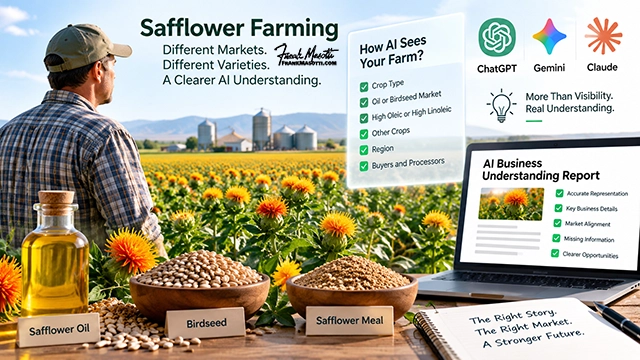
A safflower farm can be described correctly as an oilseed operation and still be misunderstood in ways that matter. One grower may be producing high oleic safflower under contract for an oil market. Another may grow a high linoleic variety. Another may be supplying safflower seed for the birdseed market. If someone asks ChatGPT, Gemini, or Claude about your farm, which version of your operation do they understand? The Frank Masotti AI Business Understanding Report is a $495 manual analysis designed to answer that question by examining what all three AI systems currently understand about your specific business.
What Is a Safflower Farming AI Visibility Audit Report?
A safflower farming AI visibility audit report examines how major AI systems understand and represent a safflower farming business.
It is not an audit of whether your farm uses artificial intelligence. It is not an automated AI audit that scans your website and assigns a visibility score.
The question is much more practical: What do ChatGPT, Gemini, and Claude think your safflower farming operation actually does?
That distinction matters because safflower is not a single uniform commodity in every market. Safflower can be produced for oil, birdseed, meal and other uses. Oil varieties can also differ substantially according to whether they produce oil high in oleic or linoleic fatty acids. A description that stops at “safflower farmer” may therefore be technically correct while missing the commercial identity of the operation.
That is the kind of difference an AI visibility audit is meant to uncover.
Why Does a Safflower Farm Need an AI Audit?
For a safflower grower, simply being recognized as a farm is not enough. AI needs to connect the operation with the right crop, production characteristics and market.
Consider two safflower farms.
One primarily produces high oleic safflower for an oilseed buyer. The other grows safflower intended for the birdseed market.
Both grow safflower. They are not offering the same product to the same market.
That creates several questions worth investigating.
Does AI recognize the farm specifically as a safflower producer, or does it describe the operation more broadly as a grain or oilseed farm?
Does it understand whether the operation grows safflower for oil or birdseed?
If the crop is destined for oil production, does AI associate the farm with the correct type of safflower?
Does it understand other crops grown by the operation, or has one crop become so prominent in available information that AI treats it as the entire business?
Does it associate the farm with the correct region?
Does it understand whether the operation sells through contracts, processors, seed buyers or another commercial relationship?
These distinctions are particularly useful for safflower because the end market can change what the harvested crop represents commercially.
An AI system could know that a company grows safflower while knowing very little about what that means for the actual business.
Safflower for Oil and Safflower for Birdseed Are Not the Same Story
This is where a safflower farming AI audit becomes particularly business specific.
Safflower has established markets for both oil production and birdseed. Within the oil market, high oleic and high linoleic varieties have different fatty acid profiles and uses.
For the grower, those distinctions can be fundamental.
If your operation is known for producing a particular safflower type, but AI describes you only as a general oilseed producer, an important part of the business has disappeared from the answer.
The opposite problem is possible as well. Historical information could associate the farm with a market, crop mix or production focus that is no longer accurate.
ChatGPT might make the correct association.
Gemini might identify safflower but miss the intended market.
Claude might understand the broader farming operation but place greater emphasis on another crop.
You cannot determine whether those differences exist by checking whether your business name appears in an AI response. Being visible to AI is not the same as being understood by AI.
What Can an AI Audit Reveal for a Safflower Farming Business?
A safflower farming AI visibility audit can examine whether the three models correctly understand characteristics such as:
Safflower as a significant crop within the farming operation
Oilseed production versus production for the birdseed market
High oleic or high linoleic production when that distinction applies to the business
Other crops grown as part of the operation
The farm’s geographic production area
Relationships with processors, buyers or markets when publicly associated with the business
Products or activities AI incorrectly associates with the operation
Important parts of the business that AI consistently leaves out
Attributes the models associate with the farm
Whether the models recognize the business when relevant recommendations are requested
Differences between what ChatGPT, Gemini and Claude understand
The objective is not to manufacture a problem. Sometimes AI may understand an operation surprisingly well.
That is useful information too.
What matters is replacing assumption with evidence.
Could AI Confuse Safflower With the Rest of the Oilseed Industry?
Yes, and the problem does not require AI to make an obviously ridiculous mistake.
Safflower sits within a much larger oilseed landscape that includes crops such as soybeans, canola, flaxseed, mustard seed and others. A diversified farm may grow several crops, while processors and agricultural companies can also work across multiple commodities.
The resulting misunderstanding can be subtle.
AI might correctly identify a company as an oilseed producer but fail to recognize safflower as an important part of its operation. It could emphasize another crop because that crop has a stronger information trail online. It could recognize safflower production but fail to understand the particular market the farm serves.
This is why category confusion is worth examining even when the broad description of the company sounds reasonable.
A nearly correct answer can still omit the distinction that makes the business relevant to a particular buyer, partner or recommendation.
What Happens When the Three AI Models Disagree?
One of the reasons I evaluate three AI systems is that there is no reason to assume ChatGPT, Gemini and Claude have formed identical pictures of a safflower farming business.
They can draw from different information, weigh that information differently and reach different conclusions.
If all three recognize the farm as a safflower producer but only one understands its primary market, that disagreement is useful.
If two models associate the operation with an outdated crop mix while the third describes the current business accurately, that is useful too.
A single AI answer cannot show you that comparison.
That is why the Frank Masotti AI Business Understanding Report evaluates all three models and manually compares their responses. You can read more about why three AI models are evaluated and review the full AI Business Understanding Report methodology.
How the Frank Masotti AI Business Understanding Report Works
I manually research how ChatGPT, Gemini and Claude understand your business.
This is not an automated scanner.
I examine their responses, compare the models and look for patterns in what they understand, misunderstand, omit and associate with the company. I also examine recognition and recommendation visibility, areas of agreement and disagreement, outdated or incorrect information, and other findings that emerge from the analysis.
For a safflower farming operation, that means looking beyond whether AI knows the farm exists. The analysis examines whether the models have assembled an accurate picture of what the operation actually is.
You can see the process on the How It Works page.
What Does a Safflower Farm Receive?
The Frank Masotti AI Business Understanding Report is a $495 one time purchase.
You receive a 10+ page PDF report covering the manual analysis of your business across ChatGPT, Gemini and Claude.
The report includes findings involving AI understanding, misunderstandings, omissions, associated attributes, recognition patterns, recommendation visibility and differences between the models. It also includes strategic observations and recommendations based on what the analysis finds.
The completed report is delivered the next business day after the analysis is completed.
There is no software subscription and no automated visibility score.
What Happens After the AI Audit?
You have evidence.
Instead of wondering whether AI understands your safflower farming business, you can see what three major AI systems actually say about it.
You can identify where their understanding is accurate, where information is missing, where their conclusions differ and what deserves attention.
I do not use the report as the beginning of an SEO, GEO, AEO or AI visibility optimization retainer. I am not selling the implementation afterward.
The purpose is diagnosis before prescription.
The findings are yours. You can decide what, if anything, should be done with them.
Do ChatGPT, Gemini and Claude Understand Your Safflower Farming Business?
They may know that you grow safflower.
That does not tell you whether they understand the business behind the crop.
Do they understand what you produce, which market you serve, how safflower fits into the larger farming operation and what distinguishes your farm from another safflower producer?
More importantly, do all three models understand those things the same way?
There is no reason to guess.
The Frank Masotti AI Business Understanding Report costs $495 and provides a manual analysis of what ChatGPT, Gemini and Claude currently understand about your business.
Order the Frank Masotti AI Business Understanding Report and find out what the three AI systems actually understand about your safflower farming operation.