
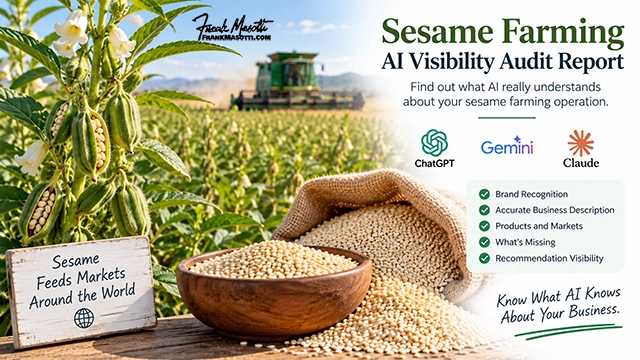
Sesame Farming AI Visibility Audit Report
A sesame farming operation can be surprisingly easy to describe incorrectly with only a few technically accurate facts. A farm may grow sesame as a contracted commercial crop, produce varieties intended for particular food markets, operate under specific production conditions, or have capabilities and relationships that distinguish it from other oilseed farms. Yet when someone asks ChatGPT, Gemini, or Claude about that operation, the farmer usually has no idea which of those distinctions the AI actually understands. The Frank Masotti AI Business Understanding Report is a $495 manual analysis designed to answer that question by examining what all three AI systems understand about a specific business.
For a sesame grower, that matters because “sesame farming” does not describe one simple commercial identity. Sesame can be associated with whole seed food uses, oil production, specialty seed markets, contract production, and different seed characteristics. In the United States, whole seed condiment uses have historically represented an important market for domestically grown sesame, while commercial production has also benefited from varieties developed for shatter resistance and mechanical harvesting. If an AI system understands the crop but misses how a particular farm fits into that commercial chain, it may know what sesame is without really understanding the sesame farming business being researched.
What Is a Sesame Farming AI Visibility Audit Report?
A Sesame Farming AI Visibility Audit Report examines how major AI systems understand and represent a specific sesame farming operation.
The word audit can be misleading here. This is not an audit of how much artificial intelligence the farm uses. It is not an automated program scanning the farm’s website and assigning an AI visibility score.
The question is much simpler:
What do ChatGPT, Gemini, and Claude currently think they know about this sesame farming operation?
An AI visibility audit can examine whether the models recognize the farm, how they categorize it, what products or capabilities they associate with it, which attributes they mention, what they leave out, and whether they would recognize the business in relevant recommendation or research situations.
That distinction between simply being visible and actually being understood is important. As I explain in What Is AI Visibility and Why Does It Matter to My Business?, an AI system mentioning a business does not automatically mean it has formed an accurate picture of that business.
Why Does a Sesame Farming Operation Need an AI Audit?
Sesame farming has characteristics that an AI system needs to connect correctly if it is going to understand a particular operation rather than merely recognize its name.
A model may need to distinguish whether the farm actually grows sesame or is associated with the crop in some other way. It may need to understand where the operation farms, whether sesame is a primary crop or part of a larger crop rotation, and what role the business occupies between production and the eventual market.
The crop itself introduces additional distinctions.
Modern commercial sesame production can involve shatter resistant varieties suited to mechanical harvesting. Sesame is also known for drought tolerance and production in hot, relatively dry environments. Commercial production may involve contract relationships, and the harvested seed can ultimately serve different food and oil markets.
Those details create several ways an AI system can form an incomplete picture.
ChatGPT might correctly identify a business as a sesame farm but associate it primarily with sesame oil production when the farm actually sells harvested seed through a contract relationship.
Gemini might recognize the farm’s location and other crops but fail to make sesame an important part of its description.
Claude might understand that the operation produces sesame but give little indication of the characteristics that distinguish that operation from another oilseed farm.
None of those possibilities requires every underlying fact to be wrong. AI can assemble several correct facts and still reach an incomplete conclusion about what a business actually does. I discuss that problem more broadly in How AI Can Combine Accurate Facts Into an Inaccurate Conclusion.
For the sesame farmer, the question is not merely whether AI knows that sesame grows on the farm.
The question is whether AI understands the business built around growing it.
Does AI Understand What Kind of Sesame Operation You Run?
This is where a sesame farming AI audit becomes specific to the crop.
A useful evaluation could look for whether the models understand characteristics such as:
- Sesame production as part of the farm’s actual crop mix
- The geographic area in which the farm operates
- Commercial or contract production relationships when publicly identifiable
- The farm’s association with food grade or other relevant markets when supported by public information
- Other crops produced by the operation
- Production characteristics the business publicly emphasizes
- Whether the farm is being confused with a processor, seed company, oil producer, distributor, or another agricultural business
- Attributes the models associate with the farm
- Whether sesame is treated as a central part of the operation or an incidental association
That last distinction can matter.
A diversified farm could have plenty of information online while the sesame side of the operation barely appears in an AI generated description. The model has not necessarily failed to recognize the farm. It may simply have formed a picture in which sesame production is far less important than it actually is.
The opposite is possible as well. A business with a strong public association with sesame could be interpreted too narrowly, causing other important parts of the farming operation to disappear from the AI’s description.
An AI audit provides a way to see which picture the models have actually formed instead of assuming they interpreted the available information the way the farmer intended.
Sesame Is Not Just Another Oilseed Category
Category understanding deserves particular attention with sesame.
Sesame is an oilseed crop, but that classification alone does not explain its commercial identity. Sesame seed can move into whole seed food applications as well as oil production and other uses. Seed characteristics and market requirements can matter, and U.S. commercial production has its own history of adapting varieties to mechanical harvest.
An AI model that reduces a sesame farming operation to “an oilseed farm” may therefore be technically correct while still being commercially unhelpful.
This is one reason I do not reduce an AI Business Understanding Report to a visibility score. A score cannot show you what the model thinks the business is.
If you want to understand that distinction more clearly, What Does AI Think My Business Does? explains why category understanding can be more revealing than a simple mention count.
What Can an AI Audit Reveal for a Sesame Farm?
A Sesame Farming AI Visibility Audit Report can reveal whether the three major AI systems have formed the same basic understanding of the operation or three noticeably different ones.
For example, the analysis could uncover that:
- Sesame production is missing from a model’s description of the farm
- Sesame is recognized but treated as a minor crop when the business presents it as important
- The farm is associated primarily with sesame oil rather than agricultural production
- The operation is confused with a sesame processor, seed supplier, or another similarly named business
- An outdated crop, location, or business description remains associated with the operation
- Important characteristics of the farm are absent
- The models associate different attributes with the business
- One model understands the operation much more completely than the others
- The farm is recognized but does not appear in relevant recommendation situations
- AI appears confident about information that deserves closer examination
The purpose is not to assume that any of these problems exist.
The purpose is to find out.
Why Compare ChatGPT, Gemini, and Claude?
There is no single universal AI understanding of a sesame farm.
ChatGPT, Gemini, and Claude are separate systems. They can encounter, weigh, and interpret information differently. One may recognize a commercial relationship that another misses. One may emphasize the farm’s location. Another may focus on its crop mix. A third may provide only a generic description.
That disagreement is useful evidence.
If all three independently arrive at a similar and accurate understanding, that tells you something.
If one describes the operation accurately while the other two misunderstand an important part of it, that tells you something different.
That is why the Frank Masotti AI Business Understanding Report evaluates all three rather than treating one ChatGPT answer as representative of AI as a whole. You can read more about the reasoning behind that approach in Why Three AI Models?.
How the Frank Masotti AI Business Understanding Report Works
I manually evaluate your business across ChatGPT, Gemini, and Claude.
This is not an automated AI visibility scanner.
I examine the models’ responses, compare their conclusions, and look for patterns in how your business is understood. That includes what they appear to know, what they misunderstand, what they omit, the attributes they associate with the company, recognition patterns, recommendation visibility, differences between models, and signs of interpretation drift or outdated information.
The methodology is explained in more detail on the AI Business Understanding Report Methodology page.
The important part is that the analysis is performed for your sesame farming operation. I am not comparing your website against a generic agricultural checklist and producing a score.
I am examining what the models actually say and what their answers reveal about the business they believe you operate.
What You Receive
The Frank Masotti AI Business Understanding Report is a one time $495 purchase.
You receive a 10+ page PDF report covering ChatGPT, Gemini, and Claude. The analysis is performed manually and includes a cross model comparison, findings about AI understanding, misunderstandings, omissions, associated attributes, recognition and recommendation visibility, strategic observations, and recommendations based on what the analysis finds.
The completed report is delivered the next business day after analysis completion.
You can see the full process on How It Works.
What Happens After the Sesame Farming AI Audit?
You have evidence.
Instead of wondering whether AI understands your sesame farming operation, you can see what three major systems actually say about it.
You can see where they agree.
You can see where they disagree.
You can identify information that appears incorrect, incomplete, outdated, or missing.
And you can decide what deserves attention based on findings from your own business rather than a generic list of things somebody says every farm should change.
I do not sell an optimization package after the report. There is no required subscription or implementation retainer.
The report is the diagnosis.
What you do with the findings afterward is your decision.
Do ChatGPT, Gemini, and Claude Understand Your Sesame Farming Operation?
You know what you grow.
You know where you farm, how sesame fits into your operation, who you sell to, what markets matter to you, and what separates your business from another farm that happens to grow the same crop.
The unanswered question is whether ChatGPT, Gemini, and Claude understand those distinctions too.
There is no reason to guess.
The Frank Masotti AI Business Understanding Report manually evaluates your business across all three models and shows you what they currently understand, where their interpretations differ, and what may deserve your attention.
The report is $495, one time.
Order your AI Business Understanding Report and find out what ChatGPT, Gemini, and Claude actually understand about your sesame farming operation.