
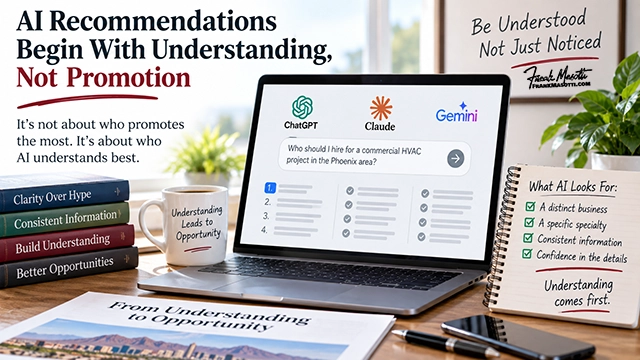
AI Recommendations Begin With Understanding, Not Promotion
If you are trying to get ChatGPT, Claude, or Gemini to recommend your business, here is the direct answer. You cannot promote your way into an AI recommendation, because a recommendation is not a placement. It is a conclusion. When a prospect asks AI who they should hire for a particular job, the model does not consult a list of businesses that have made the strongest case for themselves. It takes what it understands about each business it knows, matches that understanding against what the prospect said they need, and names the businesses where the match is clearest. Understanding comes first. The recommendation is built from it.
That order matters because most of the effort businesses put toward AI runs in the opposite direction. They treat AI the way they learned to treat search and advertising: as a channel where visibility is earned through volume, positioning, and persuasion. So they publish more, promote harder, and describe themselves in bigger language. None of that reaches the stage where recommendations are actually formed. The model is not asking who wants the business most. It is asking who it can describe accurately enough to vouch for.
There Is No Slot to Win
Search results have positions. Advertising has placements. Both can be pursued directly, and an entire industry exists to pursue them. That history is why the instinct to promote is so strong. For twenty years, being chosen online meant being placed well, and being placed well was something you could buy, optimize, or outwork a competitor for.
An AI recommendation has no equivalent position. When a model answers “who does commercial HVAC in the Phoenix area,” it is writing a fresh answer from what it holds, and what it holds is a set of descriptions attached to business names. There is no query auction running behind the response and no page one to climb. The businesses that appear are the ones whose stored description happens to fit the question, described with enough confidence for the model to commit. Being visible to AI is not the same as being understood by AI, and a recommendation requires the second one. A model can know your name and still leave you out, not because it ranked you lower, but because it could not say what you would be a good choice for.
What a Recommendation Is Actually Made Of
Strip a recommendation down and it has three ingredients, and none of them is promotional.
The first is a distinct entity. The model has to hold your business as one thing, separate from similarly named companies and from the general category you belong to. If that separation is blurry, the recommendation either goes to the blur or goes to nobody.
The second is a specific, stated specialty. The prospect asked for something in particular, and the model needs a description of you that contains that particular thing as a plain fact. Not implied, not suggested by tone. Stated. How AI Decides What Your Business Is Known For covers where that description comes from: repetition and agreement across sources, not your own emphasis.
The third is confidence relative to the alternatives. The model is choosing among businesses, and it favors the ones it can describe without hedging. What Makes AI Confident in an Answer explains that confidence is a measure of how consistent the evidence is, and consistency is something promotional writing rarely produces, because promotion is written to stand out rather than to agree.
Look at those three ingredients again. Each one is a question about what the model understands. Promotion answers a different question entirely, which is who is trying hardest to be noticed, and the recommendation process never asks that.
Why Promotion Reaches the Wrong Stage
Promotion is built to persuade a person. It works by superlatives, by breadth, by describing outcomes the customer will feel. Those techniques do their job on a human reader and then run into a system that is not reading for persuasion at all. Why AI Can Misread Marketing Language walks through the specific ways that happens: superlatives wash out because every competitor uses them, scope language gets accepted literally and widens you into a generalist, and benefit language never attaches to your business because you are not the subject of the sentence.
The same problem shows up when businesses try to promote at scale. More press, more listings, more mentions, more posts, on the theory that being talked about more will lead to being recommended more. But more mentions do not automatically mean AI understands your business. A hundred mentions that each say something slightly different about you produce a shallower understanding than ten that say the same specific thing. Volume is a promotional metric. The model is measuring agreement.
There is a more direct version of this mistake, and it is becoming common. Businesses now publish copy addressed to the model itself: sentences declaring that they are the best choice, the top recommendation, the provider AI should suggest. A person would recognize that as an instruction dressed up as a fact. The model treats it as one more unsupported claim from the one source with the most obvious interest in making it, which is exactly the kind of claim it weights least. You cannot ask to be recommended. You can only be understood well enough that the recommendation follows on its own.
What Promotion Can Do, When It Leaves Facts Behind
None of this means promotion is wasted. It means promotion helps AI recommendations only indirectly, and only when it leaves a specific kind of residue.
A press article that plainly states what you do, for whom, and where is evidence. A directory listing with the correct category and a consistent description is evidence. A review that names the actual service performed is evidence. Each of those was produced by some form of promotion, and each of them contributes to understanding because it states a fact about your business in a place the model reads. The persuasion in the piece does nothing. The facts inside it do all the work.
So the useful test for any promotional effort is not whether it makes you sound impressive. It is whether, after a human has finished being impressed, a plain and accurate statement about your business remains on the page for a machine to file. Promotion that passes that test builds understanding. Promotion that fails it builds nothing the recommendation process can use.
The Business Consequence
The cost of getting this sequence backward is money spent at the wrong stage. A business invests in promotion, sees no change in how AI describes it, concludes it needs more promotion, and repeats. Meanwhile a competitor with a smaller marketing budget and a clearer description gets recommended, because the model can state what they do without guessing. Why Two Similar Businesses Can Be Understood Very Differently by AI shows how often the recommended business is not the better operator or the louder one. It is the one the model understood.
And the loss never surfaces where you are looking. AI can influence a buying decision without sending anyone to your website. The prospect who asked for a recommendation and did not hear your name never visits, never calls, and never explains why. Your promotional metrics can all be rising while the one decision that mattered was made in a conversation you were not part of. That is the pattern behind the question I get asked most, and I answer it directly in Why Does AI Recommend My Competitors But Not Me?
Start Where the Recommendation Starts
If recommendations are built from understanding, the first move is not to promote. It is to find out what the models currently understand, because that is the material every recommendation about you is being assembled from right now. Before you pay someone to improve your AI visibility, you should know whether the problem is that AI has never heard of you, has the wrong specialty for you, has blended you with someone else, or simply cannot describe you with confidence. Each of those calls for a different fix, and only one of them is helped by more promotion.
That is what the AI Business Understanding Report documents. I question ChatGPT, Claude, and Gemini about your business from multiple angles, including the recommendation questions your prospects actually ask, and I record what each model believes you do, who it thinks you serve, which competitors it raises alongside you, and where its understanding is too thin or too outdated to produce a recommendation at all. Once that is written down, you can see which stage is failing, and AI interpretations can be changed once you know which kind of gap you are dealing with.
A recommendation is the last step in a process that begins with understanding. If you want to know what the beginning of that process looks like for your business today, ordering a report is how you find out.