
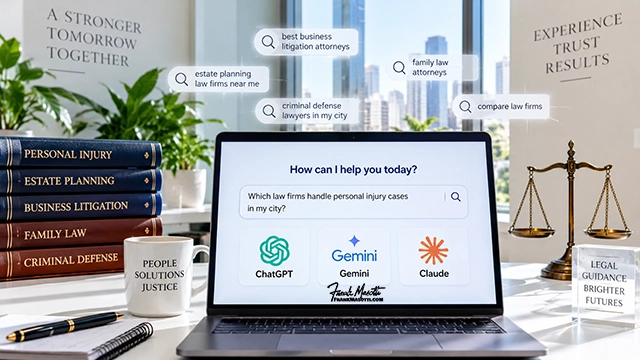
What Does AI Understand About Your Firm?
A person looking for legal help no longer has to begin with a list of law firm websites.
They can describe their situation directly to an AI search engine.
They might ask which law firms handle a particular type of case in their city. They might ask for firms that specialize in estate planning, personal injury, business litigation, family law, criminal defense, or another specific area. They might ask about a firm they have already heard of, compare several firms, or ask which attorneys appear suitable for a particular legal need.
Before an AI system can meaningfully recommend a law firm, however, it has to understand what that firm actually does.
That creates a question many law firms have never examined:
What do AI search engines understand about your firm right now?
Do they recognize the correct practice areas?
Do they understand where you operate?
Do they associate the right attorneys with the firm?
What attributes do they associate with your practice?
Do they understand the type of client or legal matter your firm is best suited to handle?
And do ChatGPT, Gemini, and Claude reach the same conclusions?
A Law Firm AI Search Engine Audit examines those questions directly rather than assuming the answers.
What Is a Law Firm AI Search Engine Audit?
A Law Firm AI Search Engine Audit is a structured examination of how major AI systems interpret, describe, and recognize a particular law firm.
It is not simply a search for the firm’s name.
It also is not the same thing as checking where a website ranks in Google.
The purpose is to examine the understanding behind the answer.
A law firm can be recognized by an AI system while still being misunderstood. An AI model might know that the firm exists but associate it primarily with the wrong practice area. It might recognize one attorney while overlooking others. It might understand the firm’s services correctly but connect the business with outdated information.
The reverse can happen as well. An AI system may have a surprisingly complete and accurate understanding of a firm.
You do not know which situation applies until you examine the answers.
That is why my [AI Business Understanding Report] AI Business Understanding Report evaluates what AI systems independently conclude about a business rather than assigning it a generic visibility score.
Why Law Firms Are Different
Law firms present AI systems with an unusually complicated business to interpret.
A restaurant may primarily need to be understood by its cuisine, location, and customer experience.
A law firm can involve several attorneys, multiple offices, overlapping practice areas, individual professional histories, geographic restrictions, different client types, and services that may have changed substantially over time.
One firm may handle both business formation and commercial litigation.
Another may concentrate almost entirely on personal injury but also advertise several related services.
A third may have individual attorneys who are much better known online than the firm itself.
That creates plenty of room for differences in interpretation.
An AI system might understand the firm’s broad category while missing an important specialty.
It might associate the firm with a practice area that one attorney handled years ago.
It might understand what the firm does but fail to recognize it when someone asks for businesses matching those services.
Those are not traditional ranking questions.
They are business understanding questions.
AI Search Engines Do Not Necessarily See the Same Law Firm
There is no single AI description of your law firm shared by every system.
ChatGPT, Gemini, and Claude can examine much of the same public information and still reach different conclusions about the business.
Current research involving legal service queries has demonstrated exactly that. Different AI platforms can produce substantially different sets of law firms, attorneys, directories, and other sources in response to comparable legal searches.
That is one reason I evaluate three models rather than relying on one.
One model might clearly identify your primary practice.
Another may describe the firm more broadly.
A third may emphasize a completely different area of law.
The differences are not noise to be thrown away. They are part of the information being measured.
My explanation of [why AI models describe businesses differently] why AI models describe businesses differently goes deeper into why those disagreements matter.
For a law firm, comparing those independent interpretations can reveal something that asking a single AI system never will.
Recognition Is Not the Same as Recommendation
Suppose ChatGPT can accurately tell you where a law firm is located, identify its attorneys, and describe its practice areas.
That establishes recognition.
Now ask a different question:
Which law firms would you consider for this particular legal need?
The firm may appear.
Or it may disappear entirely.
That distinction matters because recognition and recommendation test different parts of AI understanding.
An AI system can know a great deal about a law firm without considering that firm a strong match for a particular request.
Conversely, it can recommend a firm based on only a relatively narrow understanding of what that firm does.
This is why simply searching for the firm’s name is not enough.
As I explain in [Before AI Recommends Your Business, It Has to Understand What You Do] Before AI Recommends Your Business, It Has to Understand What You Do, recommendation starts with interpretation.
The audit examines both.
What Can an AI Search Engine Audit Reveal About a Law Firm?
A useful audit should tell the law firm considerably more than whether its name appeared.
It can reveal whether the major AI models agree about the firm’s category, specialties, location, attorneys, reputation, customer fit, and distinguishing characteristics.
It can uncover important services that are missing from the AI description.
It can identify outdated information that continues to influence how the firm is explained.
It can show whether different AI systems associate noticeably different attributes with the same practice.
It can identify situations in which competing law firms are recognized or recommended while the firm being evaluated is not.
It can also reveal strong results.
If all three models independently understand the firm’s practice areas, location, attorneys, and positioning accurately, that is useful information too.
The purpose of an audit is not to manufacture problems.
The purpose is to find out what is actually there.
A Law Firm Can Have More Than One AI Identity
Law firms have another potential complication: the business and the attorneys inside it can develop separate online identities.
An attorney may have decades of references, professional profiles, articles, court appearances, speaking engagements, awards, or other public information associated with their name.
The firm may have its own history, website, listings, reviews, offices, services, and reputation.
AI systems have to connect those pieces correctly.
Sometimes they do.
Sometimes they only partially do.
A model might understand an attorney extremely well while having a much weaker picture of the firm.
It might associate an attorney with a previous practice.
It might correctly identify the firm but omit one of its most important lawyers.
Or it may bring the entire picture together accurately.
That relationship between people, services, locations, and the business entity itself is precisely the kind of pattern that becomes easier to see when multiple model responses are examined together.
Why One AI Answer Is Not an Audit
Anyone at a law firm can open ChatGPT and ask:
What do you know about our firm?
That answer can be interesting.
It is not an audit.
A single response gives you one model, one question, one interpretation, at one moment.
Change the question and the answer can change.
Ask another model and you may get a substantially different description.
That is why the [methodology I use to evaluate AI business understanding] methodology I use to evaluate AI business understanding keeps the models independent, starts each question without earlier conversational context, preserves the original responses, and compares the findings manually.
The value is in the pattern across the answers.
A [multi model comparison] multi model comparison makes agreements, disagreements, omissions, and interpretation differences visible in a way one conversation cannot.
Why the Audit Is Done Manually
There are automated products that monitor citations, mentions, rankings, prompts, and other AI visibility metrics.
Those tools can serve a purpose.
They are not what I do.
A law firm’s AI understanding cannot always be reduced to whether its name appeared in a response.
Two answers can both mention the same firm while communicating completely different things about it.
One may accurately understand the firm’s practice areas, location, attorneys, and customer fit.
Another may mention the firm’s name while misunderstanding something fundamental about the business.
Software can count both mentions.
A person can read the answers and recognize that they are not equivalent.
That is why the AI Business Understanding Report is researched and written manually. It is also why it [differs from an automated AI SEO report] differs from an automated AI SEO report.
The objective is not another dashboard.
It is understanding.
Diagnosis Comes Before Trying to Fix Anything
The growing interest in AI search has created an equally fast growing industry devoted to improving AI visibility.
Law firms are being told to change their websites, rewrite content, add schema, build citations, pursue digital PR, change directory profiles, and optimize for generative search.
Some of those actions may ultimately make sense for a particular firm.
But there is a more basic question that should come first:
What problem are you actually trying to solve?
You may discover that AI already understands the firm very well.
You may discover one isolated misunderstanding.
You may discover disagreement among models.
You may uncover a much larger identity or category problem.
Those situations do not call for the same response.
That is why the [way the report works] way the report works begins with evaluation and diagnosis before deciding what deserves attention.
Diagnosis before prescription.
Find Out What AI Search Engines Understand About Your Law Firm
Your law firm does not get to write the answer an AI system gives to a prospective client.
The AI system creates that answer from what it understands.
That makes the first question surprisingly simple:
What does it understand?
The Frank Masotti AI Business Understanding Report examines that question manually across ChatGPT, Gemini, and Claude.
I evaluate how each model recognizes and describes the business, where the models agree, where they disagree, what they associate with the firm, what they omit, where misunderstandings appear, and how the firm performs in relevant recommendation scenarios.
The findings are then compared and explained in a written report, along with my recommended next steps based on what the evidence actually shows.
3 models. 1 analyst. 1 report.
If you want to know what AI search engines currently understand about your law firm, you can [order the AI Business Understanding Report] order the AI Business Understanding Report for $495