
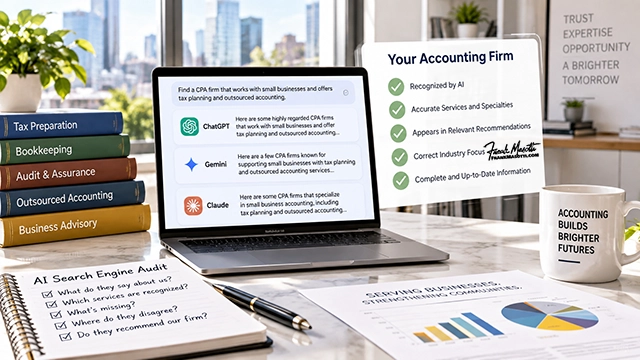
AI Search Engine Audit for Accounting Firms
Someone looking for an accounting firm may ask ChatGPT, Gemini, or Claude for much more than a list of accountants nearby. They may ask for a CPA firm that works with small businesses, an accountant experienced with real estate investors, a firm that handles both tax preparation and bookkeeping, an auditor for a nonprofit, an accountant familiar with a particular industry, or a firm that provides outsourced accounting and advisory services.
Your accounting firm can be part of those answers, absent from them, or described in a way that does not accurately represent the work you actually do.
The Frank Masotti AI Business Understanding Report is a $495 manual analysis of what ChatGPT, Gemini, and Claude currently understand about your accounting firm. I compare what the three models say about your firm, what services and specialties they associate with it, what they leave out, where they disagree, and whether they recognize your firm in relevant recommendation situations.
What Does AI Understand About Your Accounting Firm?
“Accounting firm” covers an enormous amount of territory.
One firm may concentrate primarily on individual and business tax preparation. Another may provide audit and assurance services. Another may handle bookkeeping, payroll, outsourced accounting, controller services, tax planning, or business advisory work. Some firms build their practices around particular industries such as construction, healthcare, real estate, restaurants, professional services, nonprofits, or closely held businesses.
That makes the basic question unusually important:
What does AI think your accounting firm actually does?
An AI system knowing your firm’s name is not the same thing as understanding its practice.
ChatGPT might associate your firm primarily with tax preparation while Gemini recognizes your audit practice. Claude might understand that you specialize in construction companies but fail to associate the firm with outsourced accounting. A model could accurately identify several individual services while still forming an incomplete picture of the firm as a whole.
That distinction matters when someone asks AI a specific question instead of simply searching for an accountant.
An Accounting Firm Can Be Understood Correctly in General and Wrong in the Details
Imagine a firm that provides business tax services, bookkeeping, outsourced CFO services, and specialized accounting for medical practices.
An AI description calling it an “accounting and tax firm” is not necessarily wrong.
It is also not particularly useful if a prospective client asks:
- Who handles outsourced accounting for medical practices in my area?
- Which accounting firms work with growing healthcare businesses?
- Can you recommend a CPA firm that provides both tax planning and fractional CFO services?
- Which accountants specialize in business owners rather than primarily individual tax returns?
The model needs a more detailed understanding of the firm to connect it with those questions.
This is where an AI search engine audit becomes different from simply checking whether ChatGPT knows the firm’s name. The issue is not only recognition. It is whether the model understands enough about the firm to place it in the right context.
Service Distinctions Matter More for Accounting Firms Than a Generic Label Suggests
Accounting services are not interchangeable.
Tax preparation is different from tax planning. Bookkeeping is different from audit and assurance. Outsourced accounting is different from a traditional year end engagement. Business valuation, forensic accounting, succession planning, client advisory services, and fractional CFO work can each represent an important part of a firm’s practice.
There are also services an accounting firm may deliberately not provide.
That creates several questions worth testing.
Does AI associate your firm with services you actually offer? Does it omit a major practice area? Does it describe a service too broadly? Does it associate the firm with work it no longer performs? Does it understand which types of clients the firm serves?
For a specialized accounting firm, there is another question: Does AI recognize the specialization at all?
A firm that has spent years developing expertise with dental practices, contractors, ecommerce companies, manufacturers, real estate investors, or another niche may look very different from a general accounting practice to the right client.
If AI reduces both firms to “CPA firm offering tax and accounting services,” that distinction can disappear from the answer.
Credentials and Firm Identity Can Change the Meaning of an AI Answer
Accounting also presents an identity issue that does not apply equally to every industry.
CPA firm, accounting firm, bookkeeping service, tax preparation company, advisory firm, and financial consulting firm are not automatically equivalent descriptions.
The people within the firm matter as well. Partners and professionals may have different credentials, specialties, industry backgrounds, and areas of responsibility.
An AI system can therefore know accurate facts about the organization while connecting them incorrectly.
It might associate a partner’s specialty with the entire firm. It could emphasize an older practice area while overlooking a newer one. It could understand the firm’s tax practice but miss its assurance work. A merger, acquisition, rebrand, office move, new partner, expanded service line, or changing industry focus can create additional opportunities for older and newer information to coexist.
This is one reason I evaluate three AI models rather than relying on one.
Agreement can be informative. Disagreement can be even more revealing.
The Recommendation Question Is Different From the Recognition Question
An accounting partner could ask ChatGPT, “What do you know about our firm?” and receive a reasonably accurate description.
That does not tell the partner what happens when a potential client asks:
Who would you recommend?
Recommendation questions introduce context.
The person may specify an industry, location, business size, tax situation, service requirement, or combination of needs. AI then has to decide which firms appear relevant to that particular situation.
Your firm could therefore be recognized by an AI model without appearing when someone asks for exactly the kind of accountant you are.
The reverse is also worth examining. A model could recommend the firm for a category that does not accurately reflect where the practice is focused today.
That is why I separate recognition from recommendation visibility. If AI is recommending competitors but not your firm, knowing that is more useful than assuming recognition alone tells you the whole story.
What an Accounting Firm Can Learn From the Analysis
The purpose of the analysis is not to give your accounting firm an arbitrary AI score.
It is to produce evidence.
You may find that all three models understand the firm’s core services consistently. You may find that one has a substantially better understanding than the others. A major industry specialty could be recognized by two models and absent from the third. An older service could remain strongly associated with the firm after the practice has shifted. AI could understand your services but have weak recognition of the clients those services are intended for.
You may also discover that the models make different associations with the firm’s name, partners, locations, credentials, specialties, or competitors.
Those differences are the findings.
The report gives you something more useful than guessing about whether your AI visibility is “good” or “bad.” It gives you a written record of what the models actually understand and where that understanding begins to break apart.
That is also what you are actually buying: diagnosis before deciding what, if anything, deserves to be changed.
A Manual Analysis of ChatGPT, Gemini, and Claude
I conduct each analysis manually.
The $495 report evaluates your accounting firm across ChatGPT, Gemini, and Claude and compares the models rather than treating one AI response as representative of all artificial intelligence.
You receive a 10+ page PDF covering findings such as business understanding, misunderstandings, omissions, attributes associated with the firm, recognition patterns, recommendation visibility, disagreements between models, interpretation issues, strategic observations, and recommendations based on what I find.
The report is delivered the next business day after the analysis is completed.
It is not automated AI audit software. I am not selling your firm SEO, GEO, AEO, an optimization package, or a monthly marketing retainer afterward. The report does not promise to change AI answers or guarantee that an accounting firm will be recommended.
It answers the question that comes before any of that:
What do ChatGPT, Gemini, and Claude currently understand about your accounting firm?
You probably know precisely which services your firm provides, which clients you are best equipped to serve, which industries you understand, and what separates your practice from another accounting firm.
The unanswered question is whether the AI systems your prospective clients can consult understand those distinctions too.
For $495, the Frank Masotti AI Business Understanding Report will show you what ChatGPT, Gemini, and Claude currently understand about your accounting firm, where they agree, where they disagree, what they appear to be missing, and what deserves your attention.