
AI Search Engine Audit for Joint Compound Manufacturers
A joint compound manufacturer can have an unusual problem when ChatGPT, Claude, or Gemini tries to understand the company: the words joint compound can point AI toward the wrong product category before it ever gets to what the manufacturer actually makes.
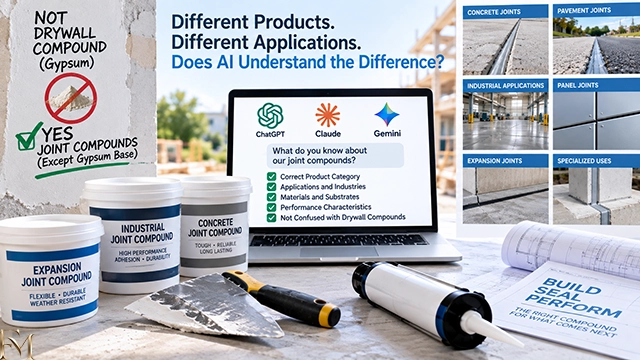
Gypsum based drywall joint compound is familiar to contractors, homeowners, retailers, and search engines. But joint compounds manufactured outside the gypsum product category can belong to a different part of the adhesives, sealants, and related compounds industry. In fact, official industry classifications specifically distinguish joint compounds made outside the gypsum based category from gypsum based joint compounds and patching plaster.
That distinction gives a manufacturer a straightforward question worth answering:
Do ChatGPT, Claude, and Gemini understand what kind of joint compounds your company actually manufactures?
The Frank Masotti AI Business Understanding Report manually examines what those three AI systems currently understand about a specific company. For a joint compound manufacturer, the analysis can show whether AI recognizes the company correctly, understands its products and applications, confuses those products with adjacent categories, or leaves out distinctions that could matter when someone uses AI to research manufacturers and suppliers.
The report costs $495 and provides a 10+ page written analysis of the findings.
What Does AI Understand About Your Joint Compound Manufacturing Business?
An AI search engine audit for a joint compound manufacturer needs to establish something more specific than whether AI recognizes the company name.
It needs to determine what AI believes the company manufactures.
That matters because “joint compound” is not necessarily a precise enough description by itself.
A model could encounter the term and associate the company with drywall finishing. It could interpret the business as a gypsum product manufacturer. It might place the company within a broader adhesive or sealant category without understanding the particular compounds it manufactures.
Another model could reach a different conclusion.
If your products are not gypsum based drywall compounds, a seemingly small classification mistake could create a substantially different picture of your company.
This is where AI understanding becomes more important than simple name recognition.
Could AI Mistake Your Products for Drywall Joint Compound?
This is one of the clearest AI interpretation issues for this particular manufacturing category.
Official industry classification separates joint compounds except gypsum based products from gypsum based joint compounds and patching plaster. Non gypsum joint compounds are classified with adhesive manufacturing and related products, while gypsum based products are classified separately.
A human familiar with the manufacturer’s products may understand that distinction immediately.
An artificial intelligence search engine may not.
Imagine a model correctly recognizing your company name but describing it as a manufacturer of drywall finishing compounds.
If that is not what you manufacture, the answer has misunderstood something fundamental about the business.
The problem could also be subtler. AI might describe the company broadly enough that the statement sounds reasonable while failing to make clear what distinguishes its compounds from the much more familiar drywall category.
That can matter when customers conduct AI searches using product terminology rather than a company name.
Does AI Understand What Your Joint Compounds Are Actually Used For?
Correct category identification is only the beginning.
A useful interpretation also needs context.
What types of joints are the compounds intended for?
What materials are involved?
What applications and industries use them?
What performance characteristics determine whether a particular compound is appropriate?
Those details help define what the manufacturer actually does.
If AI understands only the phrase “joint compound manufacturer,” it may lack enough information to connect the company with the situations in which its products are relevant.
That creates an important distinction between knowing a company exists and understanding when that company belongs in an answer.
A prospective customer might never ask:
“Tell me about ABC Manufacturing.”
Instead, the customer could describe an application, material, joint, performance requirement, or purchasing need and ask AI which manufacturers should be considered.
For your company to be relevant to that conversation, the model needs more than your name.
It needs the right understanding of your products.
Joint Compounds Sit Among Several Easily Confused Product Categories
Joint compounds do not exist in isolation.
The broader adhesive manufacturing classification also includes adhesives, glues, caulking compounds, epoxy adhesives, pipe sealing compounds, rubber cement, and related products.
That creates another possible interpretation problem.
Does AI understand your company specifically as a joint compound manufacturer?
Does it collapse your products into a generic adhesive category?
Does it treat them as caulking or sealing products?
Does it associate the company primarily with another product family you also manufacture?
Or does it recognize the relationship between those categories while preserving the distinctions that matter?
An answer does not have to be completely false to be incomplete.
A company can legitimately operate within the broader adhesives and related products industry while still needing its particular manufacturing specialty to be understood correctly.
That is especially important for manufacturers whose product identity depends on technical distinctions that may disappear when AI summarizes the company in a sentence or two.
For a broader example of how adjacent terminology can create a different AI understanding problem, see AI Search Engine Audit for Caulking Compound Manufacturers.
Does AI Understand the Difference Between the Manufacturer and the Product Seller?
Another question is whether AI understands the company’s role in the supply chain.
A manufacturer that formulates and produces joint compounds is not necessarily the same thing as a distributor, dealer, retailer, or supplier selling compounds made by somebody else.
Yet AI systems can encounter information about all of them.
Product catalogs, distributor pages, retailer listings, technical documents, third party references, and manufacturer websites can all contribute information associated with products and brands.
The resulting picture may be accurate.
Or AI could know the products without clearly understanding who actually manufactures them.
For a company whose manufacturing capability is an important part of its identity, that distinction deserves to be tested rather than assumed.
What Happens When Someone Asks AI for a Joint Compound Manufacturer?
This is where the analysis moves beyond description.
Someone using ChatGPT, Gemini, or Claude might ask questions such as:
“Who manufactures non gypsum joint compounds?”
“Which companies manufacture compounds for this type of joint or material?”
“Who makes industrial joint compounds for this application?”
“Which manufacturers should I compare for this requirement?”
The exact questions will depend on the markets and applications involved.
The important issue is whether AI connects your company with the needs your products actually address.
A model could know your company perfectly well when asked directly about it and still fail to include it when a potential customer begins with a product requirement.
Another model might include the company but describe its capabilities incorrectly.
A third might associate the company with the wrong kind of joint compound entirely.
That is why recognition and recommendation visibility need to be examined separately.
Why Does AI Recommend My Competitors But Not Me? explains that distinction in more detail.
Three AI Models Could Classify the Same Manufacturer Differently
There is no reason to assume ChatGPT, Gemini, and Claude have constructed identical versions of your company.
ChatGPT could correctly identify the company as a manufacturer of non gypsum joint compounds but have only a broad understanding of its applications.
Gemini could understand particular products or markets while describing the company under a more general adhesives category.
Claude could recognize the company and its manufacturing role but associate “joint compound” primarily with gypsum based drywall products.
Those are hypothetical examples, not claims about what any model currently says about a particular manufacturer.
The actual findings only become known when the business is analyzed.
That cross model comparison is important because one apparently accurate AI answer cannot tell you whether the other major models reached the same conclusion. Why Three AI Models? explains why disagreements between the models can be useful evidence.
What Could a Joint Compound Manufacturer Learn From the Analysis?
The analysis can reveal whether ChatGPT, Gemini, and Claude agree about the basic identity of the company and what it manufactures.
It can expose category confusion between non gypsum joint compounds and gypsum based drywall products.
It can identify products, applications, markets, or capabilities that appear consistently in AI’s understanding and others that appear to be missing.
It can show whether AI recognizes the company as an actual manufacturer or interprets it primarily as a supplier, distributor, or broader adhesive company.
It can also examine whether the company appears when the models are asked relevant recommendation questions rather than being prompted with the company name.
Sometimes all three models may understand the company well.
Sometimes each model may possess a different piece of the picture.
The purpose of the analysis is to find out which situation actually exists.
The Report Is a Manual Diagnosis, Not an Automated Visibility Score
The Frank Masotti AI Business Understanding Report evaluates ChatGPT, Claude, and Gemini separately and then compares what the models understand.
I manually examine their answers for agreements, disagreements, misunderstandings, omissions, attributes, recognition patterns, recommendation visibility, and other findings relevant to the particular business.
There is no automated score pretending to summarize your company into a single number.
The completed report is a 10+ page PDF containing the findings, cross model comparison, strategic observations, and recommendations based on what the analysis actually reveals. The report costs $495 as a one time purchase and is delivered the next business day after the analysis is completed.
You can see how the evaluation is conducted on the AI Business Understanding Report Methodology page.
The report does not change what AI says, guarantee that your company will be recommended, or sell you an optimization program afterward.
It gives you the diagnosis first.
Do ChatGPT, Claude, and Gemini Understand Your Joint Compound Manufacturing Business?
You know the difference between the compounds your company manufactures and products that merely sound similar.
You know what your formulations are designed to do, where they are used, who buys them, and what distinguishes your products from gypsum based joint compounds, general adhesives, caulking compounds, sealants, and other adjacent categories.
The unanswered question is whether ChatGPT, Claude, and Gemini understand those distinctions too.
They might.
Or one model could understand your company accurately while another has built a much broader, narrower, or simply different interpretation.
You do not have to guess.
For $495, the Frank Masotti AI Business Understanding Report will show you what ChatGPT, Gemini, and Claude currently understand about your company, where their interpretations agree or differ, what appears incorrect or missing, and what deserves your attention.
Before deciding whether anything needs to change, find out what the three major AI systems actually believe your joint compound manufacturing business does.