
AI Search Engine Audit for Plumber’s Putty Manufacturers
A plumber’s putty manufacturer can be recognized by ChatGPT, Gemini, or Claude and still be understood incorrectly.
The AI system may know the company manufactures plumbing products but fail to recognize the specific plumber’s putty formulations it produces. It may understand that a product creates a watertight seal but miss important restrictions involving porous surfaces or particular plastics. It may even blur plumber’s putty with silicone sealants, caulks, epoxy putties, or pipe sealing compounds that serve different purposes.
For a manufacturer, those distinctions matter.
The Frank Masotti AI Business Understanding Report is a $495 manual analysis of what ChatGPT, Gemini, and Claude currently understand about your company. I compare the three models to identify what they understand, what they leave out, where they disagree, which attributes they associate with the company, and how the business appears in relevant recommendation situations.
For a plumber’s putty manufacturer, the central question is straightforward: Do the major AI systems understand your products well enough to explain when they should and should not be used?
What Does AI Understand About Your Plumber’s Putty Manufacturing Business?
An AI search engine audit for a plumber’s putty manufacturer is not an evaluation of how your factory uses artificial intelligence. It examines how AI systems interpret the company itself.
That interpretation can include whether ChatGPT, Gemini, and Claude understand:
- That the company manufactures plumber’s putty
- The formulations or product lines it offers
- The plumbing fixtures and applications those products are intended for
- Whether particular formulations are suitable for porous surfaces
- Compatibility or restrictions involving plastics and other materials
- Whether products are designed to remain pliable
- Whether curing is required
- Staining and nonstaining characteristics
- The markets, distributors, contractors, or other customers the manufacturer serves
- How the company differs from manufacturers of adjacent plumbing sealants and compounds
These are not trivial product details.
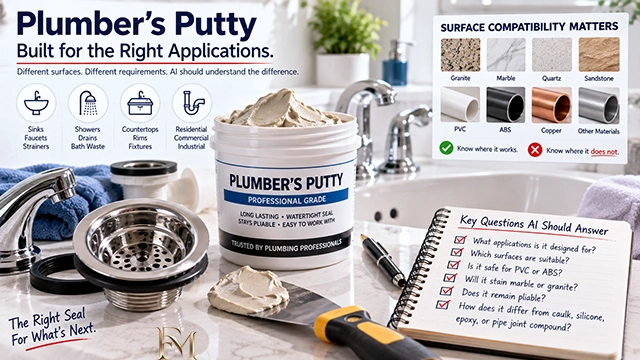
Commercial plumber’s putty formulations can differ substantially in where they should be used. Manufacturer documentation shows products designed for applications such as setting faucets, strainers, sinks, shower drains, bath waste, rims, and other plumbing fixtures. Formulations can also differ in their suitability for granite, marble, quartz, sandstone, manufactured surfaces, PVC, ABS, and other materials.
An AI answer that simply says a company “manufactures plumber’s putty” can therefore be accurate while still leaving out information that determines whether a particular product belongs in a particular application.
Surface Compatibility Can Change the Answer
Surface compatibility is one of the clearest reasons plumber’s putty manufacturers deserve their own analysis.
Traditional plumber’s putty and stain free formulations are not necessarily interchangeable across every surface. Some products specifically accommodate porous materials such as granite, marble, quartz, and sandstone, while other formulations carry restrictions for porous surfaces.
Plastic compatibility can be equally specific.
A manufacturer may offer a formulation suitable for PVC or other plastics while placing restrictions on ABS. Another formulation may have different compatibility characteristics.
That creates a much more meaningful AI search question than whether the manufacturer simply appears by name.
Imagine someone asking:
“Which plumber’s putty can I use on a granite countertop?”
“Can I use this plumber’s putty with PVC?”
“Is this product safe for an ABS fixture?”
“Which plumber’s putty will not stain marble?”
An artificial intelligence search engine answering those questions needs more than a general association between your company and plumber’s putty. It needs an accurate understanding of the individual products and their limitations.
If ChatGPT understands those distinctions but Gemini does not, you have two different versions of your product line being presented to users.
That disagreement is exactly the kind of thing worth discovering.
Does AI Confuse Plumber’s Putty With Other Plumbing Sealants?
Plumber’s putty sits inside a larger world of products designed to seal, bed, repair, join, or protect plumbing components.
That creates an obvious opportunity for category confusion.
Plumber’s putty is not automatically interchangeable with silicone sealant, caulk, epoxy putty, pipe joint compound, or other sealing products. Even when two products can both be described loosely as creating a seal, their intended applications can be substantially different.
This matters when someone conducting AI searches asks for a product rather than a manufacturer by name.
A user might describe a leaking fixture, a drain installation, a countertop material, or a particular type of plumbing connection and ask which product should be used.
The AI system then has to interpret the application before it can make a useful recommendation.
For a plumber’s putty manufacturer, I would want to know whether the models keep the company in the correct product category and whether they recognize situations where one of its plumber’s putty products is appropriate.
I would also want to know whether they associate the company with plumber’s putty in situations where a different type of sealant is actually required.
Being recommended for the wrong application is not necessarily useful visibility.
Does AI Understand the Difference Between Your Formulations?
A manufacturer with more than one plumber’s putty formulation presents another interpretation problem.
One product may be positioned for conventional applications. Another may be designed as a nonstaining formulation. Products can differ in workability, surface compatibility, material restrictions, flexibility, curing characteristics, and other attributes.
The manufacturer understands those differences because it developed and documents the products.
That does not establish that ChatGPT, Gemini, and Claude understand them equally well.
One model might recognize the stain free formulation but describe its compatibility incompletely. Another might primarily associate the manufacturer with its traditional putty. A third could understand the product line but omit an important limitation when answering an application question.
Those are materially different AI interpretations of the same manufacturer.
My Why Do AI Models Describe Businesses Differently? page explains why comparing models matters. Different systems can reach different conclusions about the same company even when they have access to overlapping information.
What Attributes Does AI Associate With the Manufacturer?
Product recognition is only part of the analysis.
I also examine the attributes AI associates with a business.
For a plumber’s putty manufacturer, those associations might involve professional plumbing products, particular materials or formulations, residential or commercial applications, specific fixture uses, product availability, manufacturing history, or other characteristics supported by information about the company.
The important question is not whether every possible attribute appears.
It is whether the attributes AI emphasizes actually represent the manufacturer.
An AI system can recognize the correct company and still create an incomplete picture by emphasizing a secondary product line, overlooking an important formulation, or associating the manufacturer with capabilities it does not actually offer.
That is one reason AI visibility and AI understanding are related but not identical.
A company can be visible and still be misunderstood.
What Happens When Someone Asks AI for a Product Recommendation?
Product recommendation questions make these distinctions more important.
Someone does not necessarily ask ChatGPT, Gemini, or Claude:
“Tell me about Company X.”
They can ask:
“What should I use to seal a sink drain?”
“What plumber’s putty is safe for granite?”
“Which putty can I use around a faucet?”
“What should I use if regular plumber’s putty could stain the surface?”
“Which manufacturers make professional plumber’s putty?”
Those questions require the AI system to connect a need with a product, and then potentially connect that product with a manufacturer.
If the model does not associate your company with the relevant formulation or application, your company may never enter the recommendation.
If it understands the company but has the wrong product information, it may make an inappropriate recommendation.
If one model understands the connection and another does not, the manufacturer has inconsistent AI search visibility.
AI recommendations begin with understanding, not promotion. Before a model can reasonably recommend a manufacturer for a particular need, it has to understand enough about that manufacturer and its products to make the connection.
What Could a Plumber’s Putty Manufacturer Learn From an AI Search Engine Audit?
The useful findings are not limited to whether your company appears in an answer.
An AI audit could reveal that all three models recognize your company as a plumber’s putty manufacturer but disagree about your product applications.
It could show that an important stain free formulation is consistently recognized while another product receives little recognition.
It could uncover an incorrect association with a surface or material.
It could show that the models recognize your products when asked about plumber’s putty by name but fail to connect them with application based questions.
It could reveal that a competitor appears repeatedly in recommendation situations where your company does not.
Or the analysis could show that the models understand the company remarkably well.
That is useful information too.
The purpose of the analysis is not to manufacture a problem. It is to find out what is actually there.
Three Models Can Produce Three Different Pictures
I manually evaluate ChatGPT, Gemini, and Claude because relying on one model can hide disagreements.
The Frank Masotti AI Business Understanding Report methodology evaluates the models independently and then compares their responses.
For a plumber’s putty manufacturer, that comparison could expose differences involving product categories, formulations, applications, compatibility, company attributes, recognition, or recommendation visibility.
The finished report is a 10+ page PDF containing my findings, cross model comparison, strategic observations, and recommendations based on what I find.
There is no automated scanner generating a visibility score.
I perform the analysis manually, one business at a time.
The report costs $495 as a one time purchase and is delivered the next business day after the analysis is completed.
Find Out What AI Understands About Your Plumber’s Putty Manufacturing Business
You already know what your plumber’s putty products are designed to do.
You know which formulations belong on which surfaces. You know their material restrictions. You know which products are appropriate for particular fixtures and applications. You know what distinguishes one formulation from another.
What you probably do not know is whether ChatGPT, Gemini, and Claude understand those distinctions too.
That is the unanswered business question.
The Frank Masotti AI Business Understanding Report gives you evidence instead of requiring you to guess. For $495, I manually evaluate your business across ChatGPT, Gemini, and Claude and show you what the three models understand, where they disagree, what they leave out, what appears incorrect, and what deserves your attention.
3 models. 1 analyst. 1 report.