
AI Search Engine Audit for Medical Office Management Consulting Services
A physician or medical group looking for management consulting usually has a problem more specific than “we need a consultant.”
The practice may be struggling with scheduling and patient access. Revenue cycle performance may be deteriorating. Staffing may no longer match patient volume. Providers may be spending too much time on administrative work. Leadership may be preparing to add physicians, open another location, change an EHR, restructure operations, or address persistent workflow problems.
The question for a medical office management consulting firm is whether ChatGPT, Claude, and Gemini understand which of those problems your company actually knows how to solve.
The Frank Masotti AI Business Understanding Report is a $495 manual analysis of what ChatGPT, Claude, and Gemini currently understand about your consulting business. I evaluate the three systems independently and compare what they understand, misunderstand, omit, associate with the firm, and potentially recommend it for.
For a medical office management consultant, being recognized as a “healthcare consultant” is not enough. The useful question is whether AI understands your actual place inside the business and operational side of healthcare.
What Does AI Understand About Your Medical Office Management Consulting Firm?
Medical office management consulting sits at the intersection of healthcare, business operations, finance, technology, staffing, and practice administration.
That creates a difficult interpretation problem.
A potential client might search an artificial intelligence search engine for:
“Who can help fix the operations of my medical practice?”
“Which consultants specialize in medical practice revenue cycle problems?”
“Who can evaluate staffing levels in a physician practice?”
“Can someone help us improve patient scheduling and reduce bottlenecks?”
“What type of consultant can help us choose a practice management system?”
“Who can help a medical group improve front office operations?”
“Which consultants help independent medical practices become more profitable?”
“Who can evaluate why our practice is seeing more patients but not making more money?”
Those questions can point toward the same consulting firm, but only if AI understands the relationship between the firm’s services and the operational problems behind them.
That distinction matters because medical practice management consulting is not simply generic management consulting performed for a healthcare client.
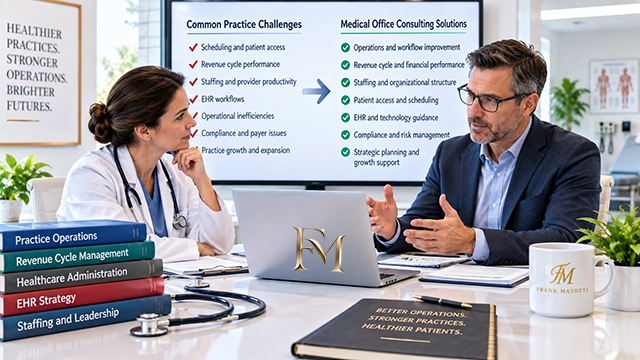
Current firms in this field describe work involving areas such as practice operations, patient access, scheduling and capacity, staffing, provider productivity, revenue cycle performance, EHR workflows, financial performance, leadership, compliance, and organizational structure.
AI needs to understand which parts of that landscape actually belong to your firm.
Does AI Know Which Part of a Medical Practice You Work On?
Two medical office management consulting firms can both accurately use the term “practice management consulting” while providing substantially different services.
One may concentrate heavily on revenue cycle performance, billing processes, payer issues, and financial management.
Another may specialize in operations, staffing, scheduling, patient flow, and front office performance.
Another may help physicians establish new practices, including credentialing, staffing, technology selection, workflows, and operational readiness.
Another may advise larger medical groups on governance, provider productivity, organizational structure, expansion, or multi location operations.
Those distinctions can disappear when a model reduces the business to “healthcare consulting.”
For example, ChatGPT might correctly recognize your firm as a medical practice consultant but associate it primarily with billing.
Gemini might emphasize operational improvement.
Claude might describe the company as a broader healthcare management consultancy.
None of those descriptions necessarily has to be completely false for there to be an AI understanding problem.
The issue can be one of emphasis.
If your strongest expertise is improving the operations of independent physician practices, being understood primarily as a medical billing consultant gives a potential client a materially different picture of your company.
Medical Office Management Consulting Can Be Confused With Several Different Businesses
Category clarity is particularly important in this field because similar terminology describes businesses that do very different things.
Medical office management consulting can overlap linguistically with medical billing companies, revenue cycle management providers, healthcare management consultants, EHR consultants, compliance consultants, credentialing companies, medical practice administrators, outsourced practice management companies, healthcare IT consultants, and general business consultants serving healthcare clients.
Those are not interchangeable services.
A consultant who evaluates a practice’s revenue cycle is not necessarily a company that takes over its billing.
A consultant who evaluates staffing structure is not necessarily a healthcare staffing agency.
A consultant who recommends improvements to an EHR workflow is not necessarily an EHR vendor.
A company providing medical practice management consulting may advise an administrator without becoming the administrator.
This is where an AI search engine audit can uncover something that a simple search for the firm’s name cannot.
The question is not merely whether AI knows the company exists.
The question is what kind of company AI believes it is.
That category distinction can influence the situations in which the firm is considered relevant.
Does AI Understand the Difference Between the Service and the Problem?
Medical office management consultants often describe their capabilities using professional terminology.
Prospective clients may describe symptoms.
A consultant may call a service “patient access optimization.”
The physician may say, “Patients can’t get appointments and our schedule is a mess.”
The consultant may offer revenue cycle analysis.
The practice owner may ask, “Why are our collections getting worse even though we’re seeing the same number of patients?”
The consulting firm may discuss staffing model alignment.
The administrator may ask, “Do we have too many people at the front desk and not enough people handling billing?”
The consultant may provide workflow optimization.
The physician may simply say, “Everything takes too long.”
AI has to make the connection between the problem expressed by the buyer and the expertise described by the consulting firm.
That is especially important in AI searches because a potential client can explain an operational situation conversationally rather than knowing the correct consulting terminology in advance.
If AI knows the names of your services but does not connect them with the problems those services solve, its understanding of the business is incomplete.
Does AI Understand the Types of Medical Practices You Serve?
“Medical practice” is itself an enormous category.
A solo primary care physician does not operate the same way as a multi physician specialty group.
A rural clinic can face different administrative realities from a large suburban specialty practice.
A single location independent practice presents different management challenges from a growing group with several locations.
Different specialties can also have different scheduling patterns, staffing requirements, patient flows, procedures, payer mixes, technology requirements, and revenue cycle considerations.
Some medical office management consultants work broadly across healthcare. Others have meaningful experience with particular specialties, practice sizes, ownership models, or stages of development.
That information can affect client fit.
A physician trying to establish a new independent practice may need a different consultant from an established ten provider group trying to improve capacity and financial performance.
Current medical practice consulting services reflect these differences, with some firms specifically addressing startup issues such as credentialing, payer enrollment, technology selection, staffing, workflows, and opening readiness, while others concentrate on improving established practices.
If your consulting firm has a defined market, AI should ideally understand that distinction rather than treating every medical management consultant as appropriate for every practice.
Revenue Cycle Expertise Can Distort the Picture
Revenue cycle management is important enough within medical practice operations that it can become the dominant interpretation of a consulting company.
That can be accurate for some firms.
For others, it can obscure a much broader practice management capability.
Revenue cycle work can involve the processes connecting scheduling, insurance verification, documentation, coding, claims, payments, collections, denials, and financial reporting. Consulting firms may evaluate those processes without functioning as the outsourced billing company that performs them every day.
That difference gives an AI system several opportunities to oversimplify.
Does it think your company performs billing when you actually advise practices on billing operations?
Does it understand that revenue cycle analysis is one part of a broader operational engagement?
Does it overlook your RCM expertise because your company is primarily described online as a management consultancy?
Does one model emphasize your financial work while another emphasizes staffing and workflow?
The correct answer depends on the individual firm.
That is precisely why the interpretation needs to be examined rather than assumed.
Technology Creates Another Layer of Possible Confusion
Medical office management increasingly intersects with technology.
A consultant may evaluate EHR workflows, practice management systems, reporting processes, patient portals, scheduling systems, or other technology used in running the practice. Industry consulting services explicitly include EHR and practice management system evaluation and workflow support among their capabilities.
But advising a medical practice about technology does not automatically make the firm a healthcare IT company.
That distinction matters.
If AI interprets your company primarily as an EHR consultant, it may miss the broader operational work.
If it sees you only as an operations consultancy, it may fail to recognize that technology selection or workflow evaluation is part of your expertise.
If your firm works with multiple systems rather than representing a particular software vendor, that may also be an important distinction.
A potential client asking AI who can evaluate whether an EHR is contributing to operational problems may receive a very different set of recommendations from someone asking for a general medical practice consultant.
Your firm could reasonably belong in both conversations.
The question is whether AI knows that.
What Attributes Does AI Associate With Your Consulting Firm?
Services tell only part of the story.
A physician evaluating a medical office management consultant may also care whether the firm appears experienced with independent practices, operationally focused, financially knowledgeable, practical, specialized, objective, implementation oriented, or familiar with a particular type of medical organization.
Those are attributes rather than service names.
ChatGPT, Gemini, and Claude can form different impressions from the information they associate with a company.
One model might present your firm as a strategic advisor.
Another might emphasize hands on operational work.
Another might view the company primarily through financial or revenue cycle expertise.
The difference can matter because medical practices do not always want the same kind of help.
A physician looking for someone to diagnose a financial problem may evaluate consultants differently from a group that already knows its problems and wants help restructuring operations.
Understanding the attributes AI associates with the firm helps reveal the kind of consultant the models believe you are.
Would AI Recommend Your Firm When Nobody Uses Its Name?
Searching your company name tests recognition.
It does not fully test recommendation visibility.
A physician or practice administrator who already knows your company may ask:
“What does [company name] do?”
That is useful, but it is not the same as a prospective client asking:
“Recommend consultants who help independent medical practices improve operations.”
“Who can help us figure out why our revenue cycle is underperforming?”
“What firms help physician groups improve scheduling and patient access?”
“We are adding two providers. Who can evaluate whether our staffing and workflows can handle the growth?”
“Who can help us determine whether our practice management problems are operational, financial, or staffing related?”
Those questions test whether AI connects your consulting firm with the need before your company name is supplied.
A model can describe your company accurately when asked directly and still fail to associate the firm with relevant recommendation questions.
I discuss this distinction separately in Why Does AI Recommend My Competitors But Not Me?
For medical office management consultants, the distinction is particularly useful because clients often begin with a problem rather than the name of the service they need.
Three AI Models Can Understand the Same Consulting Firm Differently
There is no reason to assume ChatGPT, Gemini, and Claude have assembled identical pictures of a medical office management consulting company.
One may strongly understand the firm’s revenue cycle capabilities but overlook its operational work.
Another may recognize the firm for medical practice startups but not for established practice improvement.
Another may understand the service mix correctly but associate the firm with the wrong size or type of medical organization.
One might categorize the company as a healthcare management consultancy while another sees it primarily as a billing or practice operations company.
Those disagreements are useful evidence.
They show which parts of the firm’s identity appear consistently understood and which parts depend on the AI system being asked.
That is why I evaluate three models rather than assuming one ChatGPT answer represents AI generally. You can read more about why I compare three AI models.
What the AI Business Understanding Report Can Show a Medical Office Management Consultant
My analysis is performed manually.
I independently evaluate what ChatGPT, Claude, and Gemini understand about your consulting company and compare their responses.
For a medical office management consulting firm, that can include how the models understand your category, services, healthcare specialization, types of practices served, operational expertise, attributes, recognition patterns, recommendation visibility, omissions, outdated information, and potential misunderstandings.
The analysis can reveal whether all three models understand the same firm or whether each has assembled a somewhat different version.
The finished report is a 10+ page PDF prepared by hand. It includes the findings from all three models, cross model comparison, strategic observations, and recommendations based on what I find.
The cost is $495 as a one time purchase, and the report is delivered the next business day after the analysis is completed.
This is not an automated AI visibility score.
It is not an SEO, GEO, or AEO implementation service.
It does not promise that AI systems will recommend your consulting firm or change what the models say.
The purpose is diagnosis.
You get evidence of what the three AI systems currently understand so you can see where their picture matches the consulting firm you actually operate and where it does not.
Do ChatGPT, Gemini, and Claude Understand Your Medical Office Management Consulting Firm?
You know whether your firm specializes in revenue cycle improvement, practice operations, staffing, patient access, workflow, technology, financial performance, startup consulting, or a combination of those areas.
You know what types of practices you serve.
You know the problems your clients bring to you and why a physician or practice administrator should choose your firm instead of a billing company, software vendor, general management consultant, or another healthcare advisor.
What you probably do not know is whether ChatGPT, Gemini, and Claude have reached those same conclusions.
They may understand your company accurately.
They may understand the broad category but miss your strongest expertise.
They may confuse consulting with outsourced management.
They may associate your company too heavily with one service.
They may disagree about the types of medical organizations you serve.
Or they may understand the company perfectly well when asked by name but fail to connect it with the AI searches where your expertise should make it relevant.
You do not have to guess.
Order the Frank Masotti AI Business Understanding Report for $495 and find out what ChatGPT, Claude, and Gemini actually understand about your medical office management consulting firm.