
Why AI Models Disagree About The Same Business
Ask ChatGPT, Claude, and gemini about the same business.
You may get three different answers.
The business hasn’t changed.
The interpretation has.
That surprises a lot of business owners.
Most people assume the major AI models share the same understanding of a company.
They don’t.

Trusted by Business Owners Across Industries.
 |
30+ Years Digital Marketing and Online Visibility |
 |
3 AI Models Chat GPT, Claude, and Gemini |
 |
Manual Analysis |
 |
Confidential Your business is never shared or stored |
 |
Next Business Day 10+ Pages delivered fast. |
Each Model Builds Its Own Understanding
Every AI model learns differently.
It processes information differently.
It decides what is important differently.
As a result, each model builds its own understanding of a business.
That’s why one model may describe a company as a consulting firm while another focuses on its technology. A third may emphasize a niche service that the others barely mention.
They’re all looking at the same business.
They’re simply interpreting it differently.
Different Doesn’t Always Mean Wrong
When people see different answers, they often assume one model must be wrong.
That isn’t necessarily true.
AI models don’t simply repeat information they find online.
They organize it.
They prioritize it.
They connect related information and try to understand what a business actually does.
Because every model approaches that process differently, the final description can be different as well.
Those Differences Tell A Story
One of the things I’ve learned from analyzing businesses is that these differences are often more valuable than the similarities.
When one model clearly understands your business and another struggles to describe it, there’s usually a reason.
Sometimes important information is missing.
Sometimes your positioning isn’t as clear as you think.
Sometimes your business has developed multiple identities online that confuse AI systems.
Those differences become clues.
They help explain how AI currently understands your business.
Most Business Owners Never See This
Business owners know their website.
They know their marketing.
They know the message they’re trying to communicate.
What they don’t usually see is how AI has interpreted all of that information.
That’s the blind spot.
When someone asks AI to recommend a provider, compare companies, or explain what a business does, the customer is seeing AI’s interpretation—not necessarily the story the business intended to tell.
Consistency Matters
When multiple AI models describe your business in similar ways, that’s a good sign.
It suggests they have reached a similar understanding of who you are and what you do.
When the descriptions are significantly different, it’s worth asking why.
The goal isn’t to force every AI model to use the exact same words.
The goal is to understand why their interpretations differ and whether those differences reveal gaps in how your business is being understood.
Why I Compare Multiple AI Models
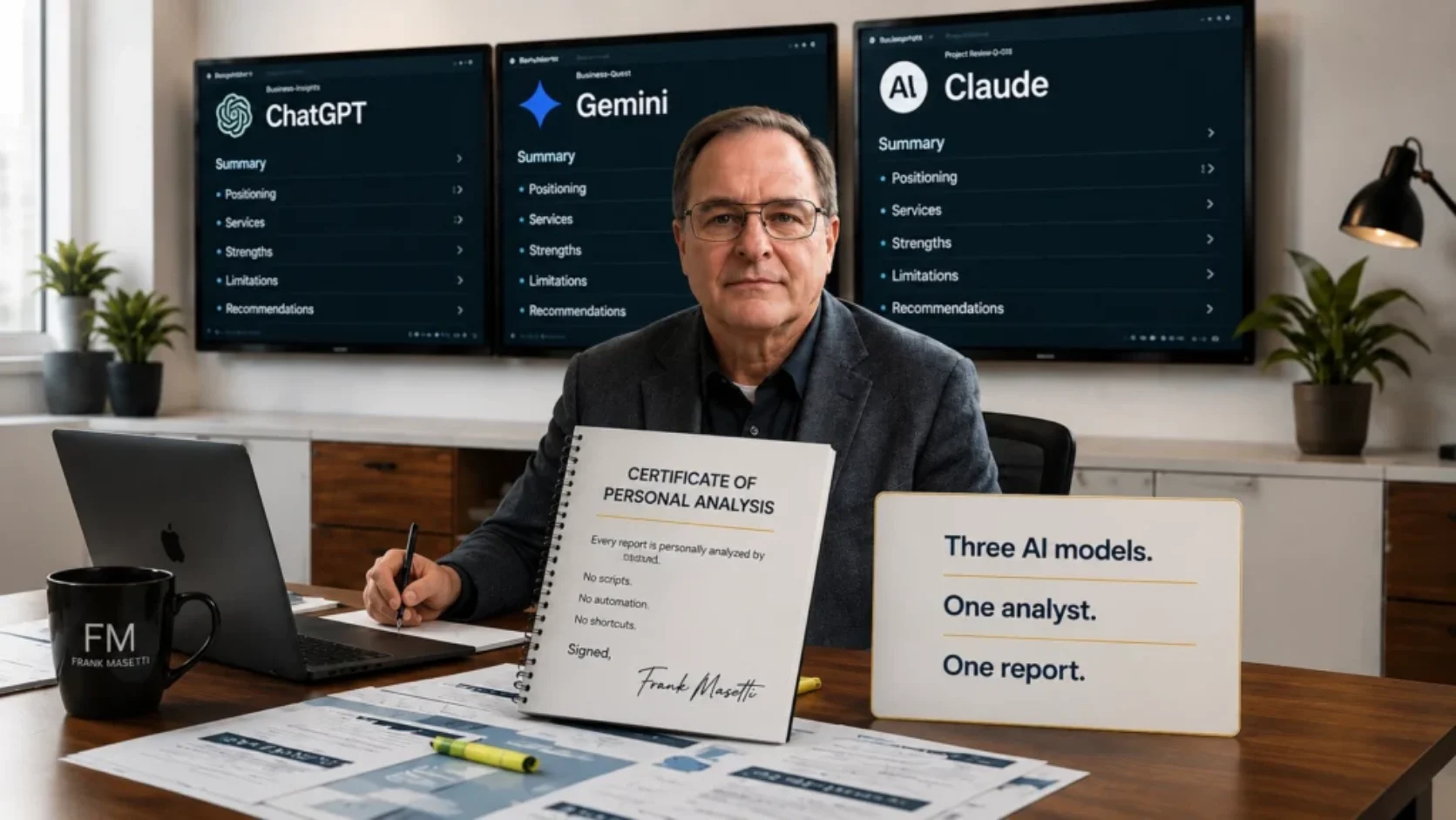
This is one of the reasons every AI Interpretation Analysis Report includes ChatGPT, Gemini, and Claude.
Looking at only one model tells part of the story.
Comparing all three provides a much clearer picture.
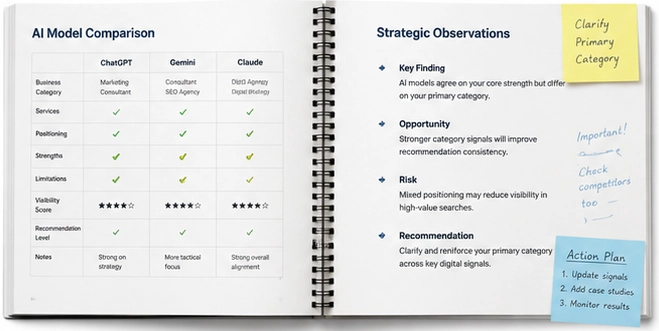
It shows where the models agree.
It shows where they disagree.
And just as importantly, it helps explain why those differences exist.
Because before you can improve how AI understands your business, you first need to understand what it’s already saying.
What you get —
A Clear Picture of Your AI Presence
Your report reveals exactly how leading AI models Interpret, describe, and recommends your business.
✔ How you are described across 3 models
✔ Where AI recommends you, and where it doesn’t
✔ Inconsistencies, gaps, and missed opportunities
✔ Strategic insights you can act on right away.

I don’t guess.
I investigate.
You get the unfiltered truth.
Working with Businesses in Competitive Markets