
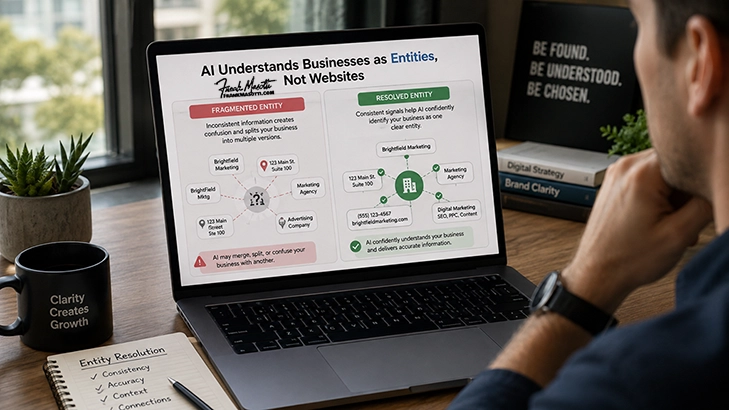
If you searched this, you have probably run into the word in a slightly confusing way. Maybe someone mentioned “entity based SEO,” or you read that Google and AI models “think in entities,” and it was never quite explained what that actually means for a business like yours. Here is the direct answer. An entity is a single, specific, real world thing, a business, a person, a place, a product, that AI can identify as one consistent object with its own attributes, separate from every other thing that might share its name.
Your business name is just a string of text until AI can confidently resolve that string to one specific thing. That resolution is the whole game. AI does not organize the world by website, or by brand voice, or by how well written your homepage is. It organizes the world by entity, and if your business has not been clearly resolved into a single entity, none of the good information you have published gets attached to you reliably, no matter how accurate it is.
The Hidden Problem: You Think of Yourself as a Website. AI Thinks of You as an Entity.
Most business owners assume that if their website is accurate and their online information is correct, AI will naturally understand who they are. That assumption treats your website as the unit AI is working with. It is not. AI is working with an entity, a concept that exists independently of any one page, and that entity has to be assembled from signals scattered across your entire footprint on the web, not just the part of it you control directly.
This distinction matters because a website can be perfectly accurate and still fail to produce a clearly resolved entity. If your business name appears slightly differently across your site, your directory listings, and your social profiles, if your category gets described one way here and another way there, AI is not looking at one clean business. It is looking at fragments that may or may not get stitched together into a single, confident picture. How AI builds a picture of your business from information across the web is exactly this process, and entity resolution is the first step of it, before any fact about you can be trusted at all.
Why This Stays Hidden From Most Business Owners
Nobody experiences their own business as ambiguous. You know exactly who you are, what you do, and how you differ from anyone else who might share your name. That certainty is precisely what makes this problem invisible from the inside. You never have to disambiguate yourself, because you already know which business you are.
AI does not have that advantage. It encounters your business name the same way it encounters any other string of text, as something that could refer to more than one thing until proven otherwise. A common business name, a name that is also an everyday word, or a name shared with a business in another city, all of these force AI to do extra work before it can even begin attaching facts to you specifically. If that work does not resolve cleanly, you will never see it happen. You will simply notice, much later, that an AI model seems to know less about you than it should, or seems to know something about a business that is not actually yours.
The Mechanism: How Entity Resolution Actually Works
In practical terms, entity resolution is the process of matching a mention, your business name appearing somewhere, to a specific underlying thing, with confirmed attributes such as category, location, and relationships to other entities. Think about how ambiguous a name like Washington is on its own. It could be a state, a president, a city, or a surname. Nothing about the word itself tells you which one is meant. Context does that work, and AI has to do the same kind of resolution for your business name every time it appears somewhere new.
The signal AI relies on most heavily for this is consistency. When your business name, address, category, and key details appear the same way across your website, your directory listings, your schema markup, and other mentions of you across the web, those signals reinforce each other and AI can resolve you into one confident entity. When those same details vary, a slightly different name here, a different category there, an address that does not quite match, AI cannot always tell whether it is looking at one business with messy data or two or three different businesses. AI crawling your site is not the same thing as AI understanding it, and this is one of the clearest reasons why. A crawler can read every page correctly and still fail to consolidate what it read into a single entity, because the underlying signals never lined up cleanly enough to do so.
Why Fragmentation Is More Costly Than It Sounds
A fragmented entity does not just mean AI is missing a detail. It means AI may be working from a partial version of your business, one that includes some of your real attributes and misses others entirely, because those other attributes got attached to a slightly different version of the entity that never got merged with the main one. This is also why AI can combine accurate facts into an inaccurate conclusion. Every individual fact might be true. The problem is which entity those facts got attached to, and whether that entity is actually the complete, current version of your business.
This also explains something business owners often find confusing, why ChatGPT understanding your business does not mean Gemini or Claude understand it the same way. Each model builds its own resolution of your entity from its own training data and retrieval process. One model may have successfully consolidated your business into a single, accurate entity. Another may still be carrying a fragmented or outdated version. This is not a bug in one of the models. It reflects the reality that all AI models know the same things, and they don’t, because entity resolution happens independently inside each one.
The Business Consequence
When your entity is not cleanly resolved, prospects asking an AI model about you can receive an answer built from an incomplete or outdated version of your business, one that is missing a service you now offer, a location you have expanded into, or a credential you have since earned. In more serious cases, a prospect can receive information that actually belongs to a different business entirely, one that happens to share your name or a close variation of it.
None of this looks like a normal marketing problem, because there is no single wrong page to fix. The issue lives in whether the pieces scattered across the web have been consolidated into one clear thing AI can confidently point to, and that is not something a routine website audit is built to catch.
Where the AI Business Understanding Report Fits
Checking whether your business has been resolved into a single, accurate entity is not the same exercise as checking your rankings or your on page SEO, which is part of why this differs from a standard SEO or AI visibility audit. The AI Business Understanding Report looks directly at how ChatGPT, Gemini, and Claude currently resolve your business, whether that resolution is complete, whether it is current, and whether any part of it has been confused with something you are not.
A Simple Way to Think About It Going Forward
An entity is not a marketing concept. It is the actual unit AI uses to organize everything it knows about the world, and your business either exists inside that system as one clear, confidently resolved thing, or it exists as scattered fragments that never quite added up. The second version is far more common than most business owners realize, precisely because it is invisible from the inside.
If you want to see which version of your business AI is currently working with, the AI Business Understanding Report will show you exactly that.