
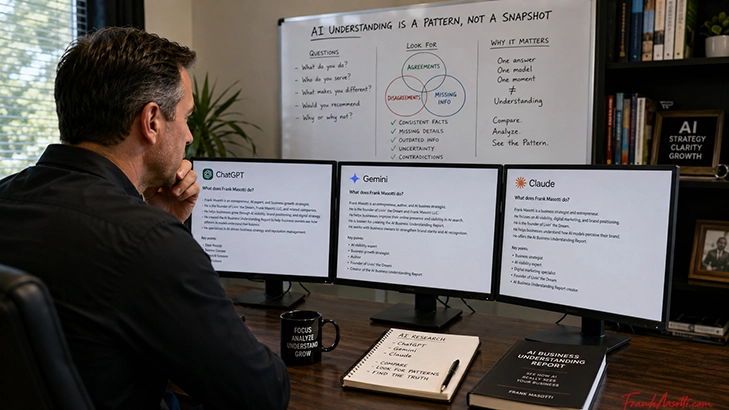
One question can show you how an AI model answered one question at one moment.
It cannot show you how AI understands your business.
That distinction matters because more business owners are beginning to test what ChatGPT, Gemini, and Claude know about their companies. They open one AI platform, type a question about their business, read the answer, and assume they have learned how AI sees them.
If the answer looks accurate, they assume everything is fine.
If the answer is wrong, they assume the AI knows nothing about them.
Neither conclusion may be accurate.
One answer is a snapshot. It is not a complete picture.
The Question Changes the Answer
Think about how people learn about a business.
If I ask someone, “What does this company do?” I may get a general description.
If I ask, “Who does this company serve?” I may learn something different.
If I ask, “Would you recommend this company?” I may discover that the person understands the business but does not have enough information to recommend it.
The same thing can happen with AI.
Different questions can bring different information into the answer. A broad question may produce a general description. A more precise question may reveal a specialty that did not appear before.
A question about credibility may produce a different answer than a question about services.
A question about recommendations may reveal uncertainty that was invisible in a basic company description.
This means the wording and purpose of the question matter.
You are not simply asking whether AI knows your business.
You are testing which parts of its understanding appear under different conditions.
One question cannot reveal all of that.
My Own Business Showed Me Why This Matters
I found a clear example while analyzing how AI models understood my own business.
In one response, Claude described my background, my companies, and my methodology in real detail.
During the same research, another Claude response claimed it had no information about me.
Same person.
Same business.
Same AI model.
Same research period.
Two completely different outcomes.
If I had asked only the first question, I might have concluded that Claude understood me consistently.
If I had asked only the second question, I might have concluded that Claude knew nothing about me.
Both conclusions would have been wrong because each was based on only one answer.
The contradiction became visible only because I asked multiple structured questions and compared the responses.
That is an important lesson for any business owner testing AI.
The answer you receive may be accurate, incomplete, inconsistent, or dependent on how the question was asked.
You cannot determine which one it is from a single response.
Recognition Is Not the Same as Understanding
A business name appearing in an AI answer does not necessarily mean the business is understood accurately.
An AI model may recognize your company while misunderstanding what makes it different.
It may know your services but describe them too broadly.
It may understand your specialty in one answer and leave it out of another.
It may connect your business with old information that is no longer relevant.
It may combine your current work with previous businesses, locations, services, or professional roles.
It may describe your company accurately and still hesitate to recommend it.
Those are different issues.
A single question may reveal one of them.
It cannot reliably show how they fit together.
Different AI Models May Understand the Same Business Differently
There is another problem with asking only one question.
Many business owners test only one AI platform.
They ask ChatGPT about their company and assume the answer represents how artificial intelligence understands the business.
It does not.
ChatGPT, Gemini, and Claude are separate AI systems. They may use different information, emphasize different details, and reach different conclusions.
One model may describe a business as a specialist.
Another may describe the same business as a general service provider.
A third may recognize the company but express uncertainty about its credibility or relevance.
None of those answers alone shows the complete picture.
The differences between the models may be just as important as the individual answers.
If all three models describe your business in a similar way, that may suggest a more consistent understanding.
If all three describe your business differently, that disagreement tells you something important too.
You cannot find agreement or disagreement by asking one question on one platform.
You need comparison.
Understanding Appears as a Pattern
This is why I do not believe AI business understanding should be judged from a single answer.
The useful information appears across multiple questions and multiple models.
You begin to see which facts appear consistently.
You see which details appear only occasionally.
You find information that is missing.
You discover where models disagree.
You identify descriptions that are outdated or incorrect.
You may also find that an AI model understands what your business does but does not have enough independent information to recommend it confidently.
No single answer can show all of those patterns.
The pattern appears only after the answers are examined together.
That is the difference between asking AI a question and analyzing how AI understands a business.
Why I Created the AI Business Understanding Report
This discovery helped shape the methodology behind the AI Business Understanding Report.
I personally ask ChatGPT, Gemini, and Claude a structured set of questions about one business.
I do not judge the business from one answer.
I compare how the models describe the company across different questions.
I look for agreement.
I look for disagreement.
I look for missing information.
I look for contradictions.
I look for places where the models understand the business accurately and places where their understanding becomes unclear, incomplete, or wrong.
The purpose is not to produce a score.
The purpose is not to promise rankings.
The purpose is to show the business owner what becomes visible when multiple AI interpretations are examined together.
That larger picture cannot come from one question because one question was never designed to reveal it.
Try It With Your Own Business
Ask ChatGPT one question about your company.
Read the answer carefully.
Then change the question.
Ask what your business does.
Ask who it serves.
Ask what makes it different.
Ask whether the model would recommend it.
Ask the same questions in Gemini and Claude.
You may receive similar answers.
You may receive completely different answers.
You may discover that the models know more about your business than you expected.
You may discover that they understand the basic facts but miss the specialty that matters most.
You may find that one model understands your company clearly while another interprets it differently.
The important point is that you will not know until you look beyond the first answer.
One AI question can tell you what one AI model said at one moment.
It cannot show you how AI understands your business.
For that, you need to see the pattern.