
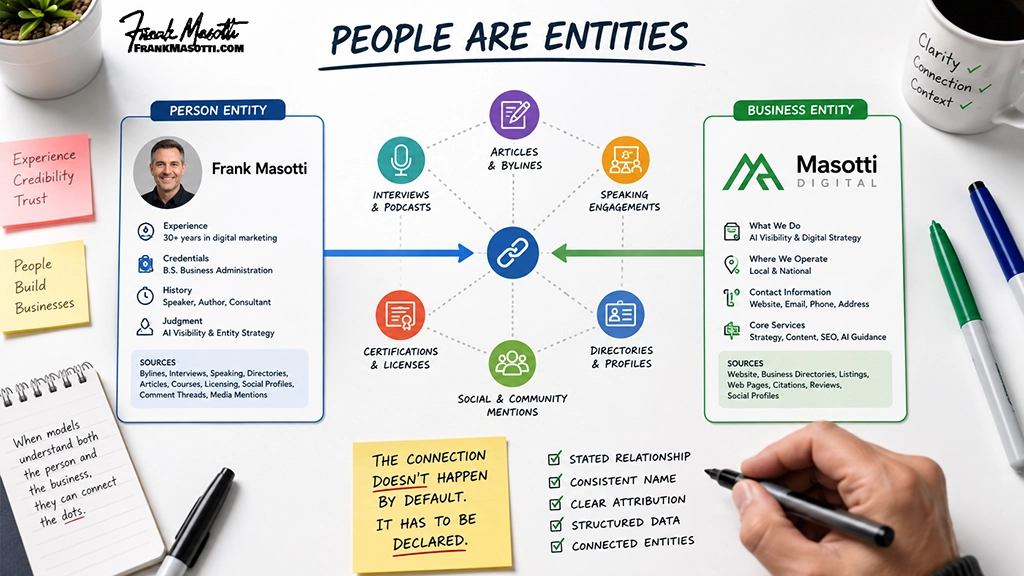
Yes. If you have wondered whether AI systems hold an understanding of you personally, the way they hold one of your company, they do. You are an entity. Your business is a separate entity. Both records already exist, both were assembled without asking you, and the relationship between them was inferred rather than declared.
Most owners assume the company is the thing being described and their own name is decoration sitting on top of it. In practice the two records are built independently, from different sources, and they carry different kinds of information. The company record tends to hold what you sell, where you operate, and how to reach you. The person record tends to hold experience, credentials, history, and judgment.
When the two are not clearly connected, a model answering a question about your business sees a company with nobody behind it, and a person attached to nothing in particular. Neither record is wrong. Both are incomplete in a way that costs you exactly when it matters most.
What an entity actually is
Strip away the vocabulary and an entity is simply a subject a system has decided is distinct enough to keep separate from every other subject. A company. A product. A place. A person.
The system holds a set of attributes for that subject and a set of relationships to other subjects. Frank Masotti is a person. Frank Masotti works on a specific thing. That thing is offered by a specific business. The business operates in a specific place. Each of those statements is a relationship, and relationships are what allow a model to answer a question it was never directly given the answer to.
Nothing about that process is reserved for organizations. A person is exactly as legible to these systems as a company is, and often more so, because people leave traces in more places than businesses do. Bylines. Interviews. Speaking listings. Professional directories. Comment threads. Course rosters. Licensing boards. Every one of those is a statement about a person, and every statement gets read. The picture a model assembles from information scattered across the web works the same way for a person as it does for a company.
The part owners miss
Here is the assumption worth examining. Owners tend to believe that anything true about them personally will naturally be understood as true about their business, because in their own mind the two are the same thing.
They are not the same thing to a machine.
If you spent twenty years in commercial roofing before opening your own company, that history lives in your person record. Your company record may have been created three years ago and may contain nothing about those twenty years at all. A model asked which local roofing company has the deepest experience is reading the company record. The twenty years are sitting in a different file.
This is the quiet asymmetry of running a business under your own name or under a brand you built yourself. The trust you have earned accumulated to you. The transaction happens through the business. If nothing in the readable record explicitly ties them together, the trust does not transfer.
How the connection breaks
The disconnect is almost never dramatic. It happens through small, ordinary gaps.
Content published without attribution. Years of blog posts, guides, and answers with no named author, or an author byline that links to an unusable URL, produce a company that appears to have written a great deal and a person who appears to have written nothing.
Name variance. Rob, Robert, Bob, R. Middle initial in some places, absent in others. Maiden name on older credentials. Each variant risks being read as a separate person, and each separate person holds a fraction of the actual record.
Shared names. If someone with your name is a published author, an athlete, or the subject of a news story, your record competes with theirs for the same string of text. Without disambiguating detail, the more documented person wins.
Credentials that live only inside a platform. A license, a certification, a degree, a thirty year work history: if these appear only on a profile page that resists crawling, they are effectively invisible to the systems doing the describing.
No stated relationship. This is the most common one. The site never says, in plain language a machine can lift, that this person founded this company, holds this role, and does this work. The reader infers it from context. Machines are worse at inference than readers are, and they do not guess when they can simply omit. Declaring the relationship outright is one of the few jobs schema markup genuinely performs, and one of the few places it is worth the effort.
Why this matters more for small businesses
A large company can afford to have an anonymous corporate record. Nobody asks who personally answers the phone at a national insurer. The brand is the entity that carries trust, and the brand has thousands of documented mentions holding it up.
Smaller businesses work the opposite way. The person is the reason anyone buys. Buyers are choosing an attorney, a designer, an advisor, a builder, a physician. When they ask a model for a recommendation, the answer they find useful is one that says who this person is and why they are credible.
If your person record is thin, or disconnected from your company record, the model has nothing to say on that point. It will describe your services accurately and say nothing about you. The competitor whose founder is clearly documented gets described as a business with a person behind it. You get described as a business.
Read those two descriptions side by side and the difference is not subtle.
The business consequence
This does not show up as a lost sale you can point to. It shows up as an absence.
A buyer asks which firm in the area handles a specific kind of work and why they should trust them. Three businesses come back. Two are described with a named principal, a background, and a stated specialty. The third is described as a company that offers the service. The buyer contacts the first two.
You never learn this happened. There is no notification, no analytics event, no bounced inquiry. The comparison took place in a conversation you were not part of, using a record you did not write, and the outcome was decided by which businesses had a person attached to them.
That is the specific cost of leaving your own entity to chance. Not a penalty. Not a ranking drop. A quieter phone, for a reason that never surfaces.
What to do about it
The first step is not a fix. It is finding out what is actually there.
You need to know how the models currently describe you personally, how they describe your business, and whether they connect the two. Those three answers frequently surprise people who assumed the record was fine, and they are the only reliable basis for deciding what needs correcting.
That is what The Frank Masotti AI Business Understanding Report is for. It documents, in detail, how the three leading models currently understand your business and the person behind it, so decisions get made against evidence rather than assumption. You can see a full sample report before deciding whether it is worth your time.
The point worth keeping
You have been treating your business as the thing that needs to be understood. It is half the picture.
The other half is you, and it is already written down somewhere, assembled from whatever happened to be available. The only real question is whether it says what you would say, and whether anything in the record connects it to the business you actually run.