
When a prospect asks ChatGPT, Claude, or Gemini about your company, the answer almost always leads with one thing. One service. One specialty. One category. One sentence that arrives before everything else and quietly sets the frame for whatever follows.
That leading detail is what your business is known for inside that model. And in most cases, you did not choose it.
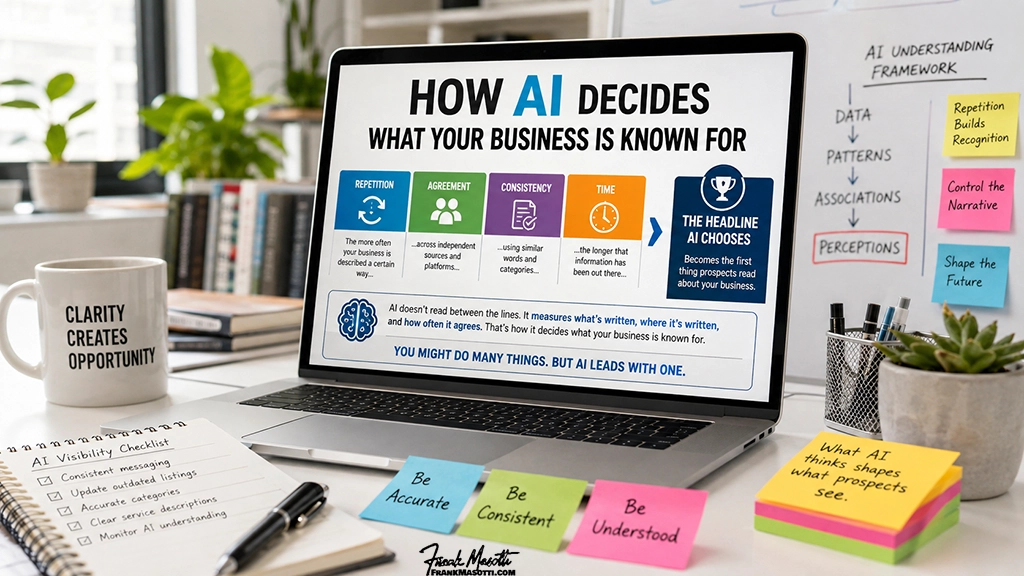
Here is the direct answer to how it gets chosen. AI decides what your business is known for by measuring which claims about you appear most often, in the most separate places, phrased most consistently, across everything it can read. Repetition and agreement decide the headline. Your revenue mix does not. Your priority ordering does not. What you would say if a customer asked you at a trade show does not. If four sources describe you one way and one source describes you another way, the model treats the first version as the settled fact about your business and the second as a detail worth mentioning later, if at all.
What You Do and What You Are Known For Are Two Different Records
Most owners never separate these two ideas, because in daily life they do not need to. You know what you do. You know which work pays best. You know which service line you built the company around and which one you kept because a few longtime clients still ask for it.
An AI model has none of that context. It has no access to your books, your margins, your strategy, or your intentions. It has text. From that text it builds a ranked set of associations attached to your business name, and the association at the top of that ranking becomes the answer people receive. This is the difference between being visible to AI and being understood by AI. Visibility means the name resolves to something. Being known for the right thing means the strongest association attached to that name is the one you would have picked yourself.
Those two conditions come apart more often than owners expect. A model can name your company, get your city right, list your services accurately, and still lead with the work you consider secondary. Nothing in the answer is false. The emphasis is simply wrong, which is a specific and underrated failure mode covered in why AI does not need to get every fact wrong to misunderstand your business.
Repetition Decides the Headline, Not Importance
The mechanism is simpler than most people assume, and that simplicity is exactly what makes it hard to correct.
A model encounters your business name across many documents. Each time, something is said about you. Directory categories say something. Review text says something. An old press mention says something. A partner page, a chamber listing, a job posting, a supplier profile, a conference bio all say something. The model does not weigh these by how much they matter to your business. It notices which descriptions recur, and recurrence becomes confidence.
So the association that wins is usually the one that has been written down the most times in the most independent places, which is rarely the same as the one that matters most to you. This is where the assumption that more coverage equals better understanding breaks down. As covered in why more mentions do not automatically mean AI understands your business, volume of mentions and accuracy of emphasis are separate measurements. Fifty listings that all use a category you outgrew will produce a very confident answer about a business you no longer are.
The same logic applies inside your own site. Publishing more pages about a new service does not automatically shift the association if the older service still appears in more places overall, a point examined in why more content does not automatically make your business easier for AI to understand.
Why Sources You Do Not Control Usually Set the Frame
Your website is one voice describing your business. Every other source is a separate voice, and separate voices agreeing carries more weight than one voice insisting.
That is not a flaw in the model. It is a reasonable heuristic. A business describing itself has an obvious interest in the description. Independent sources describing the same business the same way look like corroboration. So when your homepage says one thing and a dozen third party sources say another, the model tends to resolve toward the crowd. This is the practical reason that when AI gets your business wrong, your website is not always the problem, and why rewriting a homepage sometimes changes nothing at all.
It also explains why structured data helps less than owners hope in this particular situation. Schema labels what is already on your pages so a model can read it cleanly, but it cannot vote in an election happening off your domain. That limit is the subject of why schema stops at the edge of your website and, more precisely, why schema changes what AI knows rather than what AI thinks.
Your Newest Work Is Almost Always Your Least Known Work
There is a time problem layered underneath all of this, and it moves in one direction.
Anything you have done for a decade has had a decade to be written about. Anything you launched last year has had a year. The older description has more repetitions behind it, more inbound references, and more places it sits undisturbed. That is why a model may trust older information about your business even when your current site clearly says otherwise, and why so many owners find that AI is describing the business they used to be.
When the old record and the new record disagree, the model does not flag the conflict for you. It resolves it silently and answers with the same steady tone either way. That resolution process is worth understanding on its own, and it is laid out in what happens when AI finds conflicting information about a business and in what happens when your website says one thing and older sources say another.
The wording you use matters here too, because models read literally rather than charitably. A tagline meant as positioning can be absorbed as a factual claim about your operations, which is why clear writing beats clever writing for AI and why ambiguous sentences create ambiguous AI answers.
The Cost Is Being Recommended for the Wrong Work
This is not a branding inconvenience. It changes which conversations you get invited into.
If a model believes you are known for your entry level service, you will be surfaced when someone asks about entry level work and skipped when someone asks about the complex, higher value project you actually built the company to handle. You never see the second question. You simply notice, over time, that the inquiries arriving are smaller than the ones you want, and nothing in your analytics explains why.
That screening happens earlier in the buying process than most owners realize, because increasingly your prospect asks AI about you before contacting you. It also happens without any visible signal, since AI sounds equally certain when its understanding is incomplete. A confident answer about the wrong specialty reads exactly like a confident answer about the right one. This is the quiet mechanism behind the question why AI recommends my competitors but not me.
And it does not resolve the same way everywhere. Each model built its associations from a different mix of sources, which is why all AI models do not know the same things and why you can be known for one thing in ChatGPT and something else entirely in Gemini. Asking a single model once tells you almost nothing, as covered in why one AI question cannot show you how AI understands your business.
Where the AI Business Understanding Report Fits
You cannot adjust an association you have never read.
The AI Business Understanding Report documents what ChatGPT, Claude, and Gemini currently lead with when asked about your business. Not just whether they know you exist. What they say first, what they leave out, which version of your company they treat as current, and where those conclusions appear to be coming from. Comparing three models is deliberate, for the reason explained in why three AI models, and the specifics of the deliverable are laid out in what you are actually buying.
Once the ranking is written down, it becomes something you can work on. Some of it is a content problem on your own pages. Some of it is a third party record that needs correcting. The distinction matters, and AI interpretations can be changed once you know which kind you are dealing with.
The Short Version
What your business is known for inside an AI model is not a summary of your priorities. It is a ranking built from repetition, agreement across independent sources, and age of the record. The top of that ranking becomes the first sentence a prospect reads about you, and it forms before anyone visits your site or picks up the phone.
You can find out what currently sits at the top of that list. Order your AI Business Understanding Report here.