
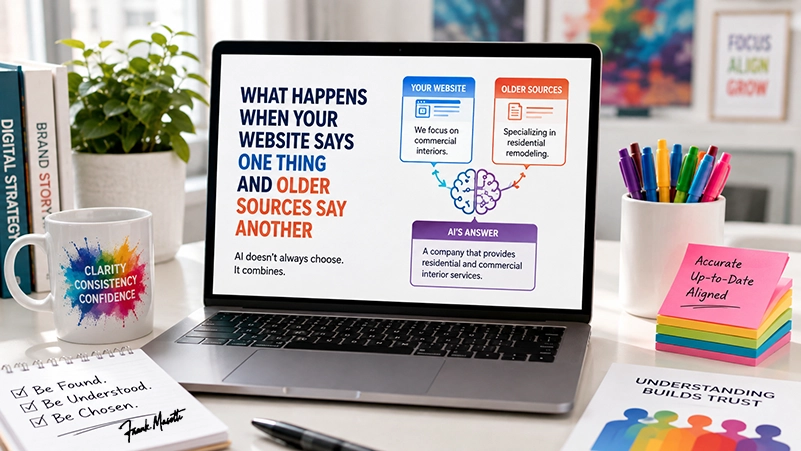
Here is the short answer. When your website describes your business one way and older sources describe it another way, AI rarely chooses between them the way you would expect. It does not usually look at the two versions, notice that one is newer, and discard the older one. More often, it treats both as partial evidence about the same company and produces a single description that borrows from each.
That merged description is the part most business owners never anticipate. The answer a customer receives may not be your current positioning, and it may not be your old positioning either. It may be a third version that does not exist anywhere on the internet, assembled from pieces of both.
Nothing in the answer signals that a conflict occurred. The customer sees a confident paragraph. You see nothing at all.
Why this feels like it should not happen
Most owners assume that a contradiction gets resolved in favor of the official source. Your website is the primary source. You control it. You updated it. It should win.
The problem is that AI does not experience your website as authoritative in the way you do. It experiences it as one input among many. I have written before about how AI builds a picture of your business from information across the web, and that process is the reason a single accurate page cannot simply overwrite everything else. Your site is weighed alongside directory listings, old press coverage, association profiles, partner pages, review sites, aggregator entries, and anything else that has ever described your company.
When those inputs agree, the resulting description is clean. When they disagree, something has to give.
What contradiction actually produces
There are four common outcomes, and only one of them is the outcome owners expect.
The newer version wins. This happens when your current description is repeated consistently across enough independent places that it clearly outweighs the older story. It is the outcome everyone assumes is automatic. It is not automatic. It is earned through repetition and consistency across sources you do not own.
The older version wins. If the outdated description appears in more places, has existed longer, or sits on sources that carry weight, it can outweigh a single updated page. That dynamic is the subject of a separate piece on why AI may trust old information about your business, and it is the outcome most owners are warned about.
The two versions merge. This is the outcome almost nobody plans for, and in my experience it is the most common. Say a firm spent years doing residential remodeling and now works only on commercial interiors. The website says commercial. A dozen older listings say residential. AI does not necessarily conclude that one is wrong. It can conclude that the company does both. The resulting sentence sounds entirely reasonable. It describes a business with a broad service range serving residential and commercial clients. Every individual fact behind it was true at some point. The conclusion is still wrong. This is the same failure mode I describe in how AI can combine accurate facts into an inaccurate conclusion.
The description goes vague. Sometimes conflict produces hedging instead of merging. Rather than commit to either version, the answer retreats to language general enough to be safe. The company becomes a professional services firm offering a range of solutions. Nothing stated is false. Nothing stated is useful either. A prospect comparing you against a competitor with a clear, uncontested description will notice the difference even if they cannot articulate why.
Why the conflict stays invisible to you
A human reader resolves contradictions out loud. They notice a listing from 2019, decide it looks stale, and move on. AI resolves the contradiction internally and reports only the result.
This matters because the output stays fluent. A merged or hedged description does not arrive with a warning. It arrives in the same steady tone as a completely accurate one. I have covered this separately in why AI sometimes sounds certain when its understanding is incomplete, and it is the reason spot checking does not surface the problem. You ask a question, you get a plausible answer, and you assume the underlying picture is sound.
There is a second layer to this. Different models resolve the same contradiction differently, because they are working from different collections of sources gathered at different times. ChatGPT may have settled on your current description while Gemini still merges the two, or the reverse. This is why all AI models do not know the same things and why checking one model tells you very little. Asking one AI question cannot show you how AI understands your business, and asking one model cannot either. It is the reason my report compares three models rather than one.
The business consequence
Consider what a merged description does to a sales conversation you never learn about.
A prospect asks an AI assistant what your firm specializes in before deciding whether to contact you. They receive a description that includes work you no longer do. If they were looking for that work, they call you and you disappoint them. If they were looking for your actual specialty, the description reads as unfocused and they call someone whose answer sounded more precise.
Either way, the conversation ends before you enter it. No inquiry arrives. No feedback arrives. The only visible symptom is a slightly quieter pipeline, which almost never gets traced back to a description you did not write and have never seen.
This is also why the instinct to fix the website first is incomplete. Your website may already be perfect. The contradiction lives in the gap between your website and everything else, which means it does not need to get every fact wrong to misunderstand your business. Correcting a page you already control does not resolve a conflict originating somewhere you do not.
Where the AI Business Understanding Report fits
You cannot resolve a contradiction you have not located. The first question is not what to change. It is which version of your business each model currently believes, and where the two stories are still competing.
That is what the AI Business Understanding Report is built to answer. I manually examine how ChatGPT, Claude, and Gemini currently describe your company, then document where they agree, where they diverge, and where a description appears to be drawing on information that no longer reflects how you operate. Where a merged or outdated picture shows up, the report identifies it directly rather than leaving you to guess. You can see how the process works before deciding whether it is useful to you.
The point is not to produce a report. The point is to give you something specific enough to act on, because AI interpretations can be changed once you know what is being interpreted.
The plain version
Your website tells one story. Older sources tell another. AI does not referee that disagreement the way a person would. It often blends both into a description that is neither, states it confidently, and shows no sign that anything was in conflict.
Your customers see that description. You do not. That asymmetry is the entire problem, and it stays in place until someone goes and looks.
If you want to know which version of your business AI is currently describing, you can order the AI Business Understanding Report.