
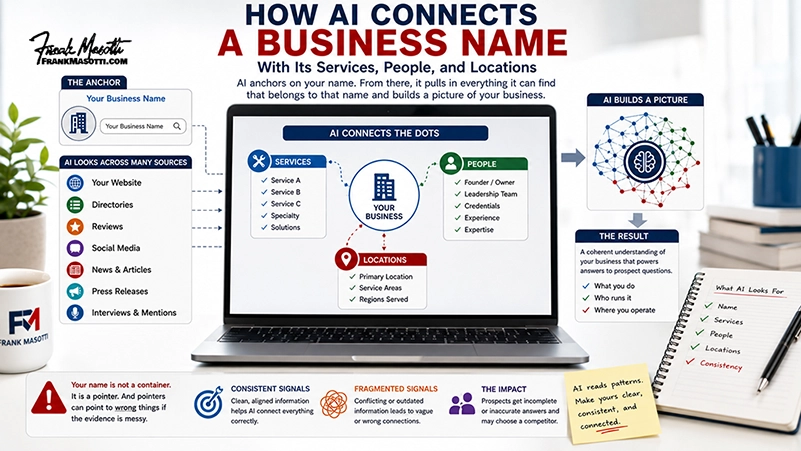
When a prospect asks ChatGPT, Claude, or Gemini about your business, the first thing the model does is anchor on your name. The name is the reference point. From there, it pulls in everything it can find that belongs to that name: what services you offer, who runs the company, where you’re located. The connections seem obvious to you because you live inside them every day. But from the outside, the model has to work to connect them correctly.
Your name is not a container. It is a pointer. And pointers can point to wrong things if the evidence is messy.
How the Name Works as an Anchor
AI systems do not approach a business like a customer does, reading your website top to bottom and absorbing your story. They approach it like someone reading dozens of mentions of your business at once, scattered across different sources, without context. Your website is one mention. A directory listing is another. A review site is another. An old interview. A social media profile. A press release. Each one contains pieces of information, some connected to your name, some connected to a variation of your name, some connected to a person or location that happens to be associated with your name.
AI’s job is to figure out which pieces belong together.
It starts with the name as the anchor. Every mention of that name, or a recognized variation of that name, becomes a candidate for connection. The model then collects all the information attached to those mentions and tries to assemble a coherent picture. What gets mentioned alongside the name most consistently? What location appears most often when the name appears? Who gets described as running the organization? What services get mentioned in sentences containing the name?
The model is not reading a single authoritative source. It is counting signals across many sources and letting the pattern decide what is most likely to be true.
This works remarkably well when the signals are consistent. A business with a clean online presence, where the name, location, and service descriptions align across directories, your website, reviews, and news mentions, presents a clear pattern to the model. The pointers all aim at the same entity.
It breaks when the signals are fragmented or conflicting.
When Service Descriptions Get Connected Wrong
Your services are connected to your name through the simplest possible mechanism: they appear near it. If your service description sits in a sentence with your business name, the model learns that association. If a review describes someone as visiting your business for a specific service, the model learns that connection. The problem is scale and consistency.
Most businesses describe their services differently across different platforms. Your website emphasizes one service. A directory listing emphasizes another. An older article describes services you no longer provide. A social media post highlights a specialty version of what you do. Review sites use generic service categories that miss your actual specialty.
The model has to build a hierarchy of what you actually offer from sources that do not agree.
The risk is not that one piece of information is wrong. The risk is that weak signals can create wrong associations. If a single mention connects your name to a service you no longer offer, and that mention sits on an authoritative domain, the model might weight it more heavily than dozens of consistent mentions on directories you control. Or the model might resolve the conflict by becoming vague, listing multiple possible services without confidence in any of them.
Neither outcome is flagged as an error to you. From your perspective, you just notice that when prospects ask the model about you, the description lacks specificity or focuses on work you have moved away from.
The model has connected your name to a service, which is correct. It has simply connected it to the wrong one, or to too many at once.
When People Get Connected to the Wrong Organization
The person problem is sharper and easier to misdiagnose.
People are entities. Organizations are entities. When a business is named after its founder, or when a founder is publicly associated with the business, the model has to make constant small decisions about which entity a given mention refers to. Is this article about John Smith the consultant, or about Smith Consulting, the organization? Does this credential belong to the person or to the company? Does this review describe an interaction with John or with his firm?
Most of the time, the model figures it out from context. Smith Consulting has a business address and phone number and the person does not. The organization has service descriptions and the person has a biography. When the sources are clean and the distinction is stated explicitly, the model separates them correctly.
When the sources are tangled, the entities can collapse into each other.
A founder who is heavily quoted in old articles about the business creates a special problem. The biographical information, the credentials, the expertise, and the business reputation all get connected to a string that now has two possible referents. The model is not being confused. It is following the actual sources, which frequently treat the founder and the organization as interchangeable.
The practical effect: the model speaks with specific knowledge about the founder and vague knowledge about the business, or vice versa. A prospect learns that John Smith is extremely credible and gets told almost nothing about what his company actually does. Or they learn that Smith Consulting offers several services and learn almost nothing about who runs it.
The connection was made. It was simply made between the wrong pair of entities.
When Multiple Locations Create Ambiguous Associations
Location associations work similarly. AI learns that your business operates in certain places primarily through seeing your name connected to those locations across sources.
If you operate in one city, this is clean. Your address appears consistently. Your name appears in local directories. Your service area is described clearly. The model learns that your business is located in one place.
If you operate in multiple cities, or if you serve a region, or if you have moved locations, the model has to assemble a location picture from scattered evidence.
A business that serves the entire Phoenix metro area but lists its legal address in Tempe, has its main office in Phoenix, and used to be located in Scottsdale creates a three location problem. Which one is “the” location? The model will likely identify all three. But when a prospect asks what city you are in, the model has to choose. It might pick the most recent mention. It might average them. It might list all three and signal no preference. Each answer is defensible from the available evidence. None of them is necessarily the one you wanted to emphasize.
Worse: a business that closed one location but never explicitly said so will have a gap in the model’s understanding. The old address still appears in old articles and older directories. The new address sits in your website and recent listings. The model has to decide which one is current. It usually does, but not always.
When locations are ambiguous, service areas become ambiguous too. If the model is not certain which location is your primary base, it cannot confidently describe your service area. The risk is vagueness, not error. A prospect learns that you serve “the Phoenix area” when they were looking for someone in a specific neighborhood.
Why These Connections Matter and When They Fail Silently
The consequence is not that AI gets your business obviously wrong. It is that the connections get made, but loosely, without the specificity you need to close sales.
A prospect asks “What does Sarah’s consulting firm do?” and the model conflates Sarah the person with Sarah’s Consulting the organization, producing an answer that sounds like biography and business description blended together. They ask “Where is this business located?” and the model, uncertain between two addresses, gives an answer that includes both but lacks confidence in either. They ask “What services do you offer?” and the model names several possibilities because the evidence for each one is scattered across different sources.
None of these read as errors to the prospect. They read like a model that knows something about the business but does not know it well.
You lose credibility in that gap.
The gap exists because the name is just the anchor. The actual connections, the service specifications, the person associations, the location certainties, all have to be built from evidence spread across the web. When that evidence is consistent, the connections are strong. When it is fragmented or contradictory, the connections can misfire while appearing confident.
The Link Between Your Information and How AI Connects It
The schema markup approach addresses this by making those connections explicit rather than left to inference. When you state directly that a person works for an organization, or that an organization operates in a specific location, or offers a specific service, you are not adding new information. You are clarifying the relationships that already exist in your content. This removes the model’s need to guess at what belongs to what. It can read it as structured fact instead.
But schema is a language layer on top of existing content. It can only clarify what is already stated somewhere on your site or across your web presence. It cannot override the signals the model is gathering from the wider internet. If your website clearly states one thing and decades of directory listings, old articles, and reviews state something different, the model has to choose which one to trust. Schema tips the balance toward your website, but it does not eliminate the underlying fragmentation.
This is why the most important step is seeing what the model currently believes. Most owners discover these problems only when prospects stop contacting them, or when they start attracting the wrong kinds of business. By then, the connections have been wrong for long enough to have shaped your reputation inside AI systems.
Where the AI Business Understanding Report Fits
The only way to know which connections your name is currently making is to ask the models directly and read exactly what they report back. The AI Business Understanding Report does this across all three models: ChatGPT, Claude, and Gemini. It shows you which services have connected to your name, which locations the models associate with you, whether any of them belong to something you are not, and whether the different variations of your name in circulation are landing in the same place.
Once you can see the connections the models have actually made, you can make strategic decisions about what to address first. Sometimes the fix is on your website. Sometimes it requires updating old directories. Sometimes it means clarifying the relationship between your name and a person’s name. The specific answer depends on seeing the problem.
You can order the report and have it delivered the next business day.