
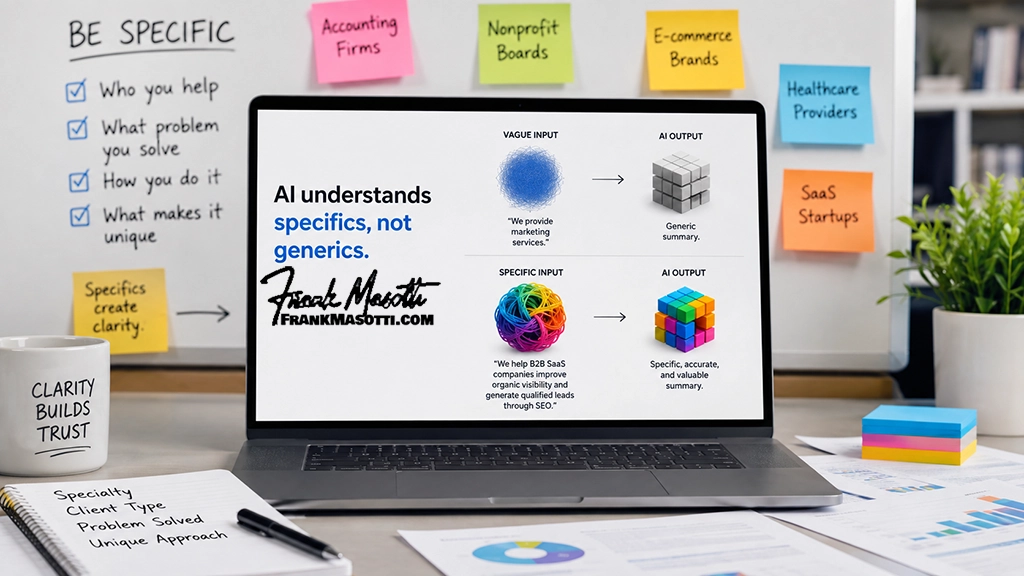
Definitions matter to AI because AI cannot fill in the context that a human automatically supplies when you describe your business in broad terms. When you say “we provide marketing services” or “we offer business consulting,” you know what you actually do. You know your specialty, your client type, the problems you solve, and the boundaries of your work. An AI model reading that description has none of that context. It only has the words you wrote, and broad words produce broad descriptions, no matter how clear those words are grammatically.
That gap between what you know and what an AI can infer from a vague definition is where your business description becomes generic. It is not because the AI is lazy or inaccurate. It is because a vague definition is all the information you gave it to work with.
The Hidden Problem: Vague Sounds Professional
Almost every business owner has learned that professional language means staying at the category level. Too much detail sounds like bragging. Too much specificity makes you sound like you are shouting. Stay broad, stay professional, let the work speak for itself. That logic has been reinforced by a thousand pieces of business advice that rewards underselling.
The problem is that this rule was written for a human reader who already decided to look at your business. A person who visits your website or reads your LinkedIn profile has already chosen to see you. They fill in what matters. They add context. They assume your work is better than your modest description.
An AI model reading your site has no such inclination. It is not trying to find the best interpretation of vague language. It is trying to build a factual summary from what the words literally say. When the words are broad, the summary stays broad.
This problem compounds silently. Nothing about a vague definition looks wrong. A sentence like “we provide digital marketing solutions to midsize businesses” is clear. It is perfectly grammatical. It makes sense. It also describes approximately 15,000 other agencies nationwide. Without additional detail, an AI model has no way to distinguish your business from them.
Why This Stays Invisible to You
You never see this happen because you are not the audience. You are not asking an AI model what it thinks about your vague definition. Your customers are not complaining that ChatGPT described you generically. This confusion happens in conversations you were never part of, between a prospect and an AI assistant that was asked a question about your business.
The prospect asking the question probably phrased it specifically. “Do you know any IT consultants who specialize in accounting firms?” or “Who handles marketing for SaaS startups?” The specificity is in the question. But if your definition is broad, the AI answer will be broad too. You will appear as one option among many generic options, when you might actually be the only one in that room who specializes in accounting firms.
There is also a second reason this stays hidden. Testing an AI model yourself on your own business introduces what you know. You ask ChatGPT “what does my business do” and you read the answer through your own knowledge of what you actually do. You notice where the description is missing something. You correct it mentally. What you are not seeing is what a stranger would see if they asked the same model the same question, arriving with no prior knowledge of your business at all.
The Mechanism: How AI Generalizes From Sparse Language
When an AI model reads your website, it is not storing you as a piece of writing. It is building an entity profile, the way a database would. Your business name is attached to attributes. One of those attributes is “what this business does.” That attribute has to be filled in with something specific enough to distinguish you from other businesses in your category.
If your website uses broad language like “we provide marketing services” or “we offer strategic consulting,” the model has to infer what specifically distinguishes you from other businesses offering the same thing. It can look for patterns. Are there repeated words that suggest a specialty? Do certain client types appear frequently? Is there a problem you mention solving over and over? These details, if they exist, can narrow the picture. This pattern matching is part of how AI understands context, but context built from sparse material is thin context.
But if your site stays at the broad level throughout, there is no specificity for the model to find. It has no choice but to store you as a generically defined business in your category. This is not a failure of the AI. It is the logical conclusion from vague input.
The model is also constrained by what it does not know. You work with a specific client type. Maybe your consulting is exclusively for nonprofit boards, or your marketing is exclusively for e-commerce companies, or your IT services only work with healthcare providers. This specificity is obvious to you. It might even be written somewhere on your website. But if the defining sentence of your specialty is buried on a services page, and the category description is on your homepage and your LinkedIn profile, the model has to weight the sources and the frequency. Vague, repeated language wins out. Specific, buried language stays sparse.
How Vagueness Affects What Prospects Hear
The business consequence is concrete. When a prospect asks an AI assistant about your category of business before they ever reach your website or call you, they get back a generic version of what you do, built from your vague definition. That description does not sound wrong to the prospect. It sounds like you are a competent, professional option in a broad category with many competent, professional options.
If you actually specialize, that specialization is invisible to them. If you only work with certain client types, they do not know that either. If you have developed expertise in a specific problem that requires years to build, none of that has reached the AI description because your definition was too broad to carry it.
This affects more than one conversation. Increasingly, this generic description is the first impression a prospect forms of your business. It happens before they read a review, before they see your portfolio, before they hear anything else about you. If that first impression is built from a vague definition, your business sounds smaller, less specialized, and less valuable than it is.
The Distinction From Related Problems
This is different from consistency, which is the problem of using different words for the same thing. Why Consistent Terminology Matters covers that problem in detail. You could be perfectly consistent and still be vague. “We provide IT support, we offer IT solutions, and we deliver IT services” is consistent. It is also generic and tells a prospect nothing about what you actually specialize in.
It is also different from unclear writing. A sentence can be grammatically clear and still too broad to carry specificity. “We help businesses grow” is clear. It is also true for nearly every business service that exists. This connects to the broader problem of why AI takes your words literally, but in reverse: here the words are clear, just too broad to carry distinction. Clarity is necessary but not sufficient. Specificity is the missing piece.
What a Better Definition Looks Like
The fix is to write your definition the way your best customer would describe you to someone else. Not the way you think sounds professional, but the way someone who actually benefited from your work would explain what you do and who you do it for.
A vague definition like “we provide marketing services” becomes “we build content strategies for B2B SaaS companies with developer audiences.” A generic definition like “we offer IT consulting” becomes “we handle IT infrastructure for multi-location healthcare practices.” A broad definition like “we do business consulting” becomes “we help nonprofit boards transition to new executive directors.”
Each of these specific definitions is still professional. None of them sound like bragging. But each one is also specific enough that an AI model reading it can distinguish this business from others in the same category. More importantly, each one is specific enough that when a prospect asks an AI model about that specialty, they get you, not a generic list.
The language also matters. Your best customers use certain words. They do not call it “IT consulting.” They call it infrastructure management, or network administration, or tech support. They do not say “marketing services.” They say content strategy or social media management or lead generation. Match the language your market actually uses, and your definition starts to carry specificity immediately.
How This Connects to Entity Understanding
The reason definitions matter connects to why AI thinks in entities. Your business is stored in an AI model not as a document, but as an entity with attributes. One of those attributes is your specialty. If that attribute is filled in as “general marketing services,” you are interchangeable with 10,000 other general marketing services businesses. If it is filled in as “B2B SaaS content strategy,” you are one of maybe a few hundred. Specificity is how an entity becomes distinct.
This is also why how AI builds a picture of your business from information across the web matters: every source contributes to that picture. If every source uses vague language, the entity profile stays vague. If sources begin to carry specificity, the profile sharpens.
This is also where the AI Business Understanding Report reveals what is currently stored about you. When three separate AI models describe your business, the language they use shows you exactly how specific or vague your definition has become in their entity profiles. If they all use broad categories, you are seeing the consequence of a vague definition reflected back at you. If they start to carry specificity, you are seeing a definition that is landing.
The Business Consequence
The cost of a vague definition is a generic description arriving at prospects silently, before you have any chance to make a real impression. It is also a lost opportunity to appear as a specialist rather than a generalist, even if you are one.
The fix requires one thing: being willing to define yourself more specifically than you have before, even if that specificity feels narrower than you think your business actually is. Specific definitions work because they carry information. Vague definitions do not carry any information at all.
Order the AI Business Understanding Report to see how your business definition is currently landing with AI. If the description you get back sounds too generic, the definition itself is usually the problem, and specificity is the answer.