
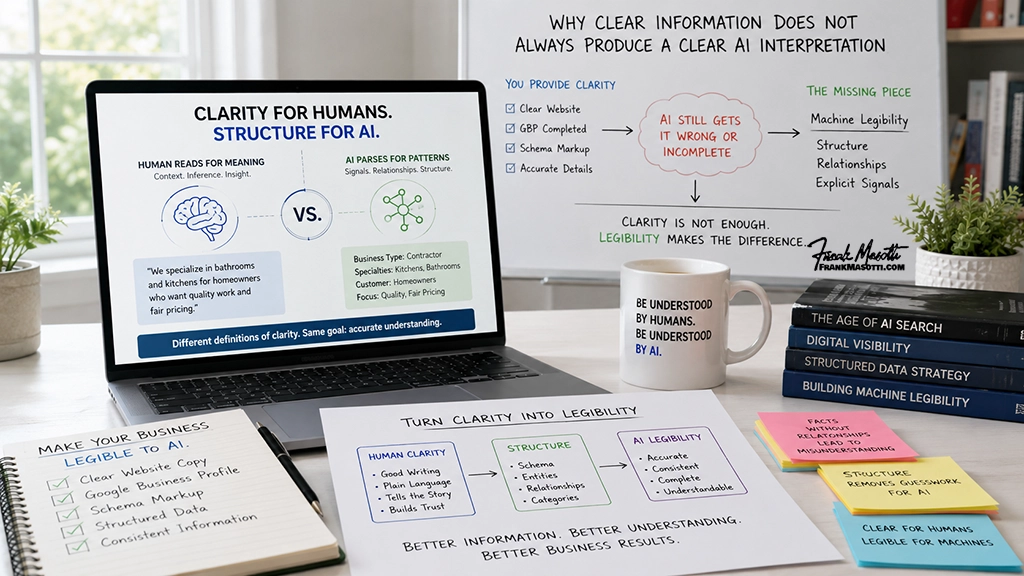
You have clear information about your business. Your website describes what you do, step by step. You have filled out every field on Google Business Profile accurately. You have completed your schema markup. Your business description is direct, unambiguous, factual. And yet when an AI model summarizes your business, it still comes back incomplete or wrong.
The gap is not between clarity and confusion. It is between two different definitions of clarity. What makes information clear to a human reader and what makes it clear to an AI system are not the same problem. Humans read for meaning, context, and inference. AI systems parse for patterns, relationships, and explicit signals. You can have information that is perfectly clear to one and still ambiguous to the other.
This matters because a growing number of your potential customers are asking AI about you before they ask you anything directly.
The Hidden Problem: Clarity Is Not Universal
Most business owners assume clarity is a single thing. If you write accurately about your business, if you use plain language instead of clever phrasing, if you avoid ambiguous sentences, then you have done everything necessary to be understood. You have made your business clear.
That assumption is incomplete. You have made your business clear to humans. That is not the same as making it legible to machines.
Here is a concrete example. A home renovation contractor might write: “We specialize in bathrooms and kitchens for homeowners who want quality work and fair pricing.” A human reader understands instantly. The business is clear: a contractor who does kitchen and bathroom work, positioned as quality focused and competitively priced, serving homeowners.
An AI model reading that sentence can extract the basic facts. But it has to work to find the structure underneath. It has to infer that “we” is a company. It has to recognize that “bathrooms and kitchens” are room types, not some other category. It has to connect “homeowners” to a customer segment, not assume it is a project type. It has to parse “quality work” as a value proposition, not a literal service offering called “quality work.” A human reader does all of this automatically. An AI model has to extract it from patterns.
That extraction usually works. But it often leaves something out, or builds a connection that is slightly wrong. The information is clear to you. The information is readable to AI. But readability and clarity are not the same thing, and the gap between them is where misunderstanding lives. This is the same mechanism that explains why AI can read your website and still not know what your business does, even when the information is available to it.
Why This Gap Stays Invisible
There is no signal that tells you the gap exists. Your website looks fine. Your copy reads well. People who already know your business understand it immediately. There is no broken link, no error message, nothing that feels wrong to you or to your human visitors.
The damage happens somewhere else. When someone asks ChatGPT what you do, when Gemini suggests an alternative, when Claude gives a summary that is close but not quite right. None of that feedback makes its way back to you unless you ask for it directly. Most business owners never ask. They assume that if the information is clear to them, it is clear to everyone, including AI.
This is the trap of familiarity. You already know what your business does. You already have years of context about your positioning, your specialty, your ideal customer. When you read your own website copy, you are not just reading the words. You are reading the words plus everything you already know about yourself. That context layer makes even slightly ambiguous writing feel perfectly clear to you.
AI does not have that context layer. It has only the words on the page. And when those words are written for humans, with human context filling in the gaps, the machine has to bridge those gaps without the context that makes them bridgeable.
The Mechanism: Two Different Kinds of Clarity
To understand why this happens, it helps to see how humans and machines actually organize information differently.
When a human reads that renovation contractor’s description, the brain connects “bathrooms and kitchens” to a mental category that already exists: room types. It automatically understands that these are the kinds of spaces the contractor works in. The brain does this so quickly and effortlessly that you do not notice it is happening. The clarity feels immediate and total.
An AI model does not have pre-built mental categories the way a human does. It has learned patterns from billions of examples of how concepts relate to each other. When it sees “bathrooms and kitchens,” it can usually place these in the correct category. But it gets there through a much more mechanical process. It is looking for patterns, not filling in blanks with context.
This is why structure matters so much more to machines than it does to humans. A human can read a paragraph and extract the business information from it, even if that information is scattered across the paragraph in a narrative order. An AI system does better, often much better, when that same information is stated in a structured format. Not because the structured version is clearer in a literary sense. But because structured data removes the need for inference.
This is also why schema markup exists. Schema is not about making information more human readable. It is the opposite. Schema markup is about stating information in a way that machines can read with near zero ambiguity. It is clarity optimized for a machine instead of clarity optimized for a human.
The business consequence is this: you can have information that is clear for humans and incomplete for machines at the same time. You can have a website that reads perfectly and an AI interpretation that feels flat or generic.
Where the Gap Shows Up in Practice
The gap manifests in several ways, and each one tends to feel isolated when you encounter it.
An AI model might correctly identify that you are a contractor, correctly identify that you do kitchen and bathroom work, and still describe you using generic language like “general contractor” because it could not connect your specialty cleanly enough to a specific category. Your information was clear. The connection was not machine-legible enough.
Or an AI model might accurately extract several facts about your business but miss a key differentiator entirely because that differentiator only ever existed in prose, never in a structured statement. Your business description was clear about it. But the clarity was buried in narrative, where machines are more likely to miss details.
Or different AI models might describe your business differently because they parse the same human-readable information in different ways. One model might weight certain facts differently than another. One might extract a detail another one overlooks. All three are reading the exact same information. But without explicit structure to anchor their reading, they are free to build different interpretations of what they find. This is why two similar businesses can be understood very differently by AI, and why the same business often gets described differently across models.
These are not failures of clarity as you understand it. Your information is clear. These are failures of machine legibility. And they happen because clarity and legibility are different problems.
The Business Consequence
When AI describes your business in a way that is unclear or incomplete, most business owners assume the problem is visibility, or outdated sources, or that AI simply does not understand their niche yet. Sometimes those things are true. But very often the real problem is this: you have clarity, but you do not have machine legibility.
Machine legibility means AI can extract not just the facts about your business, but the relationships between those facts. It means AI can see that you specialize in kitchens and bathrooms, not just that kitchens and bathrooms are mentioned on your site. It means AI can distinguish between your core services and your secondary offerings. It means AI can connect your business name to your actual business reliably, across multiple questions and multiple models.
Those connections are easier to build when information is structured than when it is written as prose, no matter how clear that prose is.
This is also why having a clear website and ranking well on Google do not automatically guarantee clear AI understanding. Google can extract facts from narrative copy. AI models can too. But both are doing inferential work that structured data would make unnecessary. The difference is that Google has gotten extremely good at that inferential work after twenty five years of parsing websites. AI models are still in the early stages of learning the patterns that make inference reliable. This is why a business can rank well on Google and still be misunderstood by AI, because search ranking and AI understanding are two different tasks that require different signals.
Where Schema and Structured Data Fit
This is the specific problem that schema markup and structured data solve. Schema is a way of stating what your business is, what it does, where it is located, who owns it, what it specializes in. Not in a way optimized for human reading. In a way optimized for machines to extract and connect those relationships without ambiguity. As explained in how schema changes what AI knows about your business, structured data removes the interpretive work and replaces it with explicit statements.
This does not mean plain language clarity becomes unimportant. It does mean clarity on its own is not enough. You need both: clarity for the human reader, and structure for the machine reader.
Your website serves both audiences now. The human reads for meaning. The machine reads for patterns and relationships. Giving both audiences what they need is how you move from “clear” to “legible.”
And this is exactly what makes the AI Business Understanding Report valuable. It shows you not just what AI thinks your business is, but where the thinking is clear and where it is incomplete. You can see where the machine found solid information and where it was inferring or guessing. That visibility is how you know where to add structure, where to clarify further, and where to adjust not just your writing but the way your information is organized. Understanding how AI builds its picture of your business from information across the web is essential context for knowing where to focus your effort.
A Plain Restatement
Clarity and legibility sound like the same thing. They are not. You can be clear about your business in a way that is perfectly accessible to humans and still require machines to do work you could have saved them. They can usually do that work successfully. But they also often arrive at slightly incomplete or slightly wrong answers in the process. A business owner who assumes clarity is enough is leaving that gap in place. The business owner who also addresses legibility is the one whose AI interpretation will actually match their reality.
The difference between the two is the difference between being understood by one audience and being understood by all of them.
Want to see exactly where your AI interpretation is clear and where it is incomplete? The AI Business Understanding Report analyzes what ChatGPT, Claude, and Gemini actually understand about your business right now. You can order your report here.