
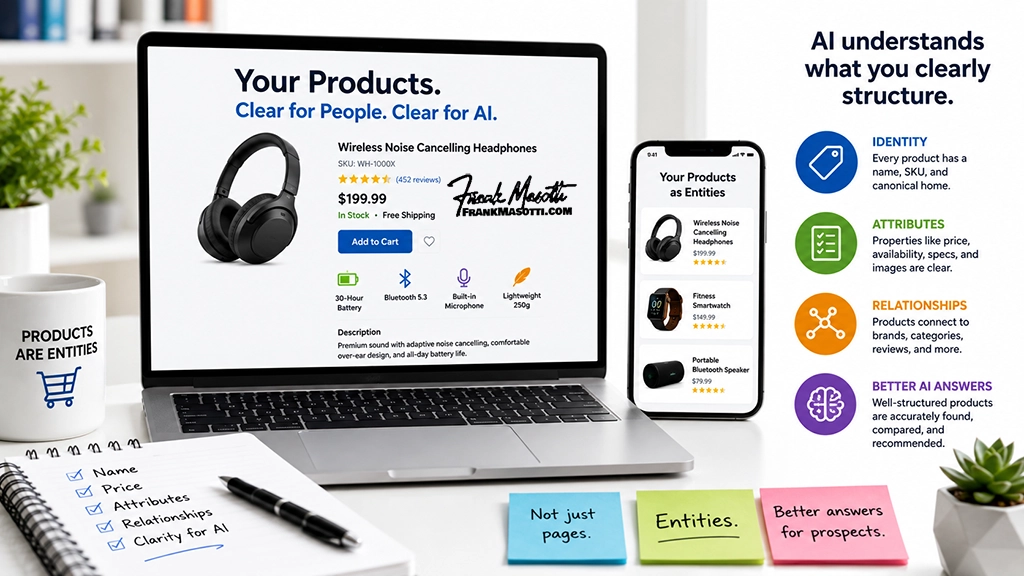
If your business sells products, you probably think of them as product pages on your website. Information about what they are, what they cost, what they do, how to buy them. That is how humans navigate your site.
AI does not think in pages. It thinks in entities. Your business is an entity. People are entities. Your products are also entities, and they deserve the same structural clarity you give to your business name or your location. When products are treated as distinct entities with their own attributes, AI can catalog them, compare them, and describe them to prospects accurately. When they are just content buried on pages, AI struggles to tell one from another or to understand what makes them distinct.
This matters because increasingly, prospects ask AI about products before they click through to your website. If your products are not clearly defined as separate entities, that AI answer will be generic, incomplete, or confuse one product with another.
The Hidden Problem: Products Without Entity Structure
Most businesses publish detailed product pages. Specifications, pricing, images, descriptions, customer testimonials. Every detail a buyer would want is there.
From a human perspective, that is sufficient. A person visiting your site knows which product they are looking at. They see the page title, the price, the photos. Context is obvious.
An AI model reading that same page does not start with the assumption that a distinct product exists on this particular page. It has to infer that from the structure of your content. Is this a product page or a service description? Is this one product or a variant of another product? Are these three pages describing three products or three reviews of one product?
Without structured data stating plainly that a product is a product, with a specific name, price, availability, and set of attributes, the model has to make these distinctions from context alone. This is where why AI thinks in entities becomes practical rather than theoretical. A business built on the sale of distinct products needs those products understood as distinct entities.
This problem compounds silently for multi-product businesses. A business with ten products may appear to AI as offering one product in ten variations, or variations of a category with no clear differentiation. Or all the products may blur together so that when a prospect asks about a specific one, the model gives a description that could fit any of them.
Why This Stays Invisible Until It Matters
You do not see this happen on your own website. Your product pages look clear to you because you know what each one is. When you ask an AI model about your products, you read the answer knowing which products you sell, so you notice what it misses.
A stranger asking an AI model about your product line arrives with no such knowledge. They take the AI answer at face value. If that answer treats your three distinct products as variants of one thing, or omits key details about one of them, or conflates two products that are actually different, the stranger does not notice. They only notice if something in the answer contradicts what they expected, or if the AI leaves out something they were specifically looking for.
This is also connected to how AI builds a picture of your business from information across the web. Information about your products comes from your own site, from review platforms, from retailer listings, from social media. Without entity structure on your own site stating what a product is, the model has to stitch together a picture from scattered external mentions. That picture is often less clear than it would be if you had stated it plainly yourself.
What Products Actually Are as Entities
What is an entity and why AI cares explains the framework. An entity is something with distinct identity, attributes, and relationships. A product fits that definition exactly.
A product has identity. It has a name. It has an SKU or a product code. It has a canonical home on your website. Multiple mentions of the same product elsewhere should connect back to that canonical version.
A product has attributes. Price. Description. Availability. Dimensions or specifications. Color, size, or other variants. An image or images. A weight. A category it belongs to. A manufacturer or brand. These are not prose descriptions. They are properties that can be extracted and compared.
A product has relationships. It is made by your company. It is reviewed by customers who have attributes and histories. It is sold on platforms that are separate entities. It belongs to a product category that other products also belong to. It may have related products or complementary products. These relationships are how AI understands context.
Product Schema: How to State a Product as an Entity
Without structure, a product is just a paragraph on a page. Product schema is how you tell an AI model that this page is not just prose about a product, but is actually describing a product as an entity.
Schema.org provides types for this. A Product type states that this entity is a product, with properties for name, description, image, brand, manufacturer, and a host of others. An Offer type states that a product is available for purchase, with a price and availability. An AggregateOffer type handles variants and multiple prices. An AggregateRating type lets you state star ratings and review counts.
More importantly, these types have properties that let you structure attributes AI cares about:
Identity and category. Name and description of the product, plus category and brand. These are the properties that let AI distinguish this product from others.
Availability and price. Whether the product is in stock, whether it is available for order, and what it costs. This is information a prospect frequently asks about. Structured price and availability means AI can answer “is this in stock?” directly rather than guessing from prose.
Details and specifications. Dimensions, weight, materials, color, size options. Attributes that buyers compare products on. Structured means the details can be extracted and compared rather than left embedded in product description text.
Reviews and ratings. The number of reviews a product has received and the average rating. This is information AI pulls from multiple sources, but your own markup lets you state your own current picture directly.
Relationships. The manufacturer or brand. Whether it is part of a bundle or collection. Related or complementary products. These connections are how AI understands a product in context.
Multi-Product Businesses: The Largest Problem
The problem surfaces fastest for businesses with multiple products.
A single product business can often get by without perfect entity structure. A prospect asks about the product, and even if the answer is generic, there is only one product to describe. Clarity is not hard to achieve by accident.
A multi-product business cannot rely on accident. When you have five products, ten products, or a hundred products, each one needs to be structurally distinct in a way that AI can recognize and catalog. Without that distinction, all those separate products may collapse into one offering in an AI description.
This is where yes business names are entities extends into product territory. Just as your business name needs distinct identity separate from other businesses, each of your products needs distinct identity separate from your other products.
A marketing software company with three distinct tiers may be described by AI as “offering marketing software” generically if the tiers are not clearly marked as separate products. A clothing brand with ten SKUs may appear to offer one garment in ten variants if the products are not listed as distinct entities. A SaaS company with three separate tools may seem to offer one tool with extra features if the products are not clearly separated in structure.
What Product Schema Cannot Do
Product schema cannot make an inferior product sound better than it is. It cannot establish expertise or authority. Those things come from reviews, from reputation, from what other sources say about the product.
Product schema also cannot change the fundamental truth about your products. If you have ten products but do not mention one of them anywhere on your website, schema cannot conjure it into existence. Structured data works with content you already have. It organizes and clarifies that content, it does not invent new content.
And like all schema, schema stops at the edge of your website. Your markup states your truth about your products. A retailer site, a review platform, an old listing somewhere else may state something different. AI encounters all of them and has to decide which to trust. Your own markup is authoritative for your own site, but it does not override external sources.
The Business Consequence
The cost of not treating products as entities is the same as the cost of not treating your business as an entity. It is an absence.
A prospect asks AI about your product and gets a generic answer that could describe any product in your category. They do not learn that your product has specific features, specific pricing, specific availability. They do not learn that you have multiple distinct products because all of them blur together in the description. They see you as a smaller, less differentiated seller than you actually are.
When prospects are increasingly turning to AI for product discovery before they visit your website, that generic answer is the first impression you make. It matters because it happens before they reach you.
Where the AI Business Understanding Report Fits
A product schema validator can confirm your markup follows the specification. It cannot tell you whether ChatGPT, Claude, and Gemini now catalog your products distinctly, whether they accurately state your pricing and availability, whether a prospect asking about your product line learns that you have multiple distinct offerings.
That is what the AI Business Understanding Report answers. It examines what each of the three major models currently understands about your business, including your product line. If all three accurately describe your products as distinct entities with accurate details, your product schema is doing its job. If they blur your products together, or omit pricing information, or describe your product line generically, you now know what needs to be clarified in the structured data.
For businesses built on the sale of products, this is increasingly not optional information to check. Prospects are asking AI about your products. What you do not structure, you leave to chance.
A Simpler Way to Think About It
Treat your products the way you treat your business. Your business is not just a company. It is an entity with identity, attributes, and relationships. Your products are not just product pages. They are entities too, and they deserve the same structural clarity.
If you have never checked what AI currently understands about your product line, there is no way to know whether product schema would make a difference. But if you sell multiple products, or if product details matter to your sales conversation, it almost certainly would.
Order the AI Business Understanding Report to see how AI currently describes your product line. If the description is generic or blurs your products together, product schema is usually part of the fix.