
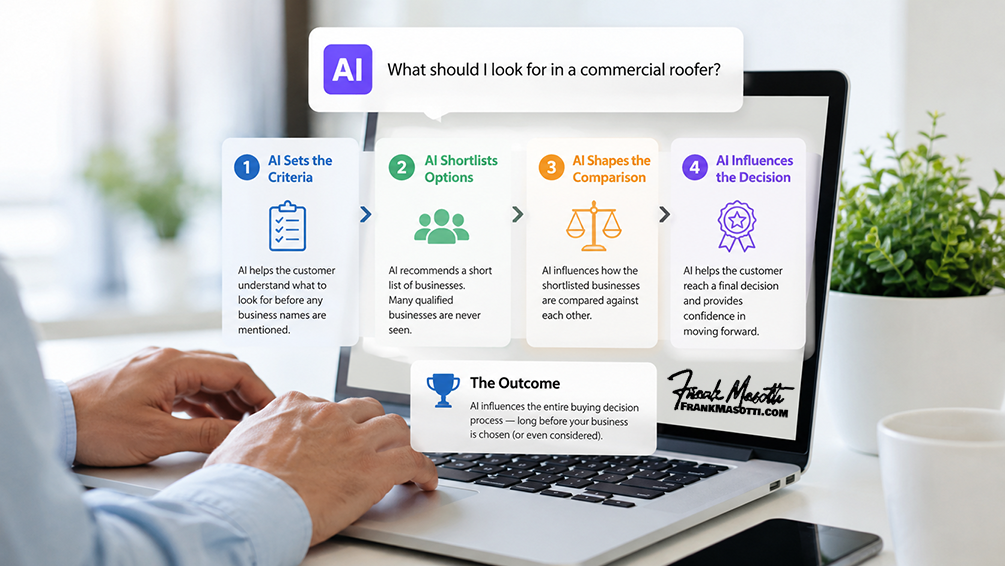
When business owners think about AI and customer decisions, they usually think about one moment: whether AI mentions their business when a customer asks for options. That moment is real, but it is only one point of contact, and it is not the earliest one.
A real buying decision has a structure. The customer works out what to look for, assembles a short list of candidates, compares those candidates against each other, and arrives at a verdict. Those are four separate steps, and AI now participates in all four. Your business is only named in the last two. By the time your name comes up, the standard you are being measured against and the field you are being measured within have already been set by a conversation you were not part of.
That is the direct answer to the question in the title. AI is not just describing your business to customers. It is shaping the framework the customer uses to evaluate you, and a framework built without you is a harder thing to notice than a wrong fact.
What a Buying Decision Used to Require
It is worth remembering how much work a customer used to do themselves.
Someone needed a service. They searched, and got a page of results. They opened several sites, formed their own impressions, checked reviews, asked a friend, and gradually decided which businesses deserved a phone call. The customer assembled their own criteria along the way, often revising them as they learned. Elimination was gradual, and it was reversible. A business ruled out on page one could come back into consideration two clicks later.
That process was slow, which was its main flaw and also its quiet advantage. Slow processes give a business several chances to make its case. A single confusing description did not end anything, because ten more inputs were coming.
AI compresses that entire sequence into a conversation. The compression is why customers like it. It is also why a single misunderstanding now carries far more weight than it used to, because there are fewer inputs left to correct it.
Stage One: AI Supplies the Criteria Before You Are Ever Named
This is the stage almost nobody accounts for, and it happens before your business enters the conversation at all.
Customers do not only ask AI for names. They ask AI how to think about the purchase. What should I look for in a commercial roofer. What questions should I ask before hiring a bookkeeper. How do I know if a firm is any good at this. Those questions get answered with a checklist: certifications to verify, warranty terms to ask about, red flags to watch for, questions to raise on the first call.
That checklist becomes the customer’s evaluation standard. It is what they carry into every conversation that follows, including yours.
Now consider what that means for a business whose real advantage sits outside the checklist. Perhaps your value is that you handle a particular kind of complicated job nobody else in your market will touch. Perhaps it is that your work is supervised by someone with twenty years in a specialty. If the criteria AI supplied never mention those things, they do not count against you exactly. They simply do not register. The customer is holding a scorecard with your best column missing.
This is a different failure from being described incorrectly. Everything AI said about your business can be accurate and the decision still goes elsewhere, because the standard was written for a generic version of your category. It connects directly to how AI decides what your business is known for, since the same accumulated evidence that shapes your description also shapes what AI thinks matters in your category at all.
Stage Two: The Short List Arrives Already Narrowed
Next the customer asks for options, and AI names three or four businesses.
Notice what is missing from that answer. There is no page two. There is no indication of how many businesses were considered and set aside, or why. The customer receives a short list that reads as a complete answer rather than as a selection, because nothing in the format signals that a selection took place. A page of search results at least looked like a page of results, with more below and more after that. A list of three names looks like the field.
Whether you appear on that list depends on whether AI holds a clear enough picture of your business to match it to the request. If the model has you filed under a broad category label, or recognizes your business but misunderstands its specialty, you are absent from exactly the requests you should win. The same goes for conflicting business categories, where the model has to pick one bucket for you and may pick the wrong one.
And absence at this stage is total. You are not ranked low. You are not there.
Stage Three: Comparison Against a Field You Cannot See
If you make the list, the next question is usually comparative. Which of these would be best for my situation. Compare these three for me.
At this point your business is being weighed against specific competitors, using the criteria from stage one, on the basis of whatever description AI holds for each company. Two firms with nearly identical capabilities can land very differently here, which is the mechanism behind why two similar businesses can be understood very differently by AI. The deciding factor is often not who is better at the work. It is who the model can describe with specificity, because a specific description gives the model something to match against the customer’s stated need and a vague one does not.
That is the practical meaning of being visible to AI is not the same as being understood by AI, and it is the honest answer to the question I hear most often, which I address in why does AI recommend my competitors but not me.
Stage Four: The Verdict, Which Rarely Sounds Like a Rejection
The last step is the customer asking whether to proceed. Owners imagine the bad outcome here is AI saying something damaging. It almost never does.
The bad outcome is a shrug. A description that places you in the general middle of your category, followed by a suggestion to get a few quotes. Nothing in it is false, nothing is insulting, and it ends the decision anyway. Those hedges are one of the clearer tells covered in what AI uncertainty looks like when it describes a business.
The reverse is just as costly. The model holds a strong but outdated pattern and answers with total assurance about work you stopped doing three years ago. Tone gives the customer no warning either way, which is the problem in why AI sometimes sounds certain when its understanding is incomplete.
Four Stages, Zero Signals
Add the four together and the picture is uncomfortable. Your business can be filtered out at the criteria stage, omitted at the short list stage, outcompared at the comparison stage, or shrugged off at the verdict stage. Each one produces the same result on your end: nothing. No bounce, no abandoned form, no complaint, no bad review to respond to. Customers are asking AI about businesses before they visit their websites in growing numbers, and your prospect may ask AI about you before contacting you without ever becoming a data point you can see.
It also is not one decision process but several running in parallel, because all AI models do not know the same things, and the same business gets described differently depending on how the question is asked. A clean answer from one model, on one phrasing, on one day, tells you very little. That is the trap in one AI question cannot show you how AI understands your business.
Seeing the Decision You Are Not Part Of
You cannot influence a decision process you have never observed, and you cannot observe this one from inside your own business. Your website tells you what you meant to say. Your analytics tell you about the customers who arrived, not the ones who were filtered out before your systems could count them.
That is what the AI Business Understanding Report documents. I question ChatGPT, Claude, and Gemini about your business from multiple angles, including the category questions, the recommendation questions, and the comparison questions a real customer would ask on the way to a decision. I record what each model believes you do, who it thinks you serve, which competitors it raises next to you, and where its picture has drifted from the business that actually exists. Then I write it down in plain language, by hand, one business at a time.
Customers are making decisions about your business in conversations you will never hear. Ordering a report is how you find out what those conversations are telling them.