
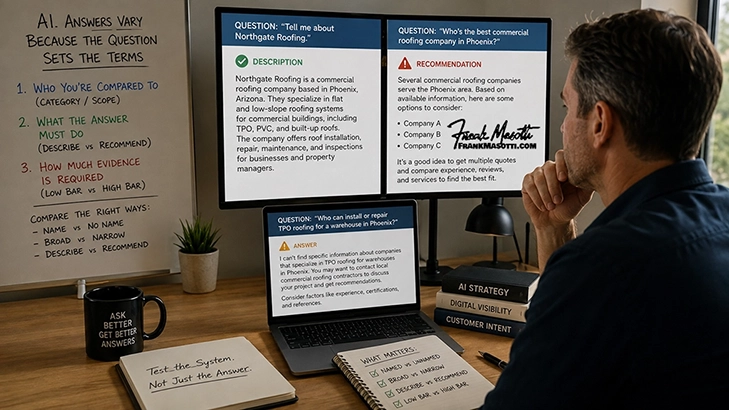
You asked ChatGPT about your company on Monday and got back a description you were pleased with. You asked again on Thursday, worded a little differently, and got something thinner, vaguer, or aimed at a version of your business you barely recognize. Nothing about your company changed in between.
Here is the direct answer to what happened. A question is not a lookup key. It is a set of instructions, and it decides three things before any information about your business is consulted: which group of businesses yours has to be found in, what job the answer is supposed to do, and how much evidence is required before a claim can be made. Change any one of those and the same stored information produces a different description. Both answers can be honest. They were answering different questions.
That matters more than it first appears, because the question you type about your own business is almost never the question your customer types. Yours names the company, assumes the category, and asks for a summary. Theirs names a problem and asks who can solve it. Those are not two phrasings of one test. They are two different tests, and passing the first tells you very little about the second.
A Question Is Not a Lookup. It Is a Set of Instructions
It helps to stop picturing a filing cabinet. There is no stored paragraph about your business waiting to be printed on request. The model assembles an answer that satisfies the specific request in front of it, and the request carries constraints with it: how wide the scope is, what the answer is being used for, what it is being measured against, and how confident the language is allowed to be. Facts about your company are raw material passed through those constraints.
Ask a longtime employee what the company does and you get a general description. Ask that same employee whether a particular prospect should hire you for a particular project and you get something narrower, more hedged, and full of qualifications the first answer never mentioned. Same person, same knowledge, two different answers, and nobody would call that employee unreliable.
So the mistake is treating variation between AI answers as a defect. Most of it is not. It is the system doing what each question asked, and the differences between those answers carry information no single answer can give you.
Naming Your Business Skips the Hardest Part of the Test
Start with the most common way owners test themselves. You type the company name and ask what it does.
That question has already done the hardest work for the model. Naming the business resolves the entity. The system no longer has to determine which company you mean or whether you belong in a given category, because you handed it the subject and asked only for elaboration. What comes back tests recall, not retrieval.
Now consider what a prospect actually types. They do not know your name yet. They describe a need and a place and ask who handles it. For your business to appear, it has to be pulled out of a category on the strength of what has been written about it, which is a completely different operation. This is the practical gap between being visible to AI and being understood by AI, and it is where most businesses quietly fail while their named test comes back clean.
A company can pass every named question and never surface in a single unnamed one. Nothing in the named answer warns you about this, because the named answer was never testing it. It is also the underlying reason behind the question why AI recommends my competitors but not me.
The Question Decides Who You Are Being Compared To
Every question that asks for a business builds a candidate set first, and that set determines how your facts read.
Ask for the best marketing agency in a metropolitan area and the model assembles a large, crowded field. Your firm, if it appears at all, appears as one of many, described in whatever terms the whole group shares. Ask instead for an agency that helps industrial manufacturers write technical documentation and the field collapses to a handful. The same facts about your company that read as generic in the first set read as specialized in the second.
You are never described in isolation. You are described relative to the group the question assembled. Which groups you can even enter depends on the qualifying language attached to your business across the web, and that language is exactly what tends to get cut in the name of clean copy, a tradeoff covered in why shorter is not always better. It also explains why the association a model leads with can feel off even when every fact is right, a mechanism laid out in how AI decides what your business is known for.
Describing You and Recommending You Require Different Evidence
The third variable is the one owners notice last. Different tasks carry different standards of proof.
Describing a business is a low bar. The claim only has to exist somewhere credible enough to repeat. Recommending a business is a higher bar, because a recommendation is an implicit endorsement, and the language shifts accordingly. Recency matters more. Corroboration matters more. Whether the specific claim can be traced to something independent matters more.
The result is that a model will state things in a description that it will not stand behind in a recommendation. Ask what your company does and you may get a confident paragraph. Ask whether someone should hire you for a specific job and the same system may hedge, list what it does not know, or suggest getting other quotes. That hedge is a finding. It is telling you which parts of your record are solid enough to be repeated but too thin to be relied on.
Owners who only ask the describing question never see the hedge, and so never learn that the gap exists. This is closely related to why a model can recognize a business and still misunderstand its specialty, and why AI often sounds certain when its understanding is incomplete.
Your Own Question May Be Supplying the Answer
There is one more issue, and it is the most common flaw in self testing.
Consider what most owners actually type. Something like: tell me about Northgate Roofing, the commercial roofing company in Phoenix. That question hands over the category and the location, and then grades the model on whether it repeats them back. It almost always does. The test looks like a pass and proves nothing, because the two facts you were most anxious about were supplied by you.
The cleaner version is to ask the name alone with no descriptors, then ask the need with no name, and compare. If the first produces a solid answer and the second never mentions you, you have found something specific and fixable. That is the same reason asking ChatGPT yourself is a starting point rather than an answer.
Some of the Variation Really Is Noise
It is worth being honest about the part that is not systematic. These systems produce different wording on repeated questions, and phrasing sometimes shifts an answer for reasons no one can trace. Some variance is genuine randomness.
But randomness does not explain a change that reappears every time you widen the scope, drop the name, or ask for a recommendation instead of a summary. To tell the two apart, ask the same question twice, then ask a differently framed question once, and see which differences hold. Differences that survive that test are structural. That is the practical form of the point that one AI question cannot show you how AI understands your business, and the variance compounds across systems, because all AI models do not know the same things.
The Cost Is Passing the Easiest Version of the Test
Put the three variables together and the pattern is hard to miss. The question owners ask is named, broad, and asks only for a description, which makes it the easiest question in the set on all three counts. The question customers ask is unnamed, narrowed by a specific need, and framed as a decision. It is the hardest.
So the owner concludes things are fine and stops looking, while the harder question keeps getting asked by people who never identify themselves. That failure produces no visible signal. There is no bounce rate for an answer you were left out of. The only symptom is that certain inquiries stop arriving, and nothing in your analytics explains why.
Where the AI Business Understanding Report Fits
You cannot correct a pattern you have only seen one angle of.
The AI Business Understanding Report exists because the useful information lives in the differences between answers, not inside any single one. I ask a structured set of questions that deliberately varies all three of the things this post describes: named and unnamed, narrow and broad, describing and recommending. I ask them across ChatGPT, Claude, and Gemini, for the reason explained in why three AI models, and I write down what each one says so the differences can be read side by side. The deliverable itself is described in what you are actually buying, and the comparative logic behind it is covered in what agreement between ChatGPT, Claude and Gemini can tell you.
The Short Version
AI describes your business differently depending on the question because the question sets the terms before your information is ever reached. It decides which businesses yours is being sorted among, what the answer has to accomplish, and how much proof is required to say it. The version you type is the easy one. The version that decides whether a prospect hears about you is not.
You can find out how your business holds up when the question gets harder. Order your AI Business Understanding Report here.