
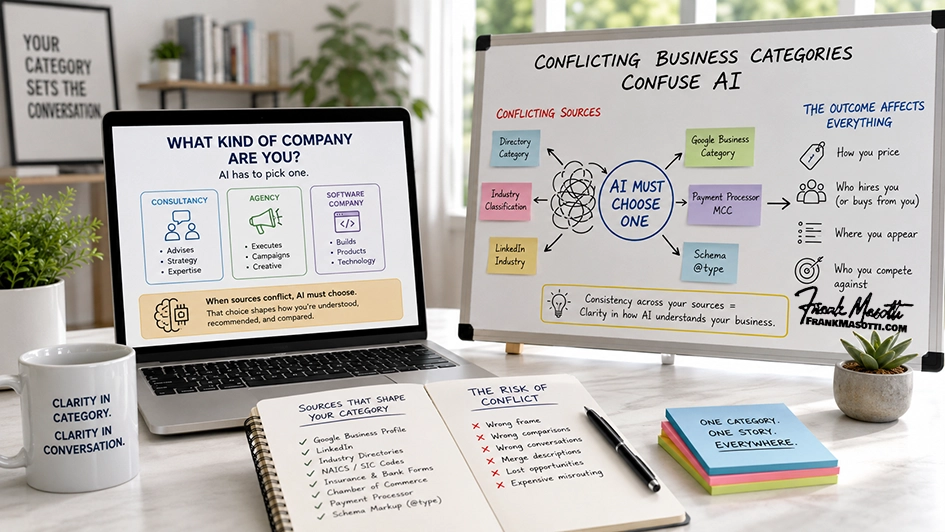
Conflicting categories confuse AI because category is the one thing about your business that can only hold a single value. You can offer eleven services and AI will hold all eleven. You can have four locations and it will hold four. But when it comes to what kind of company you are, the model has to land on one answer, and if your sources disagree, something has to lose.
That decision then quietly governs everything else. Once a model has typed you as an agency rather than a consultancy, or a supplier rather than a manufacturer, it does not just carry that word forward. It carries the assumptions that come attached to the word. How you price. How big you probably are. Whether someone hires you or buys from you. Whether you belong in a list of vendors or a list of advisors.
So a wrong category is not one wrong fact sitting alongside the correct ones. It is a wrong frame applied to all of them.
Category Is the Only Field Where Conflict Cannot Be Averaged
When AI encounters disagreement about most details, it has soft options. It can hedge. It can include both. It can retreat to something general enough that the disagreement stops mattering. I have written about those resolution patterns and what happens when AI finds conflicting information about a business more broadly.
Category does not offer those options in the same way. Models organize businesses as entities, and every entity carries a type. That is not a stylistic choice in the answer. It is structural, and why AI thinks in entities covers the mechanism behind it. An entity with no type is not usable. An entity with two competing types is not usable either.
So the model resolves it. It weighs how often each category appears, how established each source looks, and how well each label fits the surrounding language. Then it picks one and writes as though there was never a question.
You will not see that decision happen. You will only see the finished sentence.
Your Categories Were Mostly Decided by Dropdown Menus
Here is the part almost nobody accounts for. The most authoritative statements about your category are usually not on your website. They are in forms.
Think about how many times your business has been forced to pick a category from someone else’s list. The primary category on your Google Business Profile. The industry field on LinkedIn. The classification on your Yelp or industry directory listing. The NAICS or SIC code on your business registration, your insurance application, and your bank paperwork. The chamber of commerce listing. The category your payment processor assigned you. The @type value in your schema markup, if anyone ever set that up.
Every one of those is a single forced choice from a fixed menu. Most were made once, quickly, by whoever happened to be setting up that account, using whichever option seemed closest. Nobody treated it as a content decision, because it did not feel like writing. It felt like paperwork.
But these are structured, machine readable, repeated statements about what kind of company you are, and they carry real weight. Your website says what you do in prose, which a model has to interpret. A directory category says what you are in a field designed to be read literally. When the two disagree, the prose does not automatically win.
This is also why fixing your homepage does not always fix the problem. Schema stops at the edge of your website makes the same point about structured data generally. You control the clearest statement of your category. You do not control the most repeated one.
The Merge Outcome Is the One Worth Watching
When categories conflict, the outcome people expect is that AI picks the wrong one. That happens, and at least it is visible once you look.
The stranger outcome is the merge. Faced with sources calling you a consultancy, an agency, and a software company, a model may produce a description that combines all three into something no source actually claims. A consulting agency offering software driven marketing solutions. Read it quickly and it sounds like a real company.
Read it as a buyer and it is nothing. It does not match how anyone searches. A prospect looking for a consultant does not recognize themselves in it. A prospect looking for software does not either. The description is not false and not useful, which is a hard combination to spot in your own copy.
Misrouting Costs More Than Being Missed
The usual worry is disappearing from the answer. Category conflict can do something more expensive than that. It can put you in the wrong conversation.
If a model types a specialized consultancy as an agency, it will surface that firm when someone asks for agencies. It gets included. It also gets compared against agencies, on agency terms, and it looks small, expensive, and oddly narrow next to firms it was never competing with. Meanwhile it is absent from the list of consultancies where it would have been the obvious answer.
Nothing about that reads as an error. The name is right. The city is right. The services are broadly right. Only the frame is wrong, and the frame is what decides which question you get returned for. This sits underneath the question of why AI recommends your competitors but not you, and it is why I treat category confusion as the most common and most expensive misreading I find.
It is also a slower version of what happens after a repositioning, since rebranding creates confusion for AI by leaving two categories in circulation at once.
Why the Obvious Test Does Not Settle It
The natural check is to ask ChatGPT what kind of company you are. Worth doing, but it answers a question no buyer asks. Naming your company in the prompt hands the model the entity and lets it read from your strongest sources. The buyer never names you at all. They describe a need and ask who fits.
The revealing questions are indirect. Is this company a good fit for a business that needs X. Who would you compare them to. What would working with them typically involve. Those force the model to spend its category assumptions rather than just report a label, and that is where a wrong type shows itself.
The other reason one test does not settle it is that the three models do not resolve conflicts the same way. One may follow your site, one may follow the most repeated directory listing, one may hedge. You can end up with three companies carrying your name, each in a different category, each described with complete confidence.
Where the AI Business Understanding Report Fits
This is exactly what the report is built to surface. I ask ChatGPT, Claude, and Gemini a structured set of questions about your business, including the indirect ones a buyer would actually ask, and then compare the answers against each other.
What comes back is which category each model settled on, whether they agree, which assumptions each one inherited from that category, and where those assumptions are quietly distorting how you get described and recommended. Where the models disagree, that disagreement usually points straight at the conflicting source. How the report works covers the process in detail.
Category is a strange thing to get wrong, because it is rarely the result of bad information. It is usually the accumulated residue of a dozen small, reasonable, unrelated choices made on forms nobody remembers filling out. Consistency across your own sources is what fixes it, and why consistent terminology matters covers the writing side of the same problem.
But you cannot make your sources agree until you know which one the models are listening to.
If you want to find out what kind of company ChatGPT, Claude, and Gemini currently think you are, order the AI Business Understanding Report.