
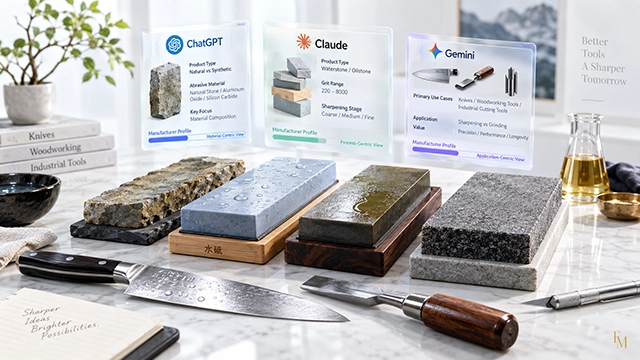
AI Search Engine Audit for Whetstone Manufacturers
A whetstone manufacturer can make an excellent sharpening product and still have no idea whether ChatGPT, Claude, and Gemini understand what makes that product different from hundreds of other sharpening stones.
Does AI understand whether your company manufactures natural stones, synthetic stones, benchstones, waterstones, oilstones, or products intended for particular sharpening applications? Does it recognize the abrasive materials you use, the grit ranges you manufacture, and the types of cutting tools your stones are designed to sharpen?
Or does AI reduce the entire company to something vague like “a manufacturer of sharpening stones”?
The Frank Masotti AI Business Understanding Report is a $495 manual analysis that examines what ChatGPT, Claude, and Gemini currently understand about your company and where their interpretations differ.
For a whetstone manufacturer, those differences can matter because the product category may look simple until someone actually needs the right stone for a particular sharpening job.
What Does AI Understand About Your Whetstone Manufacturing Business?
A useful AI search engine audit for a whetstone manufacturer needs to go much further than determining whether an artificial intelligence search engine recognizes the company name.
The real question is what the models believe the company actually manufactures.
A manufacturer might produce stones intended for knives, woodworking tools, industrial cutting tools, machine shops, agricultural tools, or other sharpening applications. Another manufacturer may concentrate on professional sharpening systems or a narrow abrasive technology.
Those differences affect whether the company belongs in a particular AI recommendation.
If someone asks an AI system for a manufacturer of sharpening stones suitable for woodworking tools, a general description of your company as an “abrasives manufacturer” may not be enough.
If someone asks about a manufacturer of synthetic waterstones and AI associates your company primarily with oilstones, the company may be understood accurately at the broadest level while being wrong for the actual question being asked.
That distinction is exactly what the analysis is intended to uncover.
Does AI Understand What Kind of Whetstones You Manufacture?
“Whetstone” is not a single product specification.
Different products can vary by abrasive material, grit, hardness, density, porosity, bonding system, size, shape, sharpening speed, finish, and intended use.
The distinction between natural and manufactured stones can matter.
So can the difference between stones intended for use with oil and stones designed for use with water.
A manufacturer using aluminum oxide may occupy a different part of a customer’s consideration process from one manufacturing silicon carbide stones. Some companies may produce several types.
The important question for the manufacturer is not whether these distinctions exist on its own website.
It is whether ChatGPT, Gemini, and Claude associate the correct distinctions with the company when answering AI searches.
One model may recognize the product range correctly.
Another may mention only a portion of it.
A third may know the company makes whetstones without understanding enough about the products to recommend the manufacturer for a specific requirement.
Can AI Distinguish Sharpening From Grinding?
This is particularly important for a whetstone manufacturer because the company may sit within the broader abrasive products industry.
AI can encounter terminology involving grinding wheels, abrasive grains, polishing products, honing products, sharpening stones, and other abrasive materials while trying to understand the manufacturer.
Those terms are related.
They are not interchangeable.
A manufacturer that primarily produces whetstones should not automatically be interpreted as a general grinding wheel manufacturer simply because both businesses operate within the abrasive products industry.
The reverse problem can also occur. A diversified abrasive manufacturer might produce whetstones as only one product line, while an AI model gives the stones disproportionate importance when describing the company.
An AI audit can show whether the models understand where whetstones actually fit within the company’s product mix.
Does AI Understand Grit and Sharpening Application?
Customers choosing sharpening stones often care about what the stone will actually do to an edge.
A coarse stone used for repairing or establishing an edge serves a different purpose from a fine stone used for refining or polishing one.
A manufacturer may therefore offer multiple grit ranges or sharpening stages rather than one interchangeable product.
That creates another interpretation problem.
AI might recognize that a company manufactures whetstones without understanding whether its products cover aggressive material removal, routine sharpening, fine honing, finishing, or several stages of the process.
The model could also associate the manufacturer primarily with kitchen knives when the company’s products are used much more broadly.
For a whetstone manufacturer, understanding the product category without understanding the application can still produce a poor representation of the business.
What Attributes Does AI Associate With the Manufacturer?
The report also looks beyond simple product recognition.
ChatGPT, Claude, and Gemini can associate attributes with a company based on the information they have encountered.
For a whetstone manufacturer, those attributes might involve product specialization, abrasive technology, professional versus consumer use, traditional versus synthetic materials, product breadth, durability, precision, or the markets the manufacturer appears to serve.
The important part is discovering which attributes the models actually associate with your company rather than assuming they see the business the same way you do.
Some associations may be accurate.
Some may be incomplete.
Some may be outdated.
And the three models may not agree.
That disagreement can be useful because it shows where your company’s AI identity is stable and where the interpretation changes depending on which system a potential customer happens to use.
Would AI Recommend Your Company for the Right Sharpening Need?
Recognition and recommendation are different questions.
ChatGPT might know that your company exists while failing to include it when someone asks for a manufacturer appropriate for a specific sharpening application.
Gemini might recommend the company in one context but not another.
Claude might understand the product line yet describe another manufacturer as a closer fit because it has formed a different interpretation of your specialization.
The goal of the analysis is not to promise that your company should appear in every recommendation.
It is to examine whether AI appears to understand enough about the business to consider it when the circumstances genuinely fit.
That includes looking at recommendation visibility as well as the reasoning behind the models’ answers.
What Three AI Models Can Reveal That One Cannot
Asking one AI model one question does not provide much evidence about how AI understands a business.
The value comes from comparison.
I independently evaluate the business across ChatGPT, Claude, and Gemini and compare the resulting interpretations.
That can reveal situations such as:
- ChatGPT recognizes a product line that Gemini omits.
- Claude associates the company with a market the other models barely mention.
- One model describes the manufacturer broadly as an abrasive products company while another recognizes its whetstone specialization.
- Two models agree on the company’s strengths while the third forms a substantially different picture.
- A product or capability appears in factual descriptions but disappears when the model is asked for recommendations.
You can read more about how the analysis works and how an AI Search Engine Audit examines business understanding.
The objective is not to generate a visibility score.
It is to see the evidence.
What You Receive
The analysis is performed manually.
I examine ChatGPT, Claude, and Gemini, preserve and compare what the models say, and look for patterns involving understanding, misunderstanding, omissions, attributes, recognition, recommendation visibility, and disagreement between the models.
The finished report is a 10+ page PDF that includes the findings, strategic observations, and recommendations based on what the analysis reveals.
The price is $495 as a one time purchase.
There is no subscription, automated scanner, software dashboard, SEO implementation service, or ongoing marketing retainer attached to it.
The purpose is diagnosis.
Before deciding what should be changed, you first find out what the models currently believe.
Do ChatGPT, Claude, and Gemini Actually Understand Your Whetstone Manufacturing Business?
You probably know exactly how your sharpening stones differ by material, grit, application, performance, and intended customer.
That does not tell you whether AI understands those differences.
And because different models can form different interpretations of the same company, checking one artificial intelligence search engine does not answer the entire question.
The unanswered question is straightforward:
When someone asks AI about a whetstone manufacturer like yours, what business do ChatGPT, Gemini, and Claude believe they are describing?
The $495 Frank Masotti AI Business Understanding Report gives you the evidence to find out.