
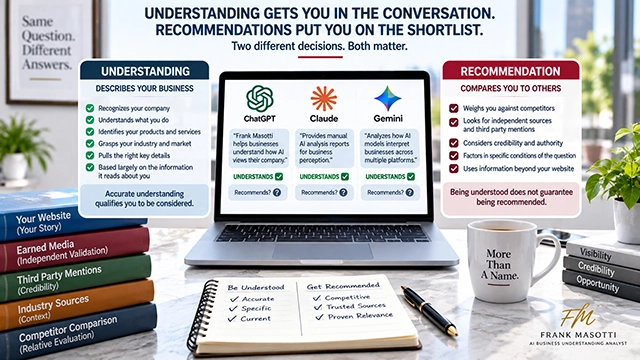
Being Understood by AI Does Not Guarantee Being Recommended
If ChatGPT, Claude, and Gemini describe your business accurately and you still do not get named when someone asks for a recommendation in your category, nothing has necessarily gone wrong with your understanding. You have run into the fact that being understood and being recommended are two separate decisions, and only the first one is about you.
Here is the direct answer. Accurate understanding is what qualifies your business to be considered. The recommendation itself turns on three things understanding never had to address: how your description compares to the other businesses the model holds in the same category, whether anything outside your own website supports naming you, and whether the specific conditions attached to the question are facts the model actually holds about you. A business can pass the understanding test cleanly and fail all three.
Understanding is the part you control, which makes it easy to treat as the whole job. Clean up the writing, state the specialty plainly, make the sources agree, and the recommendation is supposed to follow. Understanding is the prerequisite, and I have made that case directly in Before AI Recommends Your Business, It Has to Understand What You Do. This post is about the gap between a prerequisite and a result, because that is where a lot of businesses are standing without knowing it.
Understanding Describes You. A Recommendation Compares You.
Understanding is an absolute measurement. Is the model’s picture of your business accurate, specific, and current? You can answer that with nobody else in the room. The question does not require a competitor to exist.
A recommendation is a relative measurement. The model assembles whatever businesses its understanding can connect to the request, keeps the few it can justify, and drops the rest, the elimination I unpacked in Would AI Put Your Business on the Shortlist? Your description is not being graded against a standard. It is being read next to four other descriptions.
That distinction has a consequence most owners never see coming. Your understanding can improve in every measurable way and your recommendation outcome can stay exactly the same, because the bar in your category is not fixed. It is set by the clearest business in your market, and that business is also working on its description. What Makes AI Confident in an Answer explains why the model favors the descriptions it can state without hedging, and Why Two Similar Businesses Can Be Understood Very Differently by AI covers how far apart two comparable companies can land on that basis alone.
A Recommendation Is an Endorsement, and Endorsements Rest on Sources That Are Not You
When a model describes your business, it is reporting what it read. When it recommends your business, it is putting its own answer behind you. Those are different acts, and they draw on evidence differently.
Your website is the one source with an obvious interest in what it says about you, a point I covered in AI Reads My Website, So It Knows What My Business Does. Not Necessarily. It is excellent at establishing what you do, because you are the authority on that. It is weak at establishing that you are worth naming, because a claim from an interested party is not corroboration.
The sourcing data lines up with that. Muck Rack’s Generative Pulse study of more than 25 million links cited by ChatGPT, Claude, and Gemini across 17 industries, published in May 2026, found that earned media accounted for 84 percent of AI citations, while paid and advertorial content accounted for 0.3 percent. That figure has held between 82 and 89 percent across three editions of the study going back to July 2025, which suggests it describes how these systems source answers rather than a temporary quirk.
Two caveats belong with that number. Citation is not the same as understanding, and the pages a model quotes in one answer are not the whole of what it knows about you. Volume by itself also changes nothing, because more mentions do not automatically mean AI understands your business. A hundred vague mentions produce a vaguely understood business that is mentioned often.
The narrower point still holds. Your own pages can carry you to accurate understanding. They cannot carry you much past it, because schema stops at the edge of your website and so does everything else you publish. The corroboration a recommendation leans on lives on pages you do not own.
Accurate Understanding Can Correctly Exclude You
Precision builds doors and walls at the same time. If the model understands you as a commercial contractor, you drop out of residential questions accurately, including the residential work you would have been glad to take.
Accurate does not mean complete. Accurate means nothing the model holds about you is false. The picture can be entirely accurate and still missing the attributes a real question tests: the size of client you serve, whether you take small jobs, how fast you can start, whether you work outside your core city, which industries you know well. Owners rarely publish those facts, because they read as operational detail rather than marketing.
Silence on them is not neutral. The model fills unstated attributes with the category average, the pattern in What Missing Information Can Reveal About AI’s Understanding of a Business, and an average is never the reason a name survives a cut. This is also why a business can appear for a broad question and vanish when a qualifier is added, the behavior described in Why AI May Describe Your Business Differently Depending on How a Question Is Asked.
The important thing about this failure is that there is nothing to correct. The understanding does not need a fix. It needs an addition.
The Two Situations That Look Identical From the Inside
Put all of this together and a business that is not being recommended is in one of two situations. Either the model’s understanding is wrong, thin, or dated, or the understanding is fine and the business is losing the comparison anyway. From where you sit, both produce the same thing: no mention, no call, no trace. The prospect who asked for options and never heard your name did not visit and did not bounce, which is the pattern in AI Can Influence a Buying Decision Without Sending Anyone to Your Website.
The responses they call for are close to opposite. The first needs correction, and correction on your own properties is often most of the work. The second needs specificity you have never stated and corroboration from sources you do not control, and rewriting an already accurate website will do nothing for it.
Guessing between them is expensive both ways. Buy visibility work for a business whose description is wrong and you amplify the wrong description, the sequencing problem in AI Recommendations Begin With Understanding, Not Promotion. Rewrite a site that was already clear and you spend months on the one thing that was working. This is exactly why I argue you should find out what AI actually says about your business before you pay someone to improve it.
Finding Out Which One You Are In
Asking ChatGPT about yourself will not settle it. A question with your name in it tests recognition, and recognition is usually the part that was already fine, which is the trap in One AI Question Cannot Show You How AI Understands Your Business and the reason behind Why Does AI Recommend My Competitors But Not Me?
The AI Business Understanding Report separates the two. I question ChatGPT, Claude, and Gemini about your business by name, and I ask the recommendation questions your prospects ask without your name in them. Then I document what each model believes you do, whether that belief is accurate, which competitors it names beside you or instead of you, and what reason it gives for naming them. That last item is often the most useful page in the report, because the sentence a model writes to justify a competitor tells you exactly what it holds about them that it does not hold about you. Where the three disagree, that gets documented too, since they do not know the same things and a clean answer from one proves nothing about the other two.
Being understood is worth having on its own. It is also the point where most businesses stop looking, right before the decision that actually costs them something. If your description is accurate and the recommendations are still going elsewhere, ordering a report is how you find out what the model is holding against you, and whether the problem is your understanding at all.