
AI Search Engine Audit for Pipe Sealing Compound Manufacturers
A pipe sealing compound manufacturer can be correctly identified by an AI system and still be badly misunderstood where the product actually matters.
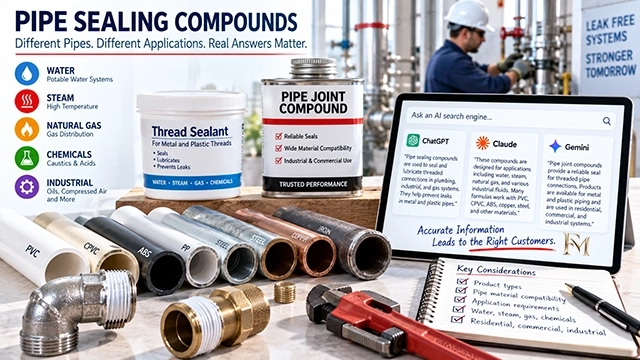
ChatGPT, Claude, or Gemini might know that your company manufactures thread sealants or pipe joint compounds. That does not mean the model understands which piping materials your products are compatible with, whether particular formulations are intended for water, steam, gas, chemicals, or industrial fluids, or how one product differs from another.
Those distinctions are not minor details. Pipe joint compounds can be formulated for different pipe materials and service conditions. Current products in the market illustrate the range: some are promoted for plastic and metal threads and for water, steam, caustics, or dilute acids, while other sealing technologies are designed specifically around metal threaded connections or particular industrial applications.
The $495 Frank Masotti AI Business Understanding Report examines what ChatGPT, Claude, and Gemini currently understand about your company. It is a manual analysis of the business, not an automated scan and not an evaluation of how your company uses artificial intelligence.
For a pipe sealing compound manufacturer, the important question is whether those systems understand enough about your actual products to represent your company accurately when someone uses an artificial intelligence search engine to research manufacturers, products, suppliers, or solutions.
What Does AI Understand About Your Pipe Sealing Compound Manufacturing Company?
Knowing that a company makes “sealants” is not enough.
Even knowing that it makes pipe sealing compounds may not be enough.
A prospective customer could be looking for a thread sealant for potable water, natural gas, steam, compressed air, petroleum, chemical service, or another specific application. Products can also differ according to the piping materials for which they are suitable. Current pipe joint compounds on the market demonstrate compatibility claims involving materials including PVC, CPVC, ABS, polypropylene, iron, steel, and copper.
That creates several layers of understanding an AI system might get right, partially right, or completely miss.
Does AI understand what kinds of pipe sealing compounds your company actually manufactures?
Does it understand the piping materials those products are intended for?
Does it know the applications and service conditions associated with different products?
Does it recognize your company as the manufacturer rather than a distributor?
Most importantly, when someone conducting AI searches describes an application instead of asking for your company by name, does AI connect that need with your products?
An AI search engine audit for a pipe sealing compound manufacturer needs to investigate those questions rather than simply determine whether the company appears in an answer.
Does AI Understand What Your Compounds Are Designed to Seal?
Pipe sealing compounds are closely associated with threaded connections, but even that apparently simple description contains distinctions.
Pipe joint compound can perform both sealing and lubricating functions on threaded joints. Depending on the formulation, manufacturers may describe products for various combinations of water, steam, gases, oils, chemicals, or other media.
Imagine that your company manufactures several products, each designed for different applications.
One AI model might recognize the complete range.
Another might associate your company primarily with plumbing applications.
A third might understand the industrial applications but overlook products intended for common water or gas systems.
None of those models necessarily has to invent a completely false fact to create a misleading picture. An incomplete association can be enough.
If a customer asks for manufacturers of pipe sealing compounds suitable for a particular application, the models need more than your company name. They need to connect your company with the application.
Pipe Material Compatibility Can Change the Answer
The pipe itself matters.
A compound suitable for certain metal threaded connections is not automatically interchangeable with every compound intended for plastic piping. Manufacturers therefore publish compatibility information identifying the materials for which particular formulations are intended.
For example, one current commercial pipe joint compound is specified for both plastic and metal threads, including PVC, CPVC, ABS, polypropylene, iron, steel, and copper. Other products are specifically positioned around metal to metal threaded connections.
That creates a highly specific AI understanding problem.
Suppose your company manufactures products for both plastic and metal piping.
Does ChatGPT know that?
Does Claude associate the company primarily with metal piping?
Does Gemini recognize the broader compatibility but fail to connect individual products with the right applications?
Now consider the reverse. If a formulation has narrower compatibility, an AI system that describes it too broadly could create an inaccurate impression of the product.
For a pipe sealing compound manufacturer, accurate AI understanding is not simply about being associated with “pipe sealant.” Product compatibility is part of the manufacturer’s identity.
Does AI Confuse Pipe Joint Compound With Other Sealing Products?
This is one of the strongest reasons this manufacturing category deserves its own analysis.
Pipe sealing compounds exist beside several products that can appear related in search results and product catalogs: PTFE thread tape, anaerobic thread sealants, threadlockers, gasket products, caulking compounds, general purpose sealants, and other adhesives.
They are not all the same thing.
Even within thread sealing, products can work differently. Traditional pipe joint compounds can remain non hardening, while anaerobic thread sealants cure between metal threads.
An AI system could therefore understand the general purpose of your products while placing the company in the wrong technical context.
That could produce answers such as associating your company mainly with thread tape when you manufacture compounds, treating an anaerobic sealant line as equivalent to a non hardening pipe joint compound, or placing a specialized industrial manufacturer into the much broader category of general adhesives and sealants.
The problem becomes more important when the customer’s question is specific.
“Who manufactures pipe joint compound for plastic threads?”
“Which manufacturers make thread sealants for gas piping?”
“Who makes sealing compounds for industrial fluid systems?”
“Which manufacturers produce non hardening pipe joint compounds?”
Those questions contain product relationships that an AI system must understand before it can make a useful recommendation.
Does AI Understand the Difference Between the Manufacturer and the Seller?
Pipe sealing products can appear across manufacturer websites, plumbing supply companies, industrial distributors, catalogs, specification sheets, and ecommerce listings.
That creates another possible source of confusion.
A distributor may have an extensive page about a product it sells. A manufacturer may have technical documentation for the same product. Another supplier may describe itself as a manufacturer, distributor, or both.
When an AI system pulls those relationships together, does it preserve who actually manufactures the product?
For your company, that distinction can matter considerably.
A purchaser specifically looking for a manufacturer may be interested in formulation expertise, private label capabilities, product development, technical support, manufacturing capacity, or a direct supplier relationship. A distributor appearing in the same product category does not necessarily satisfy that need.
This issue already matters across adhesive manufacturing generally, which is why the broader AI Search Engine Audit for Adhesive Manufacturers examines manufacturer versus distributor confusion. With pipe sealing compounds, that distinction becomes tied to a much narrower set of products and applications.
Service Conditions Can Be Part of Your AI Identity
Pipe sealing compounds are not selected solely by product name.
Pressure, temperature, media, pipe material, chemical exposure, curing behavior, and the ability to disassemble a connection can all become relevant depending on the application.
Commercial specifications demonstrate just how much detail can sit behind a seemingly simple product. Pipe joint compounds currently on the market are described using pressure and temperature limits, compatible media, pipe materials, certifications, curing characteristics, and other application restrictions.
Those technical distinctions create an unusual problem for AI recommendations.
A model may know enough to say that your company makes pipe sealing compounds but not enough to associate the company with the situations in which those compounds are actually appropriate.
That means the company can be recognized but poorly matched.
Someone researching manufacturers for a demanding industrial application may never ask, “What does Company X manufacture?”
They may describe the problem instead.
If the model has not connected your company with the relevant applications, materials, and product attributes, recognition of your company name alone does little to help.
What Happens When Someone Asks AI Which Manufacturer to Consider?
This is where AI visibility becomes more commercially interesting.
There is a difference between asking ChatGPT about your company and asking ChatGPT which companies manufacture a particular kind of pipe sealing compound.
The first tests recognition.
The second tests whether the model connects your company to a customer’s need.
A purchaser might ask for manufacturers that make products for particular pipe materials, gas service, steam systems, potable water applications, industrial fluids, or another specialized requirement.
Your company might legitimately belong in that conversation.
Does it appear?
And if it appears, how is it described?
Perhaps ChatGPT associates the company with general plumbing compounds while Claude recognizes industrial applications. Gemini might know several of the company’s product lines but omit an important compatibility or market relationship.
That is why checking a single model cannot establish what “AI” understands about the manufacturer.
The three systems can produce different interpretations from the information available to them. The Frank Masotti report methodology evaluates ChatGPT, Claude, and Gemini independently, then compares their agreements, disagreements, omissions, misunderstandings, attributes, and recommendation patterns.
A Technically Correct Description Can Still Be Commercially Incomplete
Suppose your company manufactures several pipe sealing compounds.
ChatGPT identifies the company as a manufacturer of pipe joint compounds.
Correct.
Gemini identifies the company with PTFE based products and plumbing applications.
Perhaps also correct.
Claude associates the company with industrial thread sealing applications.
Correct again.
But what if none of those descriptions captures the full business?
Maybe the plumbing association overlooks important industrial applications. Maybe one model misses products compatible with particular piping materials. Maybe another associates the company with products you distribute rather than products you manufacture. Maybe the product line has changed and an older formulation remains more strongly associated with the company.
The problem is not necessarily misinformation.
It can be partial information assembled into an incomplete business identity.
For a technical manufacturer, that matters because buyers often narrow suppliers according to capabilities and applications rather than broad industry categories.
What Can an AI Search Engine Audit Reveal for a Pipe Sealing Compound Manufacturer?
A useful analysis can show whether ChatGPT, Claude, and Gemini understand the manufacturer at several different levels.
They might agree on the company and disagree about the product range.
They might recognize the same products but associate them with different applications.
One model might understand compatibility with both metal and plastic piping while another presents the manufacturer primarily in one category.
A model might confuse the company with a distributor or associate it with an adjacent sealing technology.
The systems may also differ when asked questions that could lead to manufacturer recommendations.
Those differences are the evidence.
The purpose is not to generate an arbitrary AI visibility score. It is to document what the models actually understand and identify where that understanding is accurate, incomplete, inconsistent, or wrong.
You can see examples of that approach in the completed AI Business Understanding Reports.
Find Out What AI Understands About Your Pipe Sealing Compound Manufacturing Company
You know what your products are designed to do.
You know which pipe materials they are compatible with, which media and applications they are intended for, how the formulations differ, what technical characteristics matter, and why a customer should select one product rather than another.
The unanswered question is whether ChatGPT, Claude, and Gemini understand those things about your company.
Your business could be accurately recognized while important products are missing. It could be associated with the right category but the wrong applications. One model could understand an important specialty that the other two miss. Or all three could have a strong and accurate picture of the company.
You do not know until you look.
The $495 Frank Masotti AI Business Understanding Report manually evaluates your business across ChatGPT, Claude, and Gemini. You receive a 10+ page PDF covering what the models understand, misunderstand, and omit, where they agree and disagree, the attributes they associate with your business, recognition and recommendation visibility, strategic observations, and recommendations based on the findings.
It is diagnosis before prescription.
Before deciding whether anything about your AI search visibility needs attention, find out what three major AI systems currently understand about your pipe sealing compound manufacturing company.