
AI Search Engine Audit for Dextrin Glue Manufacturers
A dextrin glue manufacturer has a more specific AI understanding problem than simply being recognized as an adhesive company.
ChatGPT, Gemini, and Claude could know that your company makes adhesives while failing to understand that you manufacture dextrin based products. They could recognize dextrin but associate your company with starch ingredients rather than finished glues. They could understand that you serve paper and packaging markets without knowing whether your products are intended for labels, envelopes, bags, cartons, laminating, tube winding, or other converting operations.
Those distinctions matter when a prospective customer uses an artificial intelligence search engine to find manufacturers capable of meeting a particular production requirement.
The $495 Frank Masotti AI Business Understanding Report manually examines what ChatGPT, Claude, and Gemini currently understand about your company. It is not an audit of how your company uses AI. It examines how three major AI systems describe, interpret, categorize, compare, and potentially recommend your business.
What Does AI Understand About Your Dextrin Glue Manufacturing Company?
The useful question is not simply whether AI recognizes your company name.
It is whether AI understands what you actually manufacture and where those products fit.
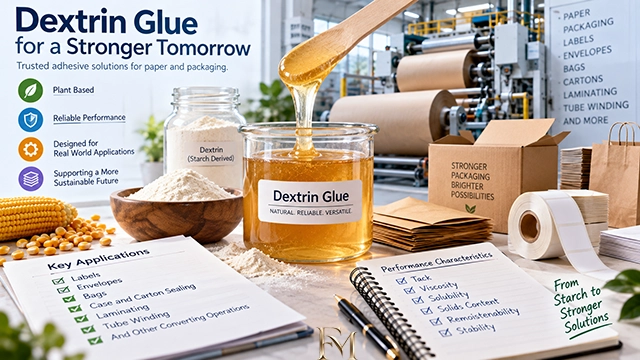
Dextrin adhesives occupy a particular part of the much larger adhesive industry. Commercial dextrins can be derived from starch and formulated for adhesive characteristics such as solubility, viscosity, tack, solids content, stability, and remoistenability. Different dextrin products can be intended for applications including labels, envelopes, tube winding, laminating, bags, case and carton work, and other paper converting operations.
That creates several layers of information an AI system may need to connect correctly.
Does ChatGPT understand that you manufacture dextrin glue rather than merely sell industrial adhesives?
Does Gemini understand the applications your formulations are designed to serve?
Does Claude associate your company with the right converting processes and product characteristics?
And if someone conducting AI searches starts with the application instead of your company name, do any of the three models connect the requirement with your business?
Can AI Distinguish Dextrin Glue From the Broader Adhesive Market?
This is where the narrower manufacturing category becomes important.
A general adhesive manufacturer can produce products based on many different chemistries. A dextrin glue manufacturer occupies a much more defined position within that market.
That distinction can disappear in an AI answer.
A model might describe the company broadly as an adhesive manufacturer. That description is not necessarily false, but it can be incomplete enough to hide the specialization that makes the company relevant to a particular buyer.
The reverse can also happen. AI could associate a manufacturer so strongly with dextrin that it fails to recognize other adhesive products the company actually produces.
This is why the broader AI Search Engine Audit for Adhesive Manufacturers and an audit for a dextrin glue manufacturer are not asking exactly the same question.
For the dextrin manufacturer, category accuracy has to go deeper.
The issue becomes whether AI understands the company’s position inside the adhesive market.
Does AI Understand the Applications Your Dextrin Glues Are Designed For?
Application is a major part of the story.
Commercial dextrin products can be used in adhesives for paper and packaging applications including labels, envelopes, bags, cartons, laminating, and tube winding. Different applications can require different combinations of tack, viscosity, solids content, drying behavior, adhesion, and remoistenability.
That means a buyer does not necessarily search for a “dextrin glue manufacturer.”
The buyer may start with the manufacturing problem.
They could be looking for an adhesive appropriate for tube winding.
They could need a glue for a label operation.
They could be researching adhesives for case and carton sealing.
They could need a remoistenable adhesive for an envelope or similar paper product.
Your company could manufacture an appropriate product and still be absent from the answer if the AI system has not connected your company with that application.
That is an AI search visibility issue that basic company recognition cannot reveal.
Does AI Understand the Performance Characteristics of Your Products?
Knowing the chemistry is only part of understanding an adhesive.
Dextrin products can differ in characteristics such as cold water solubility, viscosity, solids level, tack, adhesion, solution stability, and the ability to produce a film that can be remoistened after drying. Those characteristics help determine where a formulation is useful.
Consider what that means for AI understanding.
One model might correctly associate your company with dextrin adhesives but know almost nothing about the performance characteristics of your product lines.
Another might connect your company with high solids applications.
A third might recognize your products for tube winding or labeling but overlook other uses you support.
All three could technically know what your company does while possessing materially different pictures of what your products are suitable for.
For a technical manufacturer, incomplete understanding can matter almost as much as outright incorrect information.
Could AI Confuse a Dextrin Manufacturer With a Dextrin Glue Manufacturer?
This is one of the most important distinctions for this particular business type.
Dextrin itself can be supplied as an ingredient for adhesive formulations. Finished adhesive pastes can also be produced using dextrin based materials. Commercial product information shows both dextrins used as adhesive binders and dextrin products prepared for making finished adhesive pastes.
Those are related businesses, but they are not necessarily the same business.
If your company manufactures finished dextrin glues, does AI understand that?
If you manufacture dextrin ingredients for adhesive formulators, does it understand that instead?
If you do both, do ChatGPT, Gemini, and Claude recognize both sides of the operation?
A model that collapses a raw material supplier, adhesive ingredient manufacturer, finished glue manufacturer, and industrial adhesive distributor into one category can produce an answer that sounds reasonable while misunderstanding where a company actually sits in the supply chain.
That is exactly the kind of category confusion worth finding.
What Happens When a Buyer Searches by Production Need?
AI recommendations can expose another layer of understanding.
A purchaser may not know which manufacturers to investigate before asking the question. Instead, the purchaser describes the application or requirement and lets the AI system build the shortlist.
Questions could revolve around manufacturers serving paper converting operations, dextrin adhesives for labels, products suitable for tube winding, adhesives for envelope applications, or suppliers with formulations designed around particular production characteristics.
Now the question is no longer:
Does AI know your company?
It becomes:
Does AI know enough about your company to connect it with the buyer’s requirement?
A manufacturer can perform well on the first question and poorly on the second.
Recognition and recommendation are not the same thing.
Three AI Models May Understand Your Product Line Differently
There is also no reason to assume ChatGPT, Gemini, and Claude have constructed identical versions of your company.
One may recognize your dextrin specialization immediately.
Another may categorize you primarily as a general adhesive manufacturer.
The third may associate your company with one end use, such as packaging, while overlooking other applications that represent important parts of your business.
That disagreement is useful information.
The point is not to decide which AI model is “best.” The point is to see where understanding is consistent and where it breaks apart.
That is why the report compares three systems instead of relying on a single ChatGPT query. You can read more about why three AI models are compared.
What an AI Search Engine Audit Can Reveal for a Dextrin Glue Manufacturer
An AI search engine audit can show whether the models understand your company as a dextrin glue manufacturer or place it into a broader and less useful adhesive category.
It can reveal whether important applications are recognized consistently, whether your product characteristics are associated with the company, and whether the models understand where you fit within the adhesive supply chain.
It can uncover disagreements about the markets you serve or the products you manufacture.
It can also examine recommendation visibility. A model may know your company when asked about it directly but fail to connect the business with relevant purchasing questions.
None of those findings automatically means something needs to be changed.
The first job is diagnosis.
You need to know what the models currently understand before deciding whether anything deserves attention.
Find Out What AI Understands About Your Dextrin Glue Manufacturing Company
You already know what your company manufactures.
You know whether you produce finished dextrin glues, adhesive ingredients, or both. You know which formulations matter, which converting processes they serve, which product characteristics distinguish them, and which customers and applications represent your actual market.
What you probably do not know is whether ChatGPT, Gemini, and Claude understand the same business.
They might.
They might understand only pieces of it.
Or each model may have assembled a different version of your company.
The $495 Frank Masotti AI Business Understanding Report gives you a manual comparison across ChatGPT, Claude, and Gemini. You receive a 10+ page PDF showing what the models understand, what they misunderstand or omit, where they agree and disagree, the attributes they associate with your business, recognition and recommendation visibility, strategic observations, and recommendations based on the findings.
The report is delivered the next business day after analysis completion.
Before trying to change how AI understands your dextrin glue manufacturing company, find out what the three systems actually understand today.