
AI Can Get Your Business Mostly Right and Still Cost You the Opportunity
If you have asked ChatGPT, Claude, or Gemini about your business and the answer came back mostly right, it is natural to relax. The name is correct, the city is correct, the services look familiar, and the reviews are summarized fairly. Nine things out of ten check out. That feels like a passing grade.
It is not, because your prospects do not grade on a percentage. A customer asking AI about your business is not scoring the answer for overall accuracy. They are looking for one or two details that decide whether you fit their situation. If those details are right, the other nine barely matter. If one of them is wrong, the other nine do not save you.
And here is the part that makes this worth understanding rather than just accepting: the details AI gets wrong are rarely random. AI is most reliable on the facts that decide nothing, and least reliable on the facts that decide everything. A mostly right answer is not a near miss. It is the expected result of how these systems learn about a business, and it tends to fail in exactly the place your opportunity lives.
Customers Do Not Grade on a Curve
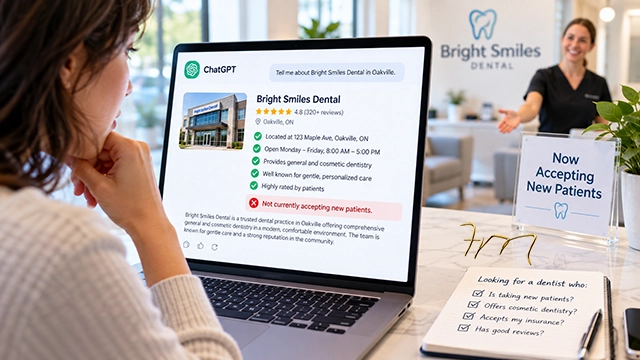
Picture a dental practice. A prospect asks ChatGPT about it and receives a clean, confident answer. Correct address. Correct hours. General and cosmetic dentistry. A strong reputation for gentle care. All accurate. Then one sentence near the end: the practice is not currently accepting new patients.
That sentence came from a notice the practice posted during a staffing shortage three years ago. The pause lasted six weeks. The notice never came down from one directory, and a local forum thread quoted it at the time. Today the practice is actively looking for new patients.
The owner reading that answer sees ten facts and one error. The prospect sees one fact. Everything else in the answer described a practice they cannot use, so they close the window and ask about the next one on their list.
That is the scoring gap. You read an AI answer as a report card. Your prospect reads it as a gate, and a gate only has one question.
Why the Wrong Detail Is Usually the One That Matters
The pattern comes from how AI assembles its picture of a business. It does not read your website and stop. It builds its understanding from information across the web, and it trusts what it sees repeated most often. That creates two very different classes of facts about you.
The first class is identity: your name, your city, your category, your phone number. These appear in every directory, every review platform, every listing, over and over, for years. They rarely change. AI sees them hundreds of times, agrees with itself, and gets them right.
The second class is qualification: whether you are taking new clients, the smallest job you will accept, the edge of your service area, which insurance you take, whether you still offer a particular service, how you price, how quickly you can start. These are the details a prospect actually uses to decide. They are usually stated once, on one page of your own site, if they are stated at all. No directory has a field for them. And they change far more often than your name or your address does.
So the facts that decide a sale are exactly the facts with the thinnest evidence behind them and the highest chance of being out of date. That is why AI may trust old information about your business most stubbornly on precisely these points. One stale mention of a paused intake or a dropped service can outweigh a single current page. And when there is no mention at all, AI does not leave the space blank. It fills it with whatever is typical for your category, which is how a firm with a high project minimum gets described as taking any job, or a specialist gets described as a generalist. What attributes AI associates with your business is decided by this imbalance, not by what you would choose to emphasize.
The result is structural. AI will usually pass the easy questions and quietly miss the one that matters.
The Right Facts Make the Wrong One Believable
You might expect a careful prospect to catch the error. In practice, the accurate parts of the answer work against you.
Every correct detail builds credibility for the whole answer. The prospect recognizes the address, knows the reviews are good, sees that the services match what they heard from a friend. By the time they reach the wrong detail, the answer has already earned their trust. The error does not look like an error. It looks like one more thing this well informed source knows. And because AI sounds just as certain when its understanding is incomplete, nothing in the tone marks that sentence as weaker than the rest.
People do verify AI answers. Yext’s 2026 survey of nearly 3,850 consumers found that only 5 percent go straight from an AI recommendation to a purchase. Most search Google, visit the business’s website, or check reviews first. That sounds reassuring until you notice who gets verified. Prospects spend their verification effort on the businesses still in contention. A business that was ruled out by a wrong qualifying detail never gets checked, because there is no reason to check a business you have already decided cannot help you. Verification protects the survivors. It does nothing for the business that failed the gate.
A Mostly Right Answer Is the Hardest One to Catch
A completely wrong answer tends to get fixed. If AI gives the wrong city or confuses you with another company, you notice the first time you look, and you start working on it.
A mostly right answer gets approved. You ask a general question, something like “what does my company do,” and the answer comes back accurate on everything a general question touches. So you move on. But your prospects are not asking general questions. They are asking whether you handle projects their size, whether you are taking new clients, whether you work in their town. Those questions pull on the thin evidence, and one AI question cannot show you how AI understands your business, least of all the question you would naturally ask about yourself. Add the fact that ChatGPT, Claude, and Gemini do not know the same things, and a clean answer from one system tells you very little about the other two.
This is related to, but different from, the problem described in AI Does Not Need to Get Every Fact Wrong to Misunderstand Your Business. That is about correct facts combined into the wrong overall picture. This is simpler and in some ways worse: the overall picture can be right, and one wrong qualifying detail still ends the conversation.
What the Missed Opportunity Costs
The prospects lost this way are not browsers. A Semrush survey of US adults in July 2026 found that nearly half of all consumers at least occasionally ask an AI chatbot about a company before buying from it, and among people who use AI to research companies, 87 percent said they would consult it before hiring a local business. Someone asking AI about you by name is already interested. They have a need, they have your name, and they are checking. That is the most qualified moment in your entire sales process, and the gate sits right in the middle of it.
When it closes, nothing tells you. There is no bounce, no abandoned form, no review to answer. As I covered in A Customer May Reject Your Business Based on an AI Description You Never Saw, the decision happens in a conversation you were never part of. Your numbers simply come in a little lower than they should, and a mostly right answer gives you no reason to suspect why.
Checking the Details That Decide
The fix starts with knowing which qualifying details AI has wrong, missing, or stale, and in which systems. That cannot be learned from a general question asked once. It requires asking the questions your prospects actually ask, the fit questions, the availability questions, the scope questions, and comparing every answer against how your business actually operates today.
That is the work behind the AI Business Understanding Report. I question ChatGPT, Claude, and Gemini about your business the way a serious prospect would, read every answer myself, and document not just whether the identity facts are right, but whether the details that decide a sale are right. Where one is wrong or missing, the report shows which models got it wrong and the likely source. The methodology explains how each answer is preserved and compared.
An answer that is ninety percent right can still be a closed door. If you want to know whether the ten percent AI is getting wrong about your business is the part your customers care about, ordering a report is how you find out.