
Why Asking ChatGPT About Your Business Once Is Not an AI Search Engine Audit
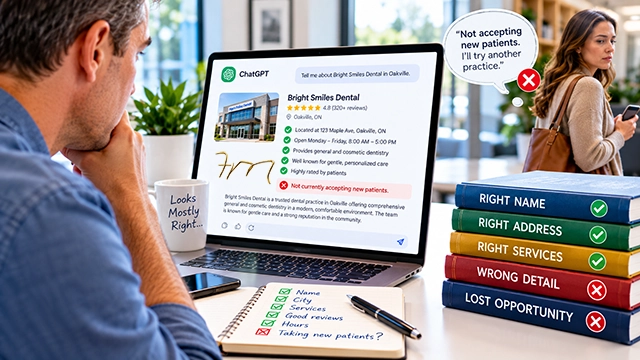
If you have typed your business name into ChatGPT, read a reasonable answer, and concluded you know where you stand with AI, here is the direct answer: you ran a spot check, not an audit. A spot check tells you what one model said to one person on one day. An AI search engine audit tells you what AI systems are likely to tell the people who matter to your business, under conditions that resemble theirs, across enough questions and enough models to see a pattern, with a written record you can act on.
Those are different things, and the difference is not thoroughness for its own sake. The single question fails for specific, structural reasons. It is asked from the wrong account, phrased the wrong way, answered only once, and graded by the one reader least able to spot what is missing. Together, they mean a clean answer on your screen tells you very little about the answer on your prospect’s screen. You are free to ask ChatGPT yourself, and you should. Just be clear about what that answer can and cannot prove.
Why One Good Answer Feels Like Enough
The self check is persuasive because of how the answer arrives. It is fluent, organized, and delivered without hesitation, and most of what it says is probably correct. Your name, your city, your general category. You recognize your business in it, and recognition feels like confirmation.
But an AI answer shows no margin of error. It does not tell you it might have said something different a minute later, or that a stranger asking a different question would hear a different description. AI sounds just as certain when its understanding is incomplete, so the tone of a single answer carries no information about how stable it is. The relief arrives before the evidence does.
What Actually Makes Something an Audit
Consider a financial audit. Nobody would accept an owner glancing at the bank balance and declaring the books sound. An audit is defined by its conditions, not by its effort: the examination is independent of what is being examined, the scope covers what matters rather than what is convenient, the test can be repeated, the findings are judged against criteria, and the evidence is kept.
An AI search engine audit follows the same logic. What an AI search engine audit examines is how AI systems understand, describe, compare, and recommend a business. To learn that honestly, you need neutral conditions, the questions real buyers ask, more than one answer, more than one model, a reader checking against reality, and a preserved record. A single question to ChatGPT meets none of them, and none of the gaps is obvious from inside the chat window.
You Are Asking From the One Account That Already Knows You
This is the failure almost nobody accounts for. ChatGPT is not a neutral terminal. OpenAI’s own documentation explains that with memory turned on, ChatGPT can draw on relevant details from your past conversations to personalize its answers, and that this memory is a running synthesis of your chats, not only the facts you explicitly asked it to save.
Now think about how business owners use ChatGPT. They draft service descriptions in it, rewrite their About page, compose proposals. Over months, the account absorbs a detailed and flattering picture of the business, supplied by the owner. When that owner asks what the company does, the answer may draw partly on what the owner taught it, in conversations your prospect has never had.
Temporary Chat skips memory and is a sensible precaution, but it only removes one layer. Your location, your plan, and whether the model searched the web in that moment still shape the result. The owner’s answer is not necessarily wrong. It simply answers a question nobody else is asking: what does ChatGPT say to the person who spent a year describing this business to it? The answer that matters is the one you never get to see.
You Asked the Question You Already Know the Answer To
Owners test the way owners think. They type the exact business name, spelled correctly, usually with the city attached, and ask what the business does. That is the easiest question AI can be asked about you, because every word in it points at the right entity.
Prospects rarely ask that way. They ask who handles a specific problem near them, whether a company fits a project their size, how two providers compare, or what a business is known for. Those questions pull on thinner evidence, and they are where businesses win or lose. An owner can pass the identity question comfortably while failing the recommendation question entirely, which is why recognition and recommendation are two separate problems. What AI tells a customer who asks whether your business is a good choice can look nothing like its answer to “what does my company do,” because AI describes a business differently depending on how the question is asked.
One Answer Cannot Show You How Much the Answer Moves
Even the same question does not produce the same answer. In research published in January 2026, SparkToro and Gumshoe.ai had 600 volunteers run 12 prompts through ChatGPT, Claude, and Google’s AI nearly 3,000 times. When the tools were asked for brand recommendations, the chance of receiving the same list twice was under one in a hundred. The chance of the same list in the same order was closer to one in a thousand.
The same research found something more useful underneath the noise. Across many runs, the group of businesses AI tended to consider was far steadier than any single list. A single response is one draw from a range you cannot see, and nothing inside it tells you whether it was the typical answer or the unusual one. That is the core of why one AI question cannot show you how AI understands your business. Add three models that learned from different data, and a clean answer from ChatGPT says very little about the other two, because all AI models do not know the same things.
You Are Grading Your Own Test
The last failure is the reader. You know your business, so you read the answer with the correct picture already in your head. Where the answer is vague, you supply the meaning. Where it describes a service in outdated terms, you recognize it anyway. Where it leaves out your most profitable specialty, you do not notice the gap, because an omission looks like nothing at all.
Your prospect reads the same answer with no picture in their head. The vagueness stays vague, the outdated description reads as current, and the missing specialty simply does not exist. What AI leaves out when it explains your business is often the costliest part of the answer, and it is exactly the part a self check is worst at catching. So do the hedges that reveal what AI uncertainty looks like to a careful reader and pass straight through a hopeful one.
Nothing Gets Written Down
A spot check also leaves no record. There is no date, no saved transcript, no fixed set of questions you can run again. So when the business adds a service, moves, or changes its name, there is no baseline to tell you whether AI caught up. AI will keep changing, and a finding without a date cannot tell you what changed or when.
What the Wrong Conclusion Costs
The danger of a spot check is not that it tells you nothing. It tells you something reassuring and unrepresentative, so the owner stops looking while prospects, asking from neutral accounts with different questions on different models, hear something else.
Your prospect may ask AI about you before contacting you, and when that answer rules you out, nothing reports it. No bounce, no complaint, no line in your analytics. A false all clear costs more than an honest unknown, because the unknown keeps you looking and the all clear ends the investigation.
What an Actual Audit Involves
The AI Business Understanding Report is built around the conditions a spot check lacks. Every question starts in a fresh conversation with no prior context. I do not give the models your website or tell them what the business is supposed to be, because coaching the model toward the right answer defeats the purpose. The same structured set of questions, covering identity, services, specialty, customer fit, comparison, and recommendation, goes to ChatGPT, Claude, and Gemini independently. The original responses are preserved, including the wrong and uncertain ones, because those failures are the evidence.
Then I read every answer against how your business actually operates and compare the three models for agreement, disagreement, omissions, and outdated details. The result is a dated, written record you can act on now and measure against later. The full process is laid out in the methodology, and you can judge the depth for yourself in the completed reports.
Asking ChatGPT about your business is a reasonable thing to do. It is just not an audit, and it should not be the reason you stop asking. If you want to know what AI tells the people who have never described your business to it, ordering a report is how you find out.