
For most of the time businesses have been online, the first impression happened on the homepage. You chose the photos, the headline, the order in which a visitor learned things about you. Whatever someone thought of your business in those first few seconds, you were the author of it.
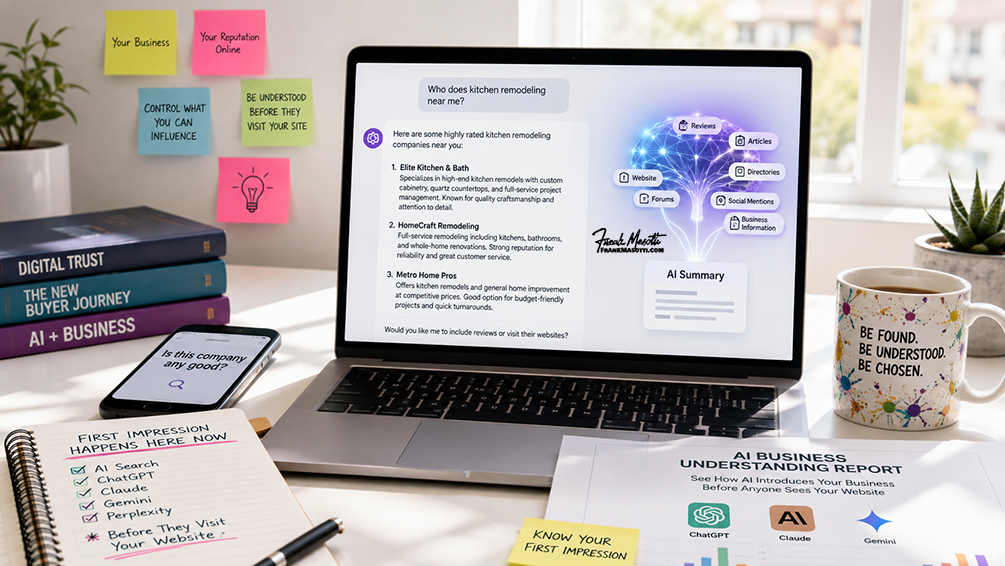
That is no longer a safe assumption. A growing number of prospects now meet your business inside an AI answer before they ever see your website. They ask ChatGPT, Claude, or Gemini something like “who does kitchen remodeling near me” or “is this company any good,” and the AI responds with a few paragraphs describing your business. That description, not your homepage, is the first impression. It was written by a machine, delivered in private, and you have never read it.
So the direct answer to the question in the title is yes. If people can find your business at all, AI systems are already introducing it to someone. The real question is what that introduction says, because the words were not yours, and the impression it creates arrives before your website gets any chance to speak.
The Introduction You Never Get to Hear
Here is the part that makes this different from every other marketing problem you have dealt with. When your website underperforms, you can see it. Analytics show you the traffic, the bounces, the pages people leave from. You can watch the problem happen and respond to it.
An AI introduction leaves no trace on your side. The conversation takes place between your prospect and their chatbot, on their screen, in their account. Your prospect may ask AI about you before contacting you, form a complete opinion, and act on it, all without generating a single event you can measure. If the answer they received was flattering, you get a phone call and never know what earned it. If the answer was wrong, or thin, or quietly pointed them toward a competitor, you get nothing. Not a complaint, not a bounce, not a data point. Just an absence.
This is why the problem stays hidden. Business owners watch the channels they can see, and this one is invisible by design. Customers are asking AI about businesses before they visit their websites in growing numbers, and no report lands on your desk when it happens.
Where That First Impression Actually Comes From
It would be comforting to believe the AI simply reads your homepage aloud. It does not work that way.
When someone asks an AI about your business, the answer is composed, not quoted. The model draws on everything it has absorbed about you: old articles, directory listings, reviews, forum mentions, your website at whatever point it was last taken in, and the websites of everyone adjacent to you. AI builds a picture of your business from information across the web, then writes a fresh summary of that picture each time someone asks. Your carefully written homepage is one input among hundreds, and not necessarily the loudest one.
That composition step is where first impressions go sideways. The model decides which of your services to mention first, which details count as defining, and which to leave out entirely. In effect, AI decides what your business is known for, and its editorial choices may not match yours. A remodeler who has spent three years repositioning toward high end kitchens can still be introduced as a general handyman service, because that is what the older and more plentiful evidence says. In that case AI might be describing the business you used to be, and the prospect has no way to know they just met your past instead of your present.
And the introduction never sounds unsure. AI sometimes sounds certain when its understanding is incomplete. A summary assembled from stale and partial evidence is delivered in the same confident tone as one built from perfect information. Your prospect cannot tell the difference. Confidence is the house style.
Why This Impression Carries More Weight, Not Less
You might expect an AI description to matter less than your website. It is secondhand, after all. In practice it tends to matter more, for three reasons.
First, it feels neutral. Your website is understood to be advertising; everyone reads it with a discount applied. An AI answer feels like the verdict of an informed third party who has no stake in the outcome. The same claim lands harder when the prospect believes nobody is selling to them.
Second, it frames everything that follows. A prospect who was told you are a small operation with mixed reviews will read your polished website as compensating for something. First impressions do not get replaced by second ones; second ones get interpreted through them. By the time someone reaches your site, your headline is no longer opening the conversation. It is responding to one that already happened.
Third, the impression does not need to be dramatically wrong to do damage. A misstated service area, an outdated specialty, a price positioning that belongs to a competitor. AI does not need to get every fact wrong to misunderstand your business, and it does not need to get every fact wrong to cost you a customer either. One confident inaccuracy in an introduction is enough to end it.
There is also no single version of this first impression, because all AI models do not know the same things. ChatGPT may introduce you accurately while Gemini introduces a blurrier version of you and Claude hedges. Your business is making several different first impressions simultaneously, and they may not agree with each other.
What This Costs a Business That Never Checks
Add this up and the consequence is plain. Somewhere between the moment a prospect gets curious and the moment they would have visited your website, a filter now sits. Businesses that come through the filter accurately get prospects who arrive warm, informed, and half decided in their favor. Businesses that come through distorted get fewer visitors, and the ones who do arrive come carrying doubts they never mention.
The unsettling part is that both outcomes look identical from the inside. Your website traffic is just a number; it does not tell you how many people were quietly turned away before reaching it. A slow month reads as seasonality or the economy. Nobody attributes it to a paragraph they have never seen.
You cannot fix an introduction you have never read. And checking is not as simple as asking ChatGPT about yourself once, because one AI question cannot show you how AI understands your business. A single answer on your own account is one draw from one model on one day. Your prospects are asking different questions, in different words, across different systems.
Reading Your Own Introduction
This is exactly what the AI Business Understanding Report was built to do. It documents how ChatGPT, Claude, and Gemini each describe your business right now: what they lead with, what they get wrong, what they leave out, and where the three of them disagree. It is, in plain terms, a transcript of the first impression AI is making on your behalf, gathered and analyzed by a person rather than a script.
Some businesses read their report and find the introduction is accurate. That is worth knowing too, because it means the filter is working for you. Others find they are being introduced as the business they were five years ago, or as a vaguer version of themselves, or with someone else’s details mixed in. Every one of those findings was invisible the day before the report existed.
Your website will keep making second impressions, and it should be good at that. But the first impression has moved, and it is being written without you. Ordering a report is how you finally get to read it.