
AI Search Engine Audit for Abrasive Coated Paper Manufacturers
If your company manufactures abrasive coated paper from purchased paper, there is a more important question than whether ChatGPT, Gemini, or Claude recognizes your company name.
Do they understand what kind of coated abrasive manufacturer you actually are?
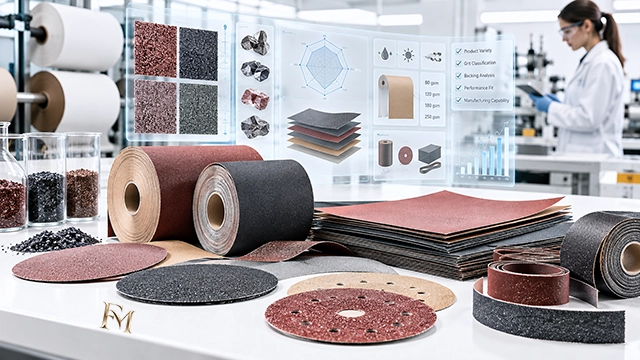
An abrasive coated paper manufacturer can work with aluminum oxide, silicon carbide, garnet, emery, and other abrasive grains across products designed for everything from fine finishing to aggressive stock removal. The paper itself can vary considerably in weight, flexibility, strength, waterproof characteristics, reinforcement, and suitability for hand sanding or machine applications. Finished material may become sheets, rolls, discs, belts, or other converted abrasive products.
An AI system that reduces all of that to “a company that makes sandpaper” has identified the general neighborhood without necessarily understanding the business.
The Frank Masotti AI Business Understanding Report is designed to determine what ChatGPT, Claude, and Gemini currently understand about an individual manufacturer. I manually evaluate the company across all three models and compare what they recognize, misunderstand, omit, associate with the business, and potentially recommend.
The report costs $495 as a one time purchase.
What Does AI Understand About Your Abrasive Coated Paper Manufacturing Business?
An AI search engine audit for an abrasive coated paper manufacturer is not an examination of artificial intelligence being used inside the factory.
It examines the company from the outside.
When someone uses an artificial intelligence search engine to research coated abrasive suppliers, identify manufacturers for a particular sanding application, compare products, or ask for a company capable of supplying a particular abrasive construction, what picture of your company has AI formed?
Does ChatGPT understand that you manufacture paper backed coated abrasives rather than abrasive grain itself?
Does Gemini recognize the abrasive materials you use?
Does Claude associate your company with the correct product forms and applications?
Do the models understand that your operation starts with purchased paper that becomes part of the coated abrasive construction, rather than assuming that you manufacture the backing paper itself?
Those distinctions can become particularly important in a manufacturing category containing abrasive grain producers, coated abrasive manufacturers, converters, distributors, private label suppliers, and companies working with entirely different backing materials.
You can read more about what an AI Search Engine Audit is and how it examines the conclusions AI systems form about a business.
“Sandpaper Manufacturer” May Be Correct and Still Be Incomplete
Sandpaper is familiar language. It can also hide much of what separates one abrasive coated paper manufacturer from another.
The abrasive grain matters.
The backing matters.
The grit matters.
The bonding system matters.
Whether the product is intended for wet or dry use can matter.
The amount of flexibility, strength, tear resistance, and resistance to loading can matter.
The workpiece can matter.
The form in which the abrasive reaches the customer can matter.
Current commercial abrasive paper illustrates just how wide those differences can become. Norton, for example, markets paper backed abrasive products using different paper weights and constructions for uses ranging from hand finishing to portable power sanding and heavier applications. Its product information also distinguishes features such as waterproof paper and anti-loading treatments.
That means an AI description does not have to be completely false to be commercially unhelpful.
A model might correctly identify a company as a sandpaper manufacturer while failing to understand the characteristics that determine where its products actually fit.
Does AI Understand the Paper Behind the Abrasive?
This is where an abrasive coated paper manufacturer becomes substantially different from the coated cloth manufacturer we have already discussed.
Paper backing is not simply a surface onto which abrasive grain happens to be placed.
Different paper backing weights provide different combinations of flexibility and strength. Lighter paper can be appropriate where flexibility is important, while heavier paper is used when greater resistance to tearing and more aggressive applications are required. Industry product literature distinguishes multiple paper weight classifications for precisely this reason.
Modern abrasive papers can also use reinforced, latex treated, waterproof, or other specialized paper constructions.
If your company manufactures several different paper backed abrasive products, does AI understand that range?
Or does it treat every product as one generic sheet of sandpaper?
That difference could matter enormously during AI searches.
Someone might ask for a manufacturer of flexible abrasive paper for finishing work, a waterproof silicon carbide paper, a heavy paper abrasive for machine sanding, or a product intended to resist loading during finishing.
Recognizing the company name is not enough if AI does not understand which of those requirements the manufacturer can actually satisfy.
Does AI Know Which Abrasive Grains You Coat Onto the Paper?
The NAICS style description of this business type specifically encompasses paper coated with abrasive materials such as aluminum oxide, emery, garnet, and silicon carbide.
Those are not interchangeable labels.
Different abrasive grains give the resulting product different characteristics and potential applications. Commercial products today pair different grains with particular paper constructions depending on the material being worked and the intended sanding or finishing operation.
For the manufacturer, this creates several questions worth testing.
Does AI associate your company with all of the abrasive grains you actually use?
Does it incorrectly associate you with one you do not use?
If aluminum oxide products dominate the information AI has encountered, has it overlooked your silicon carbide products?
If the company has a particular specialization, is that specialization visible to the models at all?
This becomes more important when an AI user asks for a manufacturer based on a requirement rather than by company name.
“Who manufactures abrasive paper?” is a broad question.
“Who makes silicon carbide waterproof abrasive paper for finishing?” requires considerably more understanding.
Does AI Distinguish Paper Backed Abrasives From Cloth Backed Abrasives?
This is one of the most obvious places for category compression.
Both products are coated abrasives.
Both can use some of the same abrasive grains.
Both can sometimes appear in similar finished forms.
But the backing changes the characteristics of the finished abrasive and the applications for which it is suited.
Cloth can be selected when strength, durability, and conformability are important. Paper offers its own range of backing weights and constructions, from flexible finishing papers through much heavier products used in demanding sanding applications. Heavy paper backings can even be used in industrial wide belt applications.
An AI system could therefore understand that your company manufactures coated abrasives while still getting one of the defining elements of the product wrong.
It might describe a paper abrasive manufacturer as producing cloth backed products.
It might combine paper and cloth manufacturing capabilities the company does not actually have.
Or it might simply omit the backing distinction entirely.
That is a meaningful misunderstanding, not a wording preference.
Does AI Understand What You Manufacture Versus What You Convert?
The phrase made from purchased paper introduces another business specific distinction.
The manufacturer is not necessarily making paper.
It is purchasing paper as an input and manufacturing the coated abrasive product from that backing.
Depending on the company, subsequent operations may also turn coated abrasive material into particular sheets, rolls, discs, belts, or other forms.
An artificial intelligence system can blur those stages.
It could interpret the company as a paper manufacturer.
It could assume the business manufactures abrasive grain.
It could describe a converter as though it manufactures coated abrasive jumbo rolls.
It could associate a manufacturer with finished forms produced by downstream customers rather than by the manufacturer itself.
Or it could recognize the coated abrasive manufacturing operation correctly but overlook conversion capabilities that are actually part of the business.
The relevant question is not which arrangement is “normal.”
The relevant question is which arrangement describes your company, and whether ChatGPT, Gemini, and Claude understand it correctly.
What Applications Does AI Associate With Your Products?
Paper backed abrasives appear across a wide range of sanding and finishing work.
Wood, metal, painted surfaces, composites, fiberglass, coatings, body filler, and other materials can require different abrasive constructions. Products may be intended for hand sanding, sanding blocks, portable machines, floor sanding equipment, or other applications.
A manufacturer may serve several of those markets or specialize in only a few.
AI needs to understand the difference.
Suppose a company primarily supplies coated abrasive paper for woodworking and finishing applications.
If an AI model strongly associates the company with automotive refinishing because of an old product listing or distributor page, the model has learned something about the company, but perhaps not the right thing.
Another model might recognize the woodworking connection but miss the company’s industrial products.
A third could describe the company merely as a general abrasive supplier without identifying any application at all.
Three AI systems can therefore begin with the same company and arrive at noticeably different representations.
That is why I evaluate all three rather than treating one ChatGPT response as a complete picture. You can read more about why the report compares three AI models.
What Can an AI Search Engine Audit Reveal for an Abrasive Coated Paper Manufacturer?
The findings depend on the individual company. I do not assume that AI is getting the company wrong before I test it.
For an abrasive coated paper manufacturer, the analysis can examine whether ChatGPT, Claude, and Gemini understand things such as:
- That the company manufactures coated abrasives from purchased paper
- Whether AI correctly identifies the business as a manufacturer rather than a distributor or paper producer
- Which abrasive grains the models associate with the company
- Which paper backed product lines AI recognizes
- Whether important grit ranges, backing types, or product constructions appear to be missing
- Whether AI confuses paper backed products with cloth, film, fiber, or other backing materials
- Whether waterproof or dry sanding products are understood correctly
- Which industries and applications AI associates with the manufacturer
- Whether sheets, rolls, discs, belts, or other finished forms are attributed correctly
- Whether obsolete products or markets remain associated with the company
- Whether AI attributes products to the manufacturer that it does not make
- What characteristics and attributes the models associate with the business
- Whether the manufacturer appears when relevant AI recommendations are requested
- Where ChatGPT, Gemini, and Claude agree
- Where one model appears to know something the other two do not
The value is not receiving a generic AI visibility score.
The value is seeing the evidence.
Three Models May Understand the Same Manufacturer Differently
There is no guarantee that ChatGPT, Claude, and Gemini have developed the same understanding of a coated abrasive manufacturer.
One model could understand the company’s paper backed product line in considerable detail.
Another might classify it simply as an abrasives company.
The third could recognize its primary grain types while misunderstanding the markets those products serve.
Those differences matter because customers are not conducting all AI searches through one model.
The AI Business Understanding Report methodology is built around examining those differences manually.
I ask structured questions across the three models, preserve the responses, compare what each system says, and look for agreements, disagreements, omissions, misunderstandings, attributes, recommendation visibility, recognition patterns, outdated information, and interpretation drift.
This is not an automated scanner producing a score.
It is a manual analysis of what the models actually say about the company.
What Does the Manufacturer Receive?
The report is a $495 one time purchase.
It includes a 10+ page PDF containing my manual evaluation of ChatGPT, Claude, and Gemini, a comparison of their findings, identified misunderstandings and omissions, attributes associated with the company, recognition and recommendation visibility findings, strategic observations, and recommendations based on what the analysis discovers.
The completed report is delivered the next business day after the analysis is finished.
There is no SEO, GEO, AEO, AI optimization package, or recurring marketing service attached to it.
The purpose is diagnosis.
You find out what the systems understand before deciding whether anything deserves attention.
Do ChatGPT, Claude, and Gemini Understand Your Abrasive Coated Paper Business?
You know whether your company coats aluminum oxide, silicon carbide, garnet, emery, or other abrasive materials onto purchased paper.
You know the backing constructions you use.
You know whether your products are designed for wet sanding, dry sanding, fine finishing, stock removal, machine sanding, hand sanding, or particular industrial applications.
You know which products you actually manufacture and which markets you actually serve.
The unanswered question is whether the AI systems increasingly being used for research, comparison, discovery, and recommendations know those things too.
The Frank Masotti AI Business Understanding Report gives you a direct way to find out.
For $495, I will manually evaluate your company across ChatGPT, Claude, and Gemini, compare what each model understands, and provide the findings in a written report so you can see what the artificial intelligence search engine landscape currently says about your business.