
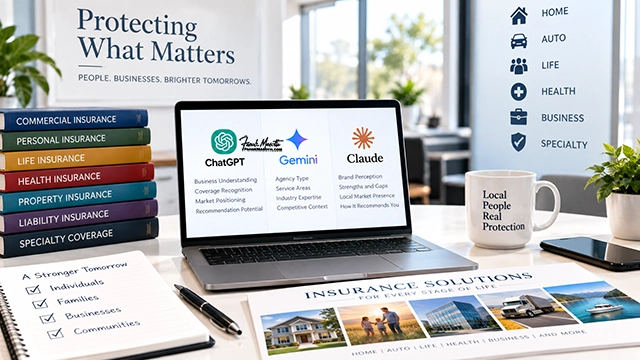
AI Search Engine Audit for Insurance Agencies
An insurance agency can be known online, have a professional website, appear in local search, and still have no clear idea what ChatGPT, Gemini, and Claude actually understand about it.
Do they know whether your agency is independent or captive? Do they understand which types of insurance you sell? Do they recognize that you specialize in commercial coverage for certain industries, or do they describe you as a general insurance agency? Do they understand the geographic markets you serve? If someone asks for an insurance agency that fits a particular need, do the AI systems recognize your agency as a possible recommendation?
Those are questions the Frank Masotti AI Business Understanding Report is designed to investigate. I manually evaluate your insurance agency across ChatGPT, Gemini, and Claude and compare what the three systems understand, misunderstand, omit, associate with the agency, and potentially recommend.
The report is a one time $495 analysis of your actual business.
What Does AI Understand About Your Insurance Agency?
An AI search engine audit for an insurance agency is not an audit of how your staff uses artificial intelligence. It is an examination of how AI systems understand the agency itself.
That distinction matters in insurance because simply recognizing an agency’s name is not enough.
An independent agency may represent multiple insurance companies, while a captive agency represents one insurer. An agency may concentrate primarily on personal lines, commercial lines, life insurance, health insurance, or some combination. Another may have developed considerable expertise serving contractors, restaurants, trucking companies, property owners, manufacturers, professional firms, or another particular market.
From the agency’s perspective, those differences are obvious.
The question is whether they are equally obvious to AI.
If ChatGPT understands that you are an independent agency specializing in commercial insurance while Gemini describes you primarily as a personal auto and homeowners agency, those systems have formed materially different pictures of the same company.
That is the kind of disagreement worth finding.
Insurance Agencies Have More Than One Layer for AI to Understand
Insurance agencies are particularly interesting from an AI understanding standpoint because the business name alone tells a model very little about what the agency can actually do for a prospective client.
AI may need to correctly connect several pieces of information.
An agency could offer homeowners, auto, renters, umbrella, life, workers compensation, general liability, commercial property, business auto, professional liability, cyber insurance, or other forms of coverage.
But a list of products still does not necessarily explain the agency.
The agency may serve both consumers and businesses but have a strong commercial focus. It may work extensively with a particular industry. It may serve clients across several states even though it has only one physical office. An independent agency may have access to multiple carriers, while another agency operates under a single insurance brand.
These distinctions affect whether an AI generated description is merely factually plausible or actually represents the agency people would be doing business with.
That difference is important because AI can know individual facts about a company while still missing the bigger picture.
Independent, Captive, Agency, or Broker?
One of the most important questions for an insurance agency AI audit is whether the models understand what kind of insurance business they are looking at.
An independent agency and a captive agency do not have the same relationship with insurance carriers. An insurance broker and an insurance agent are not necessarily interchangeable descriptions either.
A prospective customer may specifically ask an AI system for an independent insurance agency because the ability to work with multiple insurers matters to that person. A commercial buyer may be looking for an insurance professional experienced with a particular type of risk.
If your business has a clear position in that market, you would want to know whether AI recognizes it.
You would also want to know if one model gets it right while another does not.
That is one reason I evaluate three AI systems rather than relying on a single ChatGPT answer. One model gives you one interpretation. Comparing three can expose disagreements that would otherwise remain invisible.
Does AI Understand What You Actually Insure?
Consider an agency with a substantial commercial book.
Its website may discuss business insurance, workers compensation, general liability, commercial auto, property coverage, and specialized programs. Over years of operation, however, the agency may also have accumulated directory listings, carrier profiles, social pages, old website content, reviews, and third party references emphasizing personal auto and homeowners insurance.
What conclusion does AI reach from all of that?
That cannot safely be answered by looking at the agency’s current website alone.
The same problem can work in reverse. An agency focused heavily on personal lines could be described too broadly as a full service commercial insurance resource because AI found scattered references to business coverage.
The facts do not even have to be completely wrong for the resulting interpretation to be misleading.
That is why an AI visibility audit should examine more than whether the business appears in an answer. The description attached to that appearance matters too.
Specialization Can Matter More Than the General Category
For many insurance agencies, the valuable question is not whether AI knows they sell insurance.
That is the easy part.
The harder question is whether AI understands who they are particularly equipped to insure.
A commercial agency may have years of experience working with construction companies. Another may understand hospitality risks. Another may concentrate on transportation, real estate, professional services, agriculture, or small businesses in its local market.
Those specialties can be part of what separates one agency from hundreds of others.
If someone asks an AI system for an insurance agency experienced with contractors and the model sees your company only as a generic insurance agency, an important part of the business has disappeared from the answer.
The same applies to personal lines. An agency’s actual strengths, products, geographic coverage, carrier relationships, service model, and client base can all influence whether an AI recommendation makes sense.
Before AI can make a useful recommendation, it first has to understand enough about the agency to connect it with the request.
Geography Is Not Always as Simple as the Office Address
Insurance creates another issue that many local businesses do not have in quite the same way.
The location of the office and the geographic market the agency can serve are not necessarily identical.
An agency might be physically located in one city while serving clients throughout a state. It might be licensed and actively writing business in several states. Conversely, an AI system might associate an agency with an area where it no longer operates or fail to recognize a market it currently serves.
That creates several questions worth testing.
Does AI understand where the agency is located?
Does it understand where the agency actually serves clients?
Does it associate an old location with the company?
Does it incorrectly assume that the office’s city defines the agency’s entire service area?
For an insurance agency seeking clients beyond the immediate neighborhood surrounding its office, those distinctions can matter considerably.
What Happens When Someone Asks AI for an Insurance Agency?
The question becomes especially interesting when the user is not searching for your agency by name.
Someone might ask:
“Who can help me insure my contracting company?”
“Recommend an independent insurance agency near me.”
“Who specializes in commercial insurance for restaurants?”
“I need an insurance agent who can help me compare options.”
At that point, recognition and recommendation become different issues.
ChatGPT might know your agency when specifically asked about it and still never consider it when asked whom to recommend.
Gemini might associate your agency with the correct market but misunderstand its specialties.
Claude might recognize a specialization that the other two systems miss entirely.
There is no reason to assume all three systems have formed the same interpretation.
I wrote separately about why AI may recommend competitors but not your business, because recognition and recommendation are not the same problem.
For an insurance agency, that difference deserves to be examined rather than assumed.
What an Insurance Agency Could Learn From the Report
The Frank Masotti AI Business Understanding Report looks for the patterns that become visible when the actual responses from ChatGPT, Gemini, and Claude are examined together.
For an insurance agency, that could mean discovering that the models disagree about whether the agency is independent, that an important insurance specialty is consistently omitted, that the agency is strongly associated with personal lines despite a substantial commercial focus, or that a model associates the company with an outdated location or service.
It could also reveal something positive.
The models may understand the agency remarkably well. They may consistently recognize important specialties, describe the company accurately, associate it with attributes the agency wants to be known for, and consider it in relevant recommendation situations.
That is useful information too.
The purpose of the analysis is not to manufacture problems.
It is to find out what is actually there.
Three Models. One Manual Analysis.
I personally conduct the analysis rather than putting your insurance agency into an automated scanner and handing you a visibility score.
ChatGPT, Gemini, and Claude are evaluated and their responses are compared.
I look at what they understand about the business, where information appears missing, where descriptions become inaccurate or incomplete, what attributes they associate with the agency, how recognition and recommendation patterns appear, and where the models disagree.
The completed Frank Masotti AI Business Understanding Report is a 10+ page PDF containing the findings, strategic observations, and recommendations based on what I found.
It costs $495 as a one time purchase and is delivered the next business day after the analysis is completed.
This is diagnosis, not an ongoing marketing service. I do not sell an SEO, GEO, AEO, or AI visibility implementation package after the report.
If you want to see exactly what you are buying, I explain the report separately and maintain a library of completed AI Business Understanding Reports.
Do ChatGPT, Gemini, and Claude Understand Your Insurance Agency Correctly?
Your website tells people what your insurance agency does.
That does not tell you what AI concluded from everything it can associate with the business.
If your agency is independent, does AI know it?
If you specialize in particular types of insurance or industries, does AI recognize those specialties?
Does it understand your actual geographic market?
Does it know the difference between the business you operate today and information that may still exist from years ago?
And when someone asks AI to recommend an insurance agency for a need your company can handle, does your agency enter the conversation at all?
You do not have to guess.
Order the Frank Masotti AI Business Understanding Report and I will manually evaluate what ChatGPT, Gemini, and Claude currently understand about your insurance agency.
$495. One time. Three AI models. One manually researched report.