
AI Search Report for Abattoirs
| How I Score a Abattoir AI Search Performance in my AI Business Understanding Report | |
| Does AI understand what your business is? | 20 Points |
| Does AI understand what you actually sell or provide? | 20 Points |
| Does AI understand who your business is for? | 15 Points |
| Does AI understand what makes your business different? | 15 Points |
| Does AI know when your business belongs in the conversation? | 15 Points |
| What does AI have wrong, missing, or confused? | 10 Points |
| Do ChatGPT, Claude, and Gemini understand your business the same way? | 5 Points |
| Total points available 100 points | |
An abattoir can be described in a few words as a facility where livestock are slaughtered. That description may be technically correct and still leave out nearly everything a livestock producer, meat business, restaurant supplier, processor, or other potential customer actually needs to know.
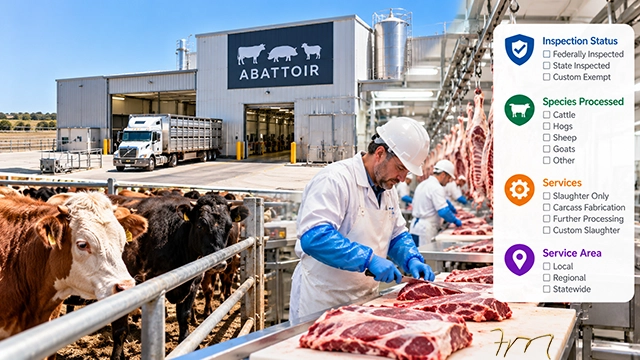
Does the facility operate under federal inspection? Does it provide custom exempt slaughter? Which livestock species does it handle? Does it only slaughter animals, or does it also provide carcass fabrication and further processing? Who can legally buy the resulting meat? What geographic market does the operation serve?
Those distinctions matter because an abattoir is not interchangeable with every other slaughter or meat processing facility.
The Frank Masotti AI Business Understanding Report examines what ChatGPT, Claude, and Gemini currently understand about an individual business. For an abattoir, that means looking beyond whether AI recognizes the company name and determining whether the models understand the type of operation that actually exists.
What Does AI Understand About Your Abattoir?
The first question is not simply whether ChatGPT, Claude, or Gemini knows that your company is an abattoir or slaughterhouse.
The more useful question is what those systems believe happens there.
An AI system could correctly identify an abattoir while misunderstanding the operation in ways that matter to someone searching for a facility.
For example, AI may need to distinguish between a federally inspected establishment and a custom exempt operation. Under USDA Food Safety and Inspection Service rules, custom slaughter involves an owner’s animal being slaughtered or prepared for the owner’s household use and is treated differently from meat produced for sale in commerce. Meat and poultry entering interstate or foreign commerce are subject to federal inspection requirements.
That is not a minor technical distinction. It can determine whether the facility AI recommends is even appropriate for what the person asking needs.
The same problem can occur with species. An abattoir processing cattle may not process hogs, sheep, goats, or other livestock. A model that understands the general category but gets the species wrong has not provided a useful answer.
AI Search Report for Abattoirs
An AI Search Report for an abattoir should examine the operational distinctions that affect whether the business belongs in a particular AI recommendation.
ChatGPT might recognize the company as a slaughter facility. Gemini might describe it more broadly as a meat processor. Claude might associate the same company primarily with custom livestock processing.
All three answers could contain pieces of the truth while presenting three meaningfully different versions of the business.
That is why different AI models can understand different versions of the same company.
For an abattoir, the difference between those versions can affect the kinds of AI searches in which the facility appears.
Someone might ask an artificial intelligence search engine for a slaughterhouse that processes cattle in a particular region. Another person might need a facility capable of handling hogs. A livestock producer might specifically need custom slaughter. A meat business may require inspected production appropriate for commercial distribution.
Simply being categorized as an “abattoir” does not answer any of those questions.
Does AI Understand Your Inspection Status?
Inspection status is one of the clearest areas where incomplete AI understanding could produce a bad match.
USDA FSIS distinguishes federally inspected establishments, state inspected operations, and qualifying custom exempt activities. Those categories affect how meat can be handled and distributed.
If an AI system fails to understand that distinction for a particular facility, it could associate the business with work it cannot perform for the customer under the required conditions.
The opposite problem matters too.
An abattoir may have capabilities that make it appropriate for a particular commercial customer, but AI could describe the facility too narrowly and leave those capabilities out.
The owner therefore needs more than recognition. The owner needs to know whether AI understands the regulatory and operational category the facility actually occupies.
Does AI Know Which Animals You Process?
Species capability sounds obvious when you work inside the industry. It is not necessarily obvious from the scattered information an AI model encounters about a business.
A cattle slaughter facility is not automatically a hog slaughter facility. A plant handling cattle and hogs should not automatically be assumed to process sheep or goats.
An AI answer that says “livestock processing” can conceal that uncertainty.
For someone merely researching what the company is, the broad description may look acceptable. For someone asking where to take a particular animal for slaughter, the missing species information becomes central to the recommendation.
This is one reason an AI visibility check cannot stop at whether the company appears in an answer. The description attached to that appearance matters.
Does AI Confuse Slaughter With Meat Processing?
“Slaughterhouse,” “abattoir,” “meat processor,” and “meat packing plant” can overlap in ordinary language, but they do not necessarily describe identical operations.
A facility may perform slaughter and dressing without providing every further processing service a customer associates with a meat processor. Another operation may provide slaughter plus cutting, wrapping, grinding, smoking, curing, or other services.
The exact capabilities depend on the facility.
AI can flatten those distinctions by taking one accurate category and filling in the rest from what is typical of that category.
That creates a particularly interesting question for an abattoir owner:
Is AI describing what your facility actually does, or what it assumes a typical slaughter and processing facility does?
The difference may not become visible until someone asks about a specific service.
Can AI Tell Who Your Abattoir Actually Serves?
An abattoir can serve very different customer groups depending on its inspection status, capabilities, capacity, location, and business model.
Potential customers can include livestock producers, ranchers, farmers, meat companies, wholesalers, retailers, restaurants, institutions, and individuals seeking custom slaughter and processing.
Not every facility serves every one of those groups.
AI needs to understand that customer fit if it is going to make a useful recommendation.
A model could know your name, location, and industry while associating your business with the wrong type of customer. That is a much deeper problem than simply getting a phone number wrong.
It means the model has misunderstood where your business belongs in the market.
What Attributes Does AI Associate With the Facility?
AI recommendations are not based solely on service lists. Models can also associate businesses with attributes that influence whether the company appears appropriate for a particular request.
For an abattoir, relevant attributes could involve processing capacity, species specialization, local or regional focus, custom processing, commercial orientation, accessibility to smaller livestock producers, or other characteristics supported by public information about the facility.
Those attributes deserve examination rather than assumption.
As I explain in What Attributes Does AI Associate With Your Business?, a model can attach characteristics to a company that go beyond the factual list of services on its website.
For an abattoir, an inaccurate attribute can change the recommendation.
If AI assumes a facility primarily serves large commercial operations when it actually works extensively with smaller producers, the business could disappear from exactly the searches where it belongs.
If AI assumes a smaller custom operation can handle commercial requirements it does not offer, the opposite problem occurs.
What Happens When ChatGPT, Claude, and Gemini Disagree?
One model knowing the business correctly does not mean the other two do.
ChatGPT could correctly identify the species processed but miss an important processing capability.
Claude could understand the services but characterize the customer base incorrectly.
Gemini could have the strongest understanding of the facility’s location and market but use a broad category that hides an important inspection or processing distinction.
Looking at one AI answer would not reveal that disagreement.
For an abattoir, comparing the models can show which parts of the business are clearly understood and which parts are unstable, incomplete, outdated, or being inferred.
That is useful information because the owner already knows how the facility operates.
What the owner usually does not know is the version of that operation being presented by AI.
What Could an Abattoir Learn From an AI Search Report?
The analysis can reveal whether ChatGPT, Claude, and Gemini understand the facility’s basic identity, slaughter and processing capabilities, customer types, important specialties, location, and other publicly supported attributes.
It can also uncover something less obvious: omissions.
Suppose all three models correctly identify the business as an abattoir, but none mentions a service or capability that matters commercially. Technically, the models have not said anything false.
They have still produced an incomplete picture of the business.
The same applies when one model understands an important distinction and the other two do not.
Those differences are difficult to discover by occasionally typing the company name into ChatGPT. They become much easier to see when the three systems are examined systematically and their answers are compared side by side.
A Manual Analysis of Your Abattoir Across Three AI Systems
I manually evaluate the business across ChatGPT, Claude, and Gemini and compare what the models understand, misunderstand, omit, and associate with the company.
The report is not an automated SEO scanner. It does not grade your website and produce a generic list of technical fixes.
It is a diagnosis of AI understanding.
The $495 one time report includes a 10+ page PDF covering findings from all three models, cross model comparison, misunderstandings and omissions, attributes, recognition and recommendation visibility, strategic observations, and recommendations based on what the analysis actually finds.
The completed report is delivered the next business day after the analysis is finished.
The purpose is not to promise that an abattoir will suddenly appear in every AI recommendation. It is to answer the question that has to come first:
Do ChatGPT, Claude, and Gemini actually understand your abattoir correctly?
You know whether you provide inspected slaughter, custom work, which species you handle, what processing capabilities you offer, and who you actually serve.
You probably do not know whether three major AI systems know the same things.
The Frank Masotti AI Business Understanding Report gives you the evidence. The report costs $495, covers ChatGPT, Claude, and Gemini, and shows you what each system currently understands about your business and where that understanding breaks down.