
AI Search Report for Abrasive Sand Quarrying
| How I Score an Abrasive Sand Quarrying AI Search Performance in my AI Business Understanding Report | |
| Does AI understand what your business is? | 20 Points |
| Does AI understand what you actually sell or provide? | 20 Points |
| Does AI understand who your business is for? | 15 Points |
| Does AI understand what makes your business different? | 15 Points |
| Does AI know when your business belongs in the conversation? | 15 Points |
| What does AI have wrong, missing, or confused? | 10 Points |
| Do ChatGPT, Claude, and Gemini understand your business the same way? | 5 Points |
| Total points available 100 points | |
An abrasive sand quarry can be understood correctly at the broadest level and still be misunderstood where it matters commercially.
ChatGPT, Claude, or Gemini might recognize a company as an industrial sand producer while failing to understand what kind of abrasive material it actually supplies, how that material is processed, what applications it is suited for, or which buyers the operation is equipped to serve.
The Frank Masotti AI Business Understanding Report shows what ChatGPT, Claude, and Gemini currently understand about an individual abrasive sand quarrying business and where those three models agree, disagree, omit important information, or associate the company with the wrong part of the industrial sand market.
For an abrasive sand producer, those distinctions matter.
What Does AI Understand About Your Abrasive Sand Quarrying Business?
Abrasive sand quarrying sits within a much broader industrial sand category. The U.S. Census Bureau places abrasive sand quarrying and beneficiating within NAICS 212322, Industrial Sand Mining, alongside blast sand, filtration sand, foundry sand, glass sand, grinding sand, molding sand, silica sand, and other industrial sand operations.
That creates an immediate AI understanding problem.
Knowing that a company produces industrial sand does not necessarily mean an artificial intelligence search engine understands that the company produces abrasive sand.
It also does not mean the model understands whether the operation extracts material, beneficiates it, screens or washes it, produces particular grades, or supplies material for particular abrasive applications.
When someone conducts AI searches for a source of abrasive sand, the useful answer is not simply a list of companies associated with sand mining. The model needs enough understanding to distinguish suppliers whose products and capabilities actually match the request.
Abrasive Sand Is Not Just Sand
The commercial identity of an abrasive sand operation can depend heavily on the material itself.
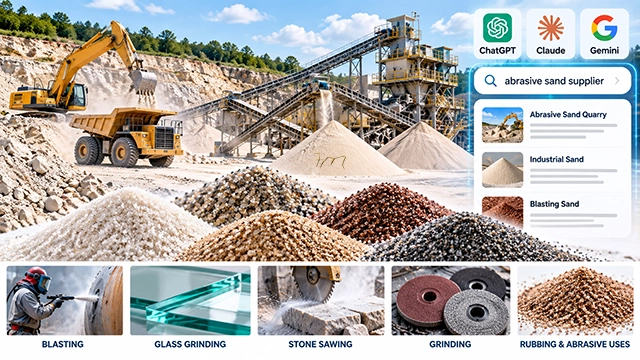
Abrasive sands have historically been used for applications including blasting, glass grinding, stone sawing, rubbing, and other grinding purposes. Different applications can require different particle sizes, grain characteristics, purity, hardness, and consistency.
That gives ChatGPT, Claude, and Gemini considerably more to understand than the phrase “sand quarry.”
For a particular company, relevant questions could include:
- What mineral material is actually being extracted?
- Is the operation producing silica sand, garnet bearing material, or another abrasive material?
- What grades or particle sizes are available?
- Is material washed, screened, classified, crushed, dried, or otherwise beneficiated?
- What abrasive applications are the finished products intended to serve?
- Does the company sell raw material, processed material, or both?
- What geographic markets can the quarry economically serve?
- Does the company supply bulk industrial customers, distributors, processors, or other buyers?
Industrial sand processing itself can involve washing, screening, classification, removal of impurities, drying, and additional preparation depending on the deposit and intended finished product.
If those distinctions are central to your operation, you would want to know whether AI systems understand them.
Could AI Confuse Your Quarry With Another Type of Industrial Sand Operation?
This is one of the more interesting questions for this particular industry.
Abrasive sand is surrounded by closely related categories.
The same NAICS industry includes foundry sand, filtration sand, glass sand, molding sand, blast sand, grinding sand, silica sand, and other industrial sands.
A company can therefore be identified correctly as an industrial sand producer while still being categorized incorrectly for a specific buyer’s purpose.
Imagine that your quarry primarily supplies abrasive material but an AI model has stronger associations between your company and general silica sand production. Another model might understand the abrasive application correctly. A third might know the company exists but provide almost no useful information about the material it supplies.
Those are three very different versions of the same business.
That is exactly why looking at one AI answer is not enough. I explain this further in Why Three AI Models?.
Does AI Understand the Material You Actually Produce?
For abrasive sand, product attributes can be as important as the company category.
Particle size and distribution can matter. Mineral composition can matter. Grain shape, hardness, cleanliness, consistency, and the presence of unwanted material can matter depending on the intended application. Published industrial sand specifications vary substantially according to end use.
An AI model does not have to completely invent something about your company to create a misleading picture.
It can simply leave out the attributes that explain why a buyer would consider your material.
Suppose the model correctly identifies your quarry and location but says nothing about processing capabilities or available grades. That description may technically be accurate while still failing to represent the operation in a useful commercial context.
This is one reason what AI leaves out when it explains a business can be just as important as what it gets wrong.
Does AI Understand the Difference Between Extraction and Beneficiation?
This distinction is particularly relevant to abrasive sand quarrying.
The official industry definition does not stop at operating industrial grade sand pits. It also includes dredging and preparing industrial sand through activities such as washing and screening.
That means two companies broadly classified in the same industry may offer substantially different capabilities.
One operation might primarily extract material.
Another might extract, wash, classify, screen, dry, and prepare multiple finished grades.
If an AI model reduces both companies to “sand mining companies,” important differences disappear.
For a buyer looking for material that already meets a particular requirement, those differences could influence which companies belong in the conversation.
Geography Can Become Part of the AI Understanding
Abrasive sand is a physical commodity, so location can become commercially significant.
Transportation economics can affect the practical market for industrial mineral products, and historical technical literature specifically notes transportation cost as an important consideration for some abrasive sand applications.
That creates another question worth testing.
Does AI understand where your operation is located and the markets it actually serves?
A model could understand your products but associate the company with an incomplete or outdated geographic footprint. It could know the quarry location without understanding where material is shipped. It could also associate the business with a corporate office while missing the location of the actual operation.
For a quarry, location is not merely contact information. It can be part of the commercial context surrounding the company.
What Happens When Three AI Models Disagree?
This is where an AI Search Report becomes more useful than simply asking ChatGPT about your company once.
ChatGPT might associate your company primarily with abrasive sand.
Claude might describe it as a general industrial sand producer.
Gemini might recognize the company but omit the abrasive applications or processing capabilities that distinguish it.
The disagreement itself becomes information.
It shows that there is no single consistent AI understanding of the business.
That matters because customers are not all using the same system. Someone researching abrasive material suppliers through ChatGPT may encounter a different representation of your company than someone conducting the same research through Gemini or Claude.
The question is therefore not simply whether AI “knows” your company.
The question is what each model thinks your company is.
AI Search Report for Abrasive Sand Quarrying
My AI Search Report process examines that question directly.
I manually evaluate how ChatGPT, Claude, and Gemini understand an individual business and compare their responses. This is not an automated SEO scanner and it is not an audit of how your company uses artificial intelligence.
The analysis looks for issues including category understanding, products and offerings, customer and use case understanding, attributes associated with the company, misunderstandings, omissions, recognition patterns, recommendation visibility, and disagreements between the three models.
You can see more about how the analysis is performed before ordering.
For an abrasive sand quarrying operation, I am looking for whether the models understand the actual business behind the broad industrial sand label.
Do they understand what you quarry?
Do they understand what you process?
Do they understand what your material is used for?
Do they understand the attributes that distinguish your products?
Do they understand where you operate and who you can realistically serve?
And when someone asks for companies capable of supplying the type of abrasive material you provide, do the models understand enough about your company for it to belong in that conversation?
Those questions cannot be answered by looking at your website and assuming AI interpreted everything correctly.
They have to be tested.
Find Out What AI Understands About Your Abrasive Sand Quarry
The Frank Masotti AI Business Understanding Report is a $495 one time manual analysis of your business across ChatGPT, Claude, and Gemini.
You receive a 10+ page PDF showing what the models understand, what they misunderstand or omit, where their interpretations differ, what attributes they associate with your company, how your business appears in recommendation related analysis, and what deserves attention based on the findings.
The report is diagnostic. I do not sell an SEO, GEO, AEO, or AI visibility implementation service afterward. The point is to establish what the three systems currently understand before deciding whether anything needs to be changed.
If you operate an abrasive sand quarry, you probably already know what makes your deposit, processing operation, finished material, and market different from another industrial sand producer.
The unanswered question is whether ChatGPT, Claude, and Gemini know it too.
Order the Frank Masotti AI Business Understanding Report for $495 and find out what the three major AI systems currently understand about your business.