
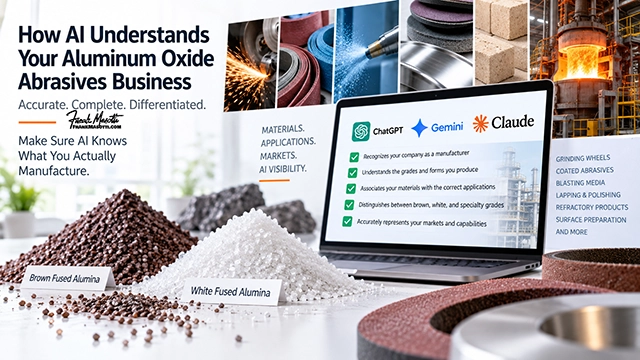
Aluminum Oxide (Fused) Abrasives Manufacturing AI Visibility Audit Report
If your company manufactures fused aluminum oxide abrasives, a customer researching suppliers through ChatGPT, Gemini, or Claude may ask questions far more specific than who sells abrasive material. They may be looking for a manufacturer of brown fused alumina, white fused alumina, a particular grit range, abrasive grain for bonded or coated products, blasting media, or material suited to a particular industrial application. The important question is whether those AI systems understand what your company actually manufactures well enough to make those distinctions. The Frank Masotti AI Business Understanding Report manually evaluates what ChatGPT, Gemini, and Claude understand about your company and shows you where that understanding is accurate, incomplete, incorrect, or different from one model to another.
What Is an Aluminum Oxide (Fused) Abrasives Manufacturing AI Visibility Audit Report?
An aluminum oxide (fused) abrasives manufacturing AI visibility audit report examines how major AI systems understand and represent a manufacturer in this specialized industry.
It is not an audit of how your plant uses artificial intelligence. It is also not an automated audit performed by AI.
In this context, an AI audit examines what AI systems believe about the company itself. Do they understand that you manufacture fused aluminum oxide abrasive material? Do they recognize the grades and forms you produce? Do they associate the company with the correct industrial applications? Do they understand whether you actually manufacture the material or merely distribute abrasive products made elsewhere?
Those distinctions can become important when a buyer uses AI to research manufacturers, compare suppliers, identify possible sources for a particular abrasive grain, or understand which companies serve a specific application.
The Frank Masotti AI Business Understanding Report is designed to show you what ChatGPT, Gemini, and Claude currently understand before you decide whether anything about that understanding needs attention.
Why Does a Fused Aluminum Oxide Abrasives Manufacturer Need an AI Audit?
Fused aluminum oxide is not a single interchangeable product.
Brown fused aluminum oxide can be manufactured in numerous grit and powder sizes and used for applications including grinding wheels, coated abrasives, blasting media, metal preparation, lapping, polishing, and refractory products. White fused aluminum oxide can serve many of those markets as well, while differences in purity, friability, chemistry, grain characteristics, and intended application can matter to the buyer.
That creates a much more complicated AI identity than simply:
“Company X makes abrasives.”
For example, an AI system could recognize your company as an abrasive supplier while failing to understand that you actually manufacture fused aluminum oxide.
It could associate you primarily with blasting media even though bonded abrasives are an important part of your business.
It could understand that you manufacture brown fused alumina but fail to recognize white fused alumina or specialty grades you also produce.
It could associate your material with grinding wheels but omit coated abrasives, lapping, polishing, refractory, surface preparation, or other applications you serve.
It could also flatten meaningful product distinctions and describe several grades as though they were essentially the same material.
For an industrial manufacturer, that incomplete understanding can matter.
A purchasing professional, abrasive product manufacturer, fabricator, refractory producer, or engineer may not be asking AI for “an aluminum oxide company.” They may be describing the material, specifications, application, or performance characteristics they need and asking which manufacturers appear relevant.
Your company can be known to an AI system and still be poorly understood for that particular question.
Does AI Understand What You Actually Manufacture?
This is one of the most important questions for a fused aluminum oxide abrasives manufacturer.
Fused alumina manufacturing can involve electric arc furnace fusion followed by processing that produces abrasive grains and powders in controlled sizes. Different products can then be manufactured or processed for particular abrasive and industrial uses.
AI therefore has several opportunities to oversimplify the company.
Does it identify you as a manufacturer?
A mineral producer?
An abrasive grain manufacturer?
An abrasive products company?
A blasting media supplier?
A refractory raw material supplier?
A distributor?
Those descriptions are not necessarily equivalent.
If your company controls actual fusion and manufacturing, being represented primarily as a distributor misses an important part of what the business is.
Likewise, if you produce abrasive grain used by other manufacturers to make grinding wheels, belts, discs, and related products, an AI system that describes you as a manufacturer of finished grinding wheels may have moved you to the wrong point in the supply chain.
That is exactly the kind of distinction an industry specific AI visibility audit should investigate.
Can AI Distinguish Your Fused Aluminum Oxide Products?
Product differentiation is another major issue.
Within fused aluminum oxide, buyers can encounter differences involving:
- Brown versus white fused aluminum oxide
- Alumina purity and chemical composition
- Toughness and friability
- Grain shape
- Macrogrits, microgrits, and powders
- Standard and custom particle sizes
- Material for bonded abrasives
- Material for coated abrasives
- Blasting grades
- Grinding and polishing applications
- Specialty treated grains
- Industrial and refractory applications
Manufacturers can offer surprisingly broad product ranges within what an AI system may summarize simply as “aluminum oxide abrasive.” Commercial product catalogs show fused alumina supplied across extensive grit ranges and in products developed for particular bonded, coated, blasting, refractory, and industrial applications.
If your competitive position depends on those distinctions, you would want to know whether AI recognizes them.
The issue is not whether ChatGPT can define brown fused alumina.
The issue is whether ChatGPT understands your company’s relationship to brown fused alumina, and whether Gemini and Claude reach the same conclusion.
What Can an AI Audit Reveal for a Fused Aluminum Oxide Abrasives Manufacturer?
A useful AI audit for this industry can reveal much more than whether the company name appears in an answer.
It can show whether ChatGPT, Gemini, and Claude understand your company as an actual manufacturer and what product categories they associate with you.
It can identify important products or capabilities that appear to be missing from their understanding.
The analysis can uncover incorrect associations with products you do not manufacture, confusion between your raw abrasive grains and finished abrasive products, or an incomplete picture of the industries and applications your materials serve.
It can also show what attributes AI associates with your company.
Does a model associate the manufacturer with product consistency, specialized grades, custom sizing, particular industrial markets, technical expertise, broad availability, or something entirely different?
Sometimes the most useful finding is not an outright error. It is discovering that an important characteristic of the company is simply absent.
What Happens When ChatGPT, Gemini, and Claude Disagree?
Three AI systems do not necessarily build the same picture of a manufacturer.
ChatGPT might correctly recognize several of your abrasive product lines while Gemini associates the company with a narrower set of applications. Claude might understand your manufacturing role but omit a specialty material that another model recognizes.
One model might identify the company when asked about manufacturers for a particular application while another does not.
That disagreement is useful information.
As I explain in Why Three AI Models?, one AI system gives you one interpretation. Comparing three lets you see where their understanding agrees and where it breaks apart.
This is also why simply opening ChatGPT and asking one question about your company does not provide the same information as a structured analysis. Why Can’t I Just Ask ChatGPT Myself? explains why the comparison matters.
Recommendation Visibility Can Be Highly Specific in This Industry
For a fused aluminum oxide manufacturer, recommendation visibility should not be reduced to whether AI recommends the company in general.
The real questions can be much narrower.
Would the company appear relevant when someone asks about manufacturers of brown fused aluminum oxide for bonded abrasives?
What about white fused alumina where contamination is a concern?
A source for abrasive blasting grain?
A manufacturer supplying material for grinding wheels?
A supplier capable of providing particular grit sizes?
An abrasive grain manufacturer serving a specialized industrial application?
Industrial fused alumina products are marketed around precisely these kinds of application and material distinctions. Aerospace applications alone can involve abrasive grains used for surface preparation of turbine blades, engine components, gears, bearings, and other precision components, with specific industry specifications potentially entering the purchasing decision.
A manufacturer could therefore have good recognition under its company name while being largely absent when AI is asked the kinds of product and application questions that a potential customer might actually use.
The report examines recommendation visibility as part of the broader question of how AI understands the business. It does not promise that your company will be recommended.
How the Frank Masotti AI Business Understanding Report Works
I manually evaluate your company across ChatGPT, Gemini, and Claude.
This is not an automated scanner that enters a company name, generates a score, and produces a templated report.
I examine the models’ responses, compare what they understand, identify agreements and disagreements, and analyze what those responses collectively say about the AI understanding of your business.
The analysis looks at areas including business recognition, category understanding, products and capabilities, attributes associated with the company, misunderstandings, omissions, outdated or incorrect information, recommendation visibility, and differences among the three models.
You can read the complete AI Business Understanding Report methodology to see how the evaluation is performed.
What Does Your Company Receive?
The Frank Masotti AI Business Understanding Report costs $495 as a one time purchase.
You receive a 10+ page PDF report covering ChatGPT, Gemini, and Claude.
Every report is manually analyzed and includes a cross model comparison, findings about how the models understand the company, misunderstandings and omissions I identify, attributes associated with the business, recognition and recommendation visibility, strategic observations, and recommendations based on the findings.
The completed report is delivered the next business day after the analysis is finished.
You can also see examples in the completed AI Business Understanding Reports library.
What Happens After the AI Audit?
You have evidence.
Instead of assuming AI understands that you manufacture fused aluminum oxide, you can see what three major AI systems actually say.
Instead of assuming they understand your products and applications, you can see which ones appear in their answers and which ones do not.
Instead of assuming ChatGPT, Gemini, and Claude see the company the same way, you can compare them directly.
If the findings reveal problems, the report gives you recommendations based on what was actually found.
I do not sell an optimization package afterward. I do not sell an ongoing AI visibility retainer. The purpose of the report is diagnosis first.
You can decide what deserves attention after you know what the problem actually is. That approach is explained further in What Happens After I Receive the Report?.
Do ChatGPT, Gemini, and Claude Understand Your Fused Aluminum Oxide Abrasives Business?
Your company may manufacture brown fused alumina, white fused alumina, specialty abrasive grains, particular grit ranges, or products engineered for specific grinding, blasting, finishing, bonded, coated, or industrial applications.
You know those distinctions.
Your customers may know them.
But do ChatGPT, Gemini, and Claude?
And when someone asks an AI system to identify or compare manufacturers capable of supplying what they need, does the model understand enough about your company to recognize where it fits?
You do not have to guess.
The Frank Masotti AI Business Understanding Report is $495, one time, and manually evaluates your business across ChatGPT, Gemini, and Claude.
Order your AI Business Understanding Report and find out what the three AI systems actually understand about your aluminum oxide abrasives manufacturing business.
This one actually feels like a manufacturer article, not an oilseed article with the nouns changed. The manufacturer vs distributor distinction and the raw abrasive grain vs finished abrasive product distinction are especially strong for this category.