
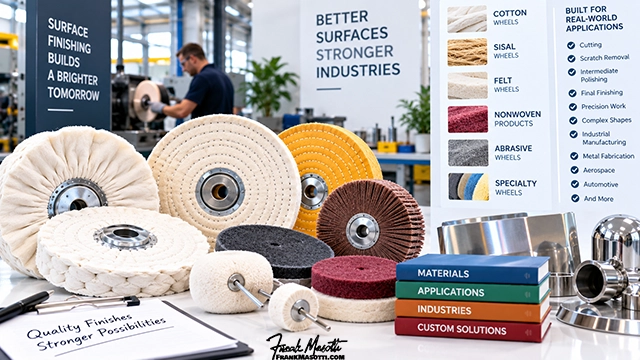
Buffing and Polishing Wheels, Abrasive and Nonabrasive, Manufacturing AI Visibility Audit Report
If your company manufactures buffing and polishing wheels, you probably know exactly where each product belongs in a finishing operation. The question is whether ChatGPT, Gemini, and Claude understand those distinctions when someone researches your company. Do they understand whether you manufacture abrasive wheels, nonabrasive buffing wheels, cotton or sisal wheels, nonwoven products, specialty wheels, or several different product lines? Do they understand the materials, applications, configurations, and industries your products are designed for? The Frank Masotti AI Business Understanding Report is a manual $495 analysis designed to show you what all three AI systems currently understand about your business.
What Is a Buffing and Polishing Wheels Manufacturing AI Visibility Audit Report?
An AI visibility audit report for a buffing and polishing wheel manufacturer examines how major AI systems understand, describe, interpret, and potentially recommend the company.
It is not an audit of the artificial intelligence your manufacturing operation uses. It is also not an audit performed automatically by AI software.
The subject being audited is AI’s understanding of your company.
When someone asks an AI system about manufacturers of industrial polishing products, sources for a particular type of buffing wheel, companies serving a particular finishing application, or alternatives to a manufacturer they already know, the AI system has to determine what companies belong in that answer and what each company actually provides.
That requires considerably more understanding than simply recognizing that your company has something to do with abrasives or polishing.
The AI needs to build an accurate picture of the manufacturer behind the products.
Why Does a Buffing and Polishing Wheel Manufacturer Need an AI Audit?
Buffing and polishing wheels occupy a particularly interesting product category because the words themselves do not completely describe what a manufacturer makes.
A wheel can be abrasive or nonabrasive. A traditional cloth buff may rely on a separately applied polishing compound for its cutting or finishing action, while another wheel may have abrasive material incorporated into its construction. Wheels can also differ substantially in material and construction.
Cotton, flannel, sisal, felt and nonwoven materials can serve different purposes. Loose, spiral sewn and other constructions can affect how firm or flexible a wheel is and the type of finishing work for which it is appropriate.
The intended operation matters as well.
One product may be designed for cutting or scratch removal. Another may be intended for intermediate polishing. A softer wheel may be designed for final finishing or for working around contours where flexibility matters.
Then there are physical specifications such as wheel diameter, thickness, number of plies, arbor or mounting configuration, and other product specific characteristics.
Those distinctions are normal to someone working in the industry. They are not distinctions you should automatically assume ChatGPT, Gemini, and Claude have connected correctly with your company.
An AI model could correctly recognize your company as a buffing wheel manufacturer while failing to understand an important part of the product line.
Another could associate the company primarily with abrasive products even though nonabrasive wheels are an important part of what you manufacture.
A model might understand that you manufacture cotton wheels but miss sisal, nonwoven or specialty products.
It could understand the products but misunderstand their applications.
It could even blur the distinction between a company that manufactures buffing and polishing wheels and one that manufactures buffing compounds, grinding wheels, polishing machinery, or distributes products made by other manufacturers.
That is why simply finding your company mentioned by an AI system does not answer the important question.
Does the AI actually understand what you manufacture?
What Can an AI Audit Reveal for a Buffing and Polishing Wheel Manufacturer?
A useful AI audit can show whether ChatGPT, Gemini, and Claude have built the same picture of your manufacturing business or three substantially different ones.
The analysis may reveal whether the models understand:
- Whether you are actually a manufacturer rather than primarily a distributor
- The abrasive and nonabrasive products you manufacture
- The materials used across your wheel lines
- The different wheel constructions and configurations you offer
- Cutting, buffing, polishing and finishing applications associated with your products
- Industries or manufacturing processes your products serve
- Specialty or custom manufacturing capabilities
- Important product categories that are missing from the AI’s description
- Products or capabilities incorrectly associated with the company
- Attributes the models associate with your business
- Whether your company appears when relevant manufacturers or suppliers are discussed
- Whether one model understands a specialty that another model overlooks
This is where a multi model comparison becomes particularly useful.
ChatGPT might build a reasonably complete picture of the product range. Gemini might emphasize a particular wheel type or market. Claude might understand the company primarily through a different part of its product catalog.
None of those individual answers gives you the complete picture.
The disagreement between them is information too.
Product Distinctions Matter to AI Understanding
For a manufacturer in this category, broad recognition can hide important misunderstandings.
Imagine that an AI system knows a company manufactures “polishing wheels.”
That sounds correct.
But what does it think that means?
Does it associate the company with cloth buffing wheels used with compounds? Does it understand abrasive wheels with abrasive material incorporated into the product? Does it recognize products intended for aggressive cutting as well as products intended for final finishing?
Does it know which wheel materials and constructions the company actually manufactures?
Does it understand whether the products are intended for flat surfaces, contours, automated operations, bench equipment, production finishing, specialty applications, or some combination of these?
For an industrial buyer trying to identify a suitable manufacturer, those details can determine whether a company belongs in the answer at all.
An AI description can therefore contain several technically accurate facts and still present an incomplete picture of the manufacturer.
That distinction is central to how AI interprets a business.
Category Confusion Can Change the Entire Picture
Buffing and polishing wheel manufacturing sits close to several related product categories.
A company in this field could be associated with buffing compounds, coated abrasives, grinding products, polishing equipment, finishing accessories, metalworking supplies, or industrial distribution.
Some manufacturers legitimately operate across several of those categories.
Others do not.
The important question is whether the AI systems have connected the right categories to your company and understand which activities represent the core manufacturing business.
If an AI system reduces a specialized manufacturer to a generic “abrasives company,” important capabilities can disappear from its explanation.
If it treats a manufacturer primarily as a supplier or distributor, the nature of the company changes.
If it associates products with the company that it does not manufacture, the picture becomes broader but less accurate.
The Frank Masotti AI Business Understanding Report methodology is designed to examine these kinds of interpretation issues rather than assign your company a generic visibility score.
How the Frank Masotti AI Business Understanding Report Works
I manually evaluate your business across ChatGPT, Gemini, and Claude.
This is not an automated scanner generating a dashboard from a collection of prompts.
I examine what the models say, preserve their responses, compare their conclusions, and analyze the patterns across all three systems.
The analysis looks at what the models understand correctly, what they misunderstand, what they omit, what attributes they associate with the company, where recognition occurs, how the business appears in recommendation related questions, and where the models agree or disagree.
You can read more about why I use three AI models and how this differs from an automated AI SEO report.
The purpose is diagnosis.
I am not selling software that promises to increase an AI visibility score. I am not selling an SEO, GEO, AEO, or AI optimization retainer after the report.
First, we find out what the AI systems actually understand.
What You Receive
The Frank Masotti AI Business Understanding Report is a $495 one time purchase.
You receive a 10+ page PDF report based on a manual evaluation of your business across ChatGPT, Gemini, and Claude.
The report includes findings about AI understanding, misunderstandings, omissions, attributes, recognition patterns and recommendation visibility. It compares the three models, identifies meaningful agreements and disagreements, provides strategic observations, and includes recommendations based on what the analysis finds.
The report is delivered the next business day after analysis completion.
You can see examples in the completed AI Business Understanding Reports library and review the complete report process here.
What Happens After the Audit?
You have evidence.
Instead of assuming that AI systems understand your manufacturing capabilities because the information exists somewhere online, you can see what three major AI systems actually concluded.
You can see whether they understand the distinction between your abrasive and nonabrasive products.
You can see whether important wheel types, materials, constructions, applications or manufacturing capabilities are missing.
You can see whether your company is being placed in the right product categories.
You can see whether ChatGPT, Gemini, and Claude agree about what your company does or whether each has developed a different interpretation.
Then you can decide what deserves attention.
That is diagnosis before prescription.
The findings are yours. You can act on them internally, give them to the people responsible for your website or marketing, share them with another provider, or simply keep the report as a record of how the three models understood the company at the time of the analysis.
There is no required implementation service afterward.
Do ChatGPT, Gemini, and Claude Understand What Your Company Actually Manufactures?
You know the difference between an abrasive wheel and a nonabrasive buff.
You know why wheel material, construction, firmness, flexibility, dimensions and application matter.
You know which products your company actually manufactures and which markets they are designed to serve.
But do ChatGPT, Gemini, and Claude know those things about your company?
There is no reason to guess.
The Frank Masotti AI Business Understanding Report gives you a manual analysis of all three models for $495.
Order the Frank Masotti AI Business Understanding Report and find out what ChatGPT, Gemini, and Claude actually understand about your buffing and polishing wheel manufacturing business.