
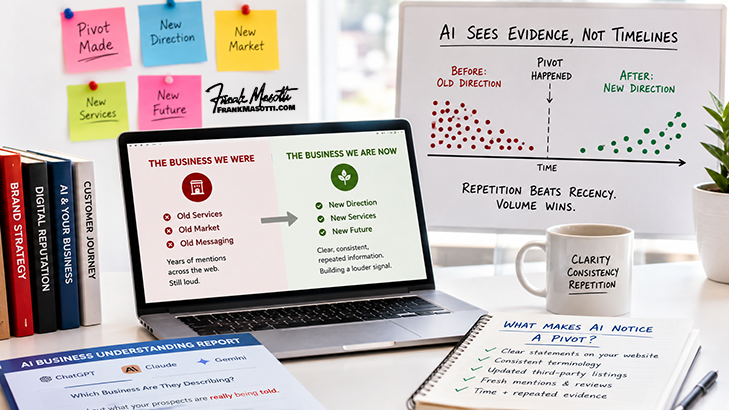
Usually not, and almost never on its own. If your business has moved into new services, dropped old ones, shifted to a different market, or repositioned entirely, systems like ChatGPT, Claude, and Gemini will not detect that change the way a person would. There is no mechanism inside these systems that notices a pivot. AI does not follow your business over time and register that something shifted. It reads evidence, and the day after you change direction, nearly all of the evidence still describes the direction you left.
So the honest answer to the question in the title is: AI can eventually reflect a change in direction, but only when the change shows up clearly and repeatedly in the information AI reads, and that usually takes far longer than owners expect. Until then, AI keeps describing the business you were, in the same confident tone it uses for everything else.
That last part matters more than it sounds. A pivot creates a specific kind of AI problem, one that is quieter than a rebrand and harder to catch, because nothing on the surface looks broken. Understanding why takes a short look at how these systems handle change, which is to say, how they fail to.
AI Has No Concept of “Before and After”
When you changed direction, there was a moment it happened. A decision, an announcement, a first client in the new specialty. Your customers processed it as an event: the business used to do one thing, now it does another. Their mental picture has a before and an after.
AI has no equivalent of that moment. These systems build their picture of your business from information gathered across the web, the way How AI Builds a Picture of Your Business From Information Across the Web describes. That picture is not a timeline. It is a file of accumulated evidence with your business name on it, and everything in the file is weighed mostly by volume and consistency, not by date. A mention from six years ago and a mention from last month sit in the same file, and AI tends to trust what it has seen most often, not what happens to be newest.
There is also a snapshot problem underneath this. AI models learn from copies of the web taken at a point in time. If your pivot happened after that snapshot, the model literally learned a version of your business that no longer exists. Some AI tools supplement their training with live search, but live search pulls from the same web, where mentions of your old direction may outnumber mentions of your new one by an enormous margin. Either way, your past has the louder voice.
Your Old Direction Left a Trail. Your New One Has Not Yet.
Think about what a decade in your original line of work actually produced: directory listings, reviews describing the old services, articles, supplier pages, social mentions, forum discussions, all of it filed under your name and all of it describing the business you used to run. That trail does not go away when you change direction. Most of it lives on websites other people control, and nobody is responsible for updating it.
Your new direction, by contrast, has whatever you have published since the change. A revised website, some new pages, maybe an announcement. From the inside, the pivot feels complete. From where AI sits, the evidence for your old direction still outweighs the evidence for your new one, sometimes overwhelmingly, and it can stay that way for years.
This is why updating your website is necessary but not sufficient. AI reads your website, but that does not mean it adopts your website’s version of events. When your own pages say one thing and dozens of older sources say another, AI does not automatically side with you. What Happens When Your Website Says One Thing and Older Sources Say Another covers that dynamic in detail, and the short version is that repetition often beats recency.
Why a Pivot Is Quieter Than a Rebrand
When a business changes its name, the AI problem at least has visible edges. Ask about the new name and AI hesitates or draws a blank, which is unmistakable once you look. I wrote about that failure mode in What Happens to AI Understanding When a Business Changes Its Name.
A change in direction is different, and in one specific way it is worse: your name stayed the same. All the old evidence and all the new evidence flow into the same entity file, under the same key. AI does not see a contradiction to resolve or a gap to admit. It sees one business with a lot of consistent older information and a little newer information, and it blends them into a single confident description.
The result is an answer that is not exactly wrong and not remotely current. AI names your business correctly, places it in roughly the right industry, and then describes the services you exited, the market you left, or the specialty you moved away from. It may mention your new direction as a side note, inverted from how you see it, with your future treated as the footnote and your past treated as the headline. This is how AI ends up describing the business you used to be, and because the answer sounds fluent and assured, nothing about it invites a second look. AI sounds just as certain when its understanding is outdated as when it is right.
What an Unnoticed Pivot Costs
Businesses rarely change direction casually. A pivot usually means the future of the company is the new thing, and the economics of the old thing are the reason you left it. Which means the prospects who matter most now are the ones looking for the new offering.
Those prospects are increasingly asking AI about businesses before they ever visit a website. When one of them asks about your company, AI reaches into that blended file and describes the business you moved away from. To a prospect who wanted your new specialty, you sound like the wrong fit. To AI answering a question like “who does this kind of work in my area,” you may not come up at all, because what AI thinks your business is known for is still anchored to your old direction.
And none of this produces a signal you can see. The prospect who got the outdated answer does not call to tell you. They simply contact a competitor whose AI description matches what they were looking for. The cost of an unnoticed pivot is not an error message. It is a quiet, steady misdirection of exactly the demand you pivoted to capture.
What Makes AI Actually Notice
AI notices a change in direction the only way it notices anything: through plain, repeated statements in the sources it reads. Your website saying clearly what you do now and, just as important, what you no longer do. New pages that describe the new work in consistent terminology rather than a mix of old and new language. Third party listings and profiles updated to match. Fresh mentions, reviews, and coverage that describe the current business, accumulating until the file tips.
That work takes time, and here is the uncomfortable part: while you do it, you cannot see whether it is working. There is no dashboard showing which version of your business AI currently describes. From the inside, every update looks done. Whether AI has caught up is a separate question, and a single test question cannot answer it, especially since ChatGPT, Claude, and Gemini learn from different data and one model catching up tells you nothing about the others.
Finding Out Which Business AI Is Describing
This is the question the AI Business Understanding Report exists to answer. It documents what ChatGPT, Claude, and Gemini currently say about your business, which after a change in direction means finding out whether AI describes the business you are now or the business you were, where old services still appear, which models have caught up and which have not, and what your prospects are actually being told while you assume the pivot speaks for itself.
If your business has changed direction in the last few years, the change happened inside your company. Whether it happened inside AI is a separate fact, and the only way to know is to look. Ordering a report shows you exactly which version of your business AI is presenting to the people you built the new direction for.