
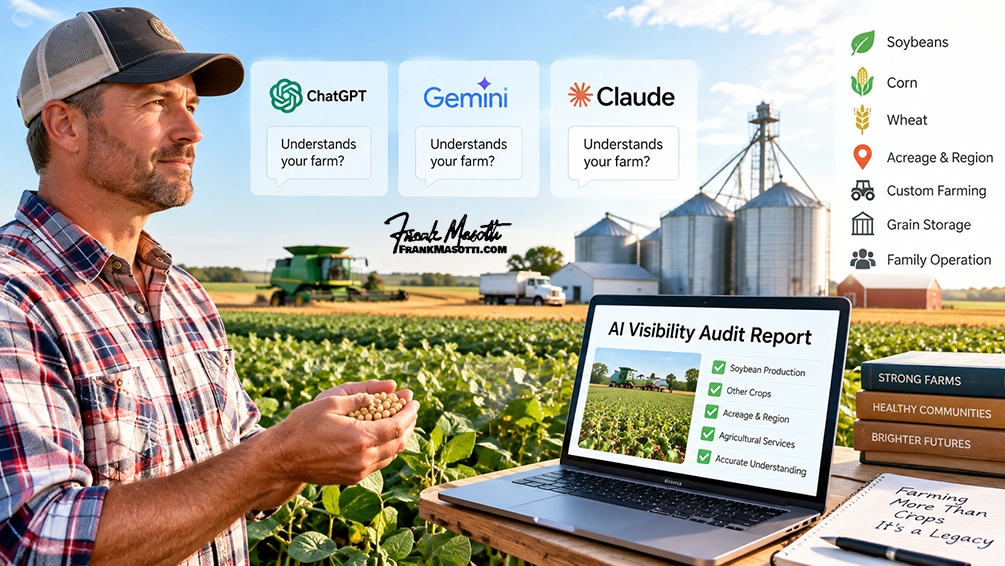
If someone asks ChatGPT, Gemini, or Claude about your soybean farming operation, do those AI systems actually understand what your farm does? They may recognize the farm name while missing the crops you produce, the acreage or region you operate in, specialized soybean production, other crops in your rotation, or additional agricultural services your operation provides. The $495 Frank Masotti AI Business Understanding Report manually examines what all three AI systems currently understand about your farming business, what they misunderstand or leave out, and where their conclusions differ.
You may never know when a landowner, grain buyer, supplier, lender, prospective employee, business partner, or someone researching agricultural businesses asks an AI system about your operation. What you can find out is what those systems currently understand when your farm becomes the subject of the question.
What Is a Soybean Farming AI Visibility Audit Report?
A soybean farming AI visibility audit report examines how AI systems understand and represent a particular soybean farming operation.
It is not an audit of how you use artificial intelligence on the farm. It is not an automated scanner grading your website. It is not software measuring whether you mentioned the right keywords.
An AI visibility audit can examine whether a business appears in AI generated answers and what those systems say about it. My approach goes further into the understanding behind those answers.
For a soybean farm, that means examining whether ChatGPT, Gemini, and Claude recognize the operation and correctly understand the type of agricultural business behind its name.
Being recognized and being understood are not necessarily the same thing.
An AI model might correctly identify a company as a farm while having only a vague understanding of what it produces. It might know the operation grows soybeans but miss that it also grows corn or wheat. It could associate the business with soybean production while failing to recognize a specialty that substantially changes what kind of soybean producer it actually is.
The purpose of the audit is to expose those distinctions.
Why Does a Soybean Farming Operation Need an AI Audit?
A soybean farm is more complicated than the label “soybean farmer” suggests.
One operation may produce conventional commodity soybeans as part of a corn and soybean rotation. Another may grow non GMO soybeans. Another may produce food grade soybeans, organic soybeans, or seed soybeans. Some operations may farm their own land while also leasing substantial acreage. Others may provide custom planting, harvesting, trucking, grain storage, or other agricultural services.
Those distinctions can matter when someone is trying to understand a specific farming business.
Geography matters too. A farm’s mailing address does not necessarily describe the full area where it operates. An agricultural business can farm land across several counties, operate multiple facilities, use different grain delivery points, and have business relationships extending far beyond the town attached to its address.
The operation itself can also change over time.
A farm can add acreage, stop growing a crop, introduce a specialty crop, expand storage, add custom farming services, change ownership, bring another generation into the operation, or change the business entities through which different parts of the farm operate.
AI systems have to make sense of whatever information about that operation they can associate with it.
That creates plenty of room for incomplete understanding.
ChatGPT might correctly identify the operation as a soybean and corn farm. Gemini might recognize soybean production but omit another important crop. Claude might understand the crops but associate the operation with a service it no longer provides.
Checking one system does not tell you what the others understand. As I explain in more detail in If ChatGPT Understands My Business, Gemini and Claude Probably Do Too. Not Necessarily., the disagreement between models can itself reveal something important.
What Can an AI Audit Reveal About a Soybean Farming Business?
For a soybean farming operation, the useful findings are the details that determine whether an AI system has built an accurate picture of the business.
Does it recognize soybean production as a major part of the operation?
Does it understand the other crops grown by the farm?
If the operation produces a specialized type of soybean, does AI recognize that distinction or reduce the business to generic soybean farming?
Does it correctly understand where the operation is located and the geographic area in which it farms?
Does it recognize additional agricultural services the business actually provides?
Does it associate the farm with services, crops, locations, owners, or business activities that are outdated or incorrect?
There is also the question of attributes.
AI systems do more than repeat facts. They can form broader conclusions about a business from the information they encounter. A model might characterize an operation as a family farm, a large commercial producer, a diversified farming operation, a specialty soybean grower, or simply an agricultural business.
Those descriptions are not interchangeable.
You may agree with the attributes an AI system associates with your farm. You may discover that an important characteristic is missing. You may find that the model has enough accurate facts to recognize the operation but still arrives at a description that does not accurately represent the business.
That is the kind of difference a simple visibility score can miss.
Why a Manual AI Audit Matters
Automated AI visibility tools have a legitimate purpose. They can run large numbers of prompts, count mentions, track citations, compare competitors, and monitor visibility over time.
That is not what the Frank Masotti AI Business Understanding Report is designed to do.
As explained in Manual vs Automated AI Visibility Audits, measurement at scale and manual interpretation answer different questions.
I am interested in what the answers mean.
If ChatGPT describes your farm one way and Gemini describes it another way, I do not want to average those answers into a score and make the disagreement disappear. I want to examine the disagreement.
If Claude knows several correct facts about the farm but combines them into an incomplete picture of the operation, the individual facts being correct do not make the overall interpretation correct.
That requires reading the responses in context and comparing what the three systems actually concluded.
Every Frank Masotti AI Business Understanding Report is analyzed manually. There is no automated scanner generating the finished report.
How the Frank Masotti AI Business Understanding Report Works
I evaluate the soybean farming operation across ChatGPT, Gemini, and Claude using the same structured methodology.
Each model is examined independently. I then compare the responses to identify agreements, disagreements, misunderstandings, omissions, recognition patterns, recommendation visibility, attributes associated with the operation, outdated information, and other interpretation issues that appear in the results.
That multi model comparison matters because there is no reason to assume all three systems have formed the same understanding of a farm.
If all three independently recognize the operation and describe its major activities accurately, that is useful evidence.
If two understand the operation correctly while the third does not, that is useful evidence too.
If all three repeatedly omit the same important part of the business, that pattern deserves attention.
You can read the complete AI Business Understanding Report methodology and see how the report works before ordering.
What Does a Soybean Farmer Receive?
The Frank Masotti AI Business Understanding Report is a $495 one time purchase.
You receive a 10+ page PDF report based on a manual evaluation of your business across ChatGPT, Gemini, and Claude.
The report includes findings about how the models understand the operation, misunderstandings and omissions, attributes associated with the business, recognition and recommendation visibility, agreements and disagreements between the three models, strategic observations, and recommendations based on what I find.
The finished report is delivered the next business day after the analysis is completed.
There is no software to install and no AI visibility dashboard to learn.
The product is the analysis and the finished report.
What Happens After the AI Audit?
Once the report is complete, you have something you did not have before: evidence showing what three major AI systems currently understand about your soybean farming operation.
You can see where their understanding appears accurate.
You can see what is missing.
You can see where one model reaches a different conclusion from the others.
You can see which information deserves attention and review my recommendations for what I would address first.
I do not sell an SEO package, GEO service, AI visibility optimization program, or monthly marketing retainer after the report.
The purpose is diagnosis before prescription.
What you decide to do with the findings is up to you.
Do ChatGPT, Gemini, and Claude Understand Your Soybean Farming Operation?
You already know what your farm grows, where it operates, what makes the operation different, and how the business has changed over the years.
The unanswered question is whether ChatGPT, Gemini, and Claude know the same things.
You cannot safely answer that question by assuming your website, business listings, industry references, or existing online presence have given all three systems the same accurate picture.
You have to examine what they actually say.
The Frank Masotti AI Business Understanding Report does exactly that.
For $495, I will manually evaluate your soybean farming operation across ChatGPT, Gemini, and Claude, compare what the three systems understand, document what they get right and wrong, identify important omissions and disagreements, and provide recommendations based on what I find.
Order your AI Business Understanding Report and find out what the three AI systems currently understand about your soybean farming business.