
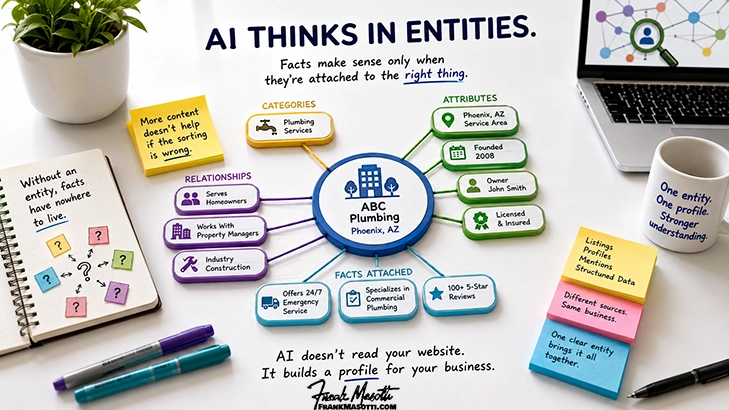
If you have read that AI models “think in entities,” you were probably left with the term and not the reason. Here is the direct answer. AI thinks in entities because information about the world does not arrive in one piece. It arrives in fragments, from different sources, at different times, written in different words, and none of those fragments are useful until they are attached to something specific. An entity is the thing they get attached to.
Without a stable object to attach facts to, an AI model would be holding a pile of disconnected sentences with no way to know which ones belong together. The sentence “they expanded into commercial work last year” means nothing on its own. It only becomes knowledge when the model can confidently say who “they” refers to, and can file that fact alongside everything else it already holds about that same specific business.
This is not a trend in AI or a preference some models have adopted. It is a structural requirement. Any system that has to accumulate knowledge from scattered sources needs somewhere to put it. Entities are that somewhere. If you want the definition and the mechanics of how a business gets resolved into one, what an entity is and why AI cares covers that ground directly. This piece is about why the whole system is built that way, and what that means for a business owner who has been thinking about their website instead.
The Problem Entities Were Built to Solve
Imagine you are handed ten thousand loose notes about businesses in Phoenix. Each note contains one true statement. No note tells you which business it belongs to beyond a name, and the names are written inconsistently. Some notes are current. Some are four years old. Some refer to businesses that no longer exist.
You cannot answer a single useful question with that pile until you first sort it. Not by source, not by date, but by which real thing each note is about. That sorting step has to happen before anything else can, because until it does, you have no way of knowing whether two notes describe the same company or two different ones.
AI faces exactly that problem at enormous scale, and it solves it the same way. It sorts the world into distinct things, then attaches what it learns to the right one. The sorting is not a step toward understanding your business. It is the precondition for understanding anything about your business at all.
Why This Stays Invisible If You Think in Pages
Most business owners picture the process differently. They imagine AI arriving at their website, reading it, and forming an impression, the way a human visitor would. Under that picture, the website is the unit of understanding, and improving the website improves the understanding.
That picture is intuitive and it is also wrong in a way that matters. AI does not retain your website. It retains what your website said about a thing. The page is a delivery mechanism. The entity is the destination. This distinction is easy to miss because from the inside, a business feels like it is its website, its logo, and its front door, all one continuous object.
It also explains a result that surprises people, which is that more content does not automatically make a business easier for AI to understand. If the sorting step has not resolved cleanly, publishing more simply produces more notes to sort. Volume is only an advantage once there is a confident destination for it to land in.
What an Entity Actually Holds
An entity is not just a label with your name on it. It carries attributes: what category of business this is, where it operates, who runs it, what it sells, what credentials it holds. It also carries relationships, meaning how it connects to other entities, such as the industry it belongs to, the city it sits in, and the kinds of customers it serves.
Those relationships are what make an entity useful to an AI model rather than merely tidy. When someone asks a model to recommend a firm that does a particular kind of work in a particular place, the model is not scanning websites in real time. It is looking at which entities it holds that carry the right category and the right location and the right attributes. This is how AI builds a picture of your business from information across the web, and it is why the picture behaves less like a summary of your site and more like a profile assembled from many sources.
Why Facts Have Nowhere to Live Without One
Here is the part that costs businesses the most, and it follows directly from everything above.
When a business has been resolved into one confident entity, every new mention of it accumulates. A new listing, a new article, a new page, each one adds to a growing profile that gets steadily more complete and more current.
When a business has not been resolved cleanly, that accumulation does not happen. Each new mention is treated as a fresh question rather than an addition, because the model has no confident place to file it. Some information lands on one partial version of the business. Some lands on another. Some does not attach anywhere. The work is being done and nothing is compounding.
This also explains why different AI models can know different things about the same business. Each model performs its own sorting, from its own sources, at its own time. One may have consolidated your business into a single accurate entity while another is still holding two partial versions it never merged. The difference is not which model is smarter. It is which model happened to sort you correctly.
The Business Consequence
The practical cost shows up at the moment a prospect asks an AI model a question that your business should be the obvious answer to, and your business does not come up, or comes up described as something adjacent to what you actually do.
That outcome does not require anyone to have published anything false about you. It only requires that the facts which would have qualified you never made it onto the entity the model was searching. This is a large part of why being visible to AI is not the same as being understood by AI, and why a business can appear in AI answers occasionally while still being absent from the answers that would actually generate work.
It is also why the usual diagnostic tools do not catch it. There is no broken page to find. Every individual piece of information may be accurate. The failure is in the sorting, and sorting is not something a site audit inspects.
Where the AI Business Understanding Report Fits
The only way to know which version of this is happening to your business is to look at what the models currently hold. The AI Business Understanding Report examines how ChatGPT, Gemini, and Claude have each resolved your business, what attributes they have attached to it, whether those attributes are current, and whether any of them belong to something you are not.
That is a different question from where you rank or how your pages are structured, and it produces a different kind of answer. It tells you what the models believe they know, which is the thing that actually gets said to a prospect.
A Simpler Way to Hold This
Stop thinking of AI as an audience reading your website and start thinking of it as a system filing information about a thing. Your website is one of the sources feeding that file. So are your listings, your profiles, your mentions elsewhere, and the structured data on your pages. What determines your outcome is not how good any single source is. It is whether all of them are pointing at the same thing clearly enough for that thing to exist as one confident entry.
If you want to see which version of your business those systems are currently holding, the AI Business Understanding Report will show you.