
If you searched for this, someone has probably told you your site needs Person schema, or you saw it flagged in an audit and want to know whether it applies to your business. Here is the direct answer.
Person schema is the structured data type used to identify a human being rather than a company. It states that a specific person exists, what they are called, what they do, where they can be found elsewhere on the web, and which organization they belong to. Schema.org treats a person and a business as two separate things, because they are, and Person schema describes the human side of that pair.
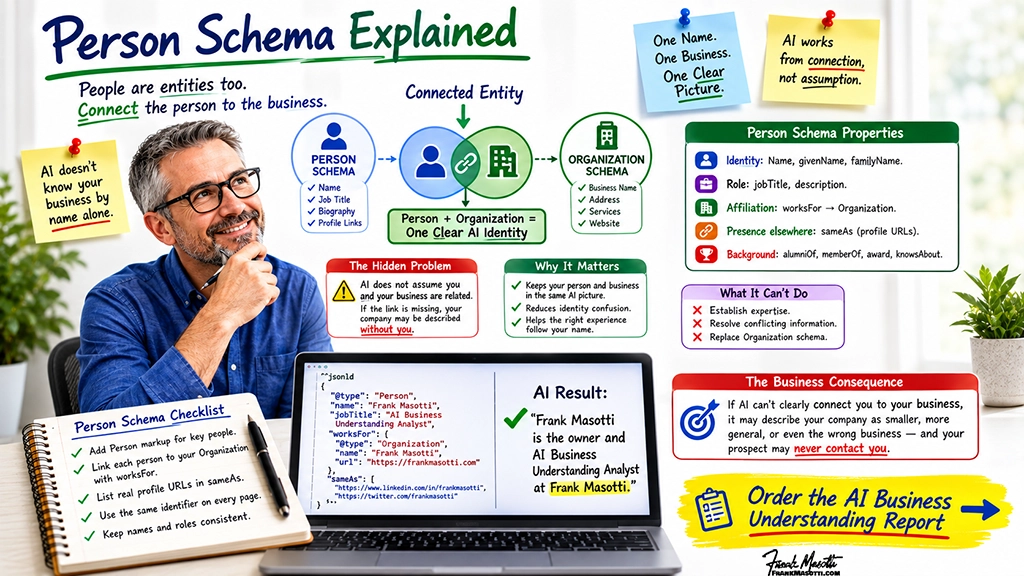
The part that carries the weight is the connection, and it is the part most implementations leave out. Person schema on its own says a human with a certain name appears on this page. Person schema connected to your Organization says this specific human founded this specific company. Only one of those changes how your business gets described.
The Hidden Problem: AI Does Not Assume You and Your Business Are Related
To you, the relationship is obvious. Your name is on the door, or on the invoices, or in the company name itself. You have never once had to explain to a customer that the person they are talking to runs the business.
A model reading your website does not start there. It sees a page about a company and a page about a person, and unless something states the link, it has to infer one. Sometimes that is easy. A biography page on a company site is a strong signal. Sometimes it is not, particularly when the same person also appears on LinkedIn, in podcast notes, in a speaker listing, and in an old article from a previous employer. Those sources describe one human being, but nothing in them declares that all the mentions belong to a single identity, or that the identity belongs to your company.
A model works with entities rather than pages, and an entity is only as clear as the statements available about it. What an entity is and why AI cares covers the foundation this sits on. Person schema exists because people are entities too, and a business built around a person has two of them to keep straight.
Why the Gap Stays Invisible
Nothing about this looks like a failure. Your about page loads, your name appears, a validator confirms the markup is correct. Every visible signal says the job is done.
What is missing is not visible on your own site. It shows up when a model has to decide whether the person with thirty years of experience is the same person who runs the company being asked about. If that is uncertain, the model does the safe thing and describes the company without the person, or the person without the company. The information was available. The link was not stated, so it was not used.
What Person Schema Actually States
Strip out the technical vocabulary and the type is a short list of declarations about a human.
Identity. The name property, plus givenName and familyName when the distinction matters. The least interesting part, and the part most implementations stop at.
Role. jobTitle states what the person does, description summarizes who they are. These are labels applied to claims your site already makes, not new claims, which is the rule for all structured data and is covered in what schema actually does.
Affiliation. worksFor points at an Organization, and the Organization type points back through founder or employee. This is the connection that does the real work.
Presence elsewhere. sameAs holds a list of URLs where the same person can be found. A LinkedIn profile, a license listing, an author page, a biography on another site.
Background. alumniOf, memberOf, award, and knowsAbout describe education, affiliations, recognition, and subject areas. Useful when verifiable somewhere else, meaningless when asserted only in your own markup.
The Two Properties That Matter Most
If you implement nothing else correctly, implement these.
The first is the affiliation link. worksFor on the Person, pointing at the Organization node that represents your business, turns two floating entities into one connected picture. Without it you have declared that a person exists. You have not declared that the person has anything to do with the company on the same website.
The second is sameAs, and its job is disambiguation. Common names are the quiet failure point. If three people share your name and one is a published author in an unrelated field, a model has to decide which one your website is about. A list of profile URLs answers that instead of leaving it to inference. This is also the only part of Person schema that reaches past your own site, and it does so in a limited way, because schema stops at the edge of your website and cannot change what those sources say about you.
One technical note worth passing to whoever implements this. The same Person should carry the same identifier across every page that mentions them, rather than being redeclared fresh each time. A name repeated on twelve pages with no shared identifier can read as twelve separate assertions rather than one consistent person.
What Person Schema Cannot Do
It cannot establish expertise. knowsAbout is a label, not a credential, and listing twenty subject areas does not make a model treat you as an authority in any of them. Standing comes from what other sources say about you, not from what you say about yourself in a format machines can read.
It cannot resolve a conflict. If your site says you founded the company in 2009 and an old profile says 2013, markup does not settle the argument. It adds a confident voice to a disagreement that already exists, and conflicting information about a business tends to reduce confidence rather than pick a winner.
It cannot replace an Organization. Owners of solo practices often ask whether to be marked up as a person or as a business. The answer is both, connected. The person holds the biography, the credentials, and the profile links. The business holds the address, the services, and the hours. Collapsing them into one node forces a model to treat your company as a human being or your human being as a company, and neither reads well.
Who This Actually Matters For
Person schema earns its place when the individual is part of what the business is. Professional services, consultancies, medical and legal practices, agencies, firms named after a founder, and any business where a prospect evaluates the person as much as the company.
It matters far less where leadership is not part of the customer decision. A distribution company gains little from an owner biography being readable by machines. If your reputation is personal and your company is how that reputation gets sold, the link between the two is not a technical detail. It is the argument.
The Business Consequence
The cost of getting this wrong is not an error message. It is an omission.
Someone asks a model about your firm and gets a description that covers the services and skips the person, because nothing connected the two clearly enough to state with confidence. Or they ask about you by name and get a summary built from an older role at a previous company, because that association was stated more clearly in more places. Or the model quietly merges you with someone else who shares your name.
None of this produces a notification. AI systems build a picture from information across the web and deliver it in the same steady tone whether the picture is complete or not. The cost is a prospect who asked about your category, heard a competent but anonymous answer, and had no reason to think a specific person with specific experience was behind it.
Where the AI Business Understanding Report Fits
A validator confirms your Person markup is correctly formed. It cannot tell you whether ChatGPT, Claude, and Gemini currently connect you to your own company.
That is the question the AI Business Understanding Report answers. It examines what all three models understand about your business right now, including whether they identify who is behind it, whether they attach the right background to the right name, and whether they are describing a role you left years ago. It works from the output side, which is the only way to find out whether your structured data changed anything.
If all three name you accurately and connect you to your business, your Person markup is doing its job. If they describe your company with no human attached, or attach the wrong one, you know which link is missing instead of guessing at it.
A Simpler Way to Think About It
Person schema does not make AI think highly of you. It makes AI certain about who you are and which business you belong to.
Certainty is the prerequisite. A model unsure whether the experienced professional and the company owner are the same individual will leave that connection out rather than risk asserting it. Everything you have built as an individual sits behind a link that either exists in readable form or does not.
If you have never checked which version of that picture AI currently holds, there is no way to know which side of that line you are on.