
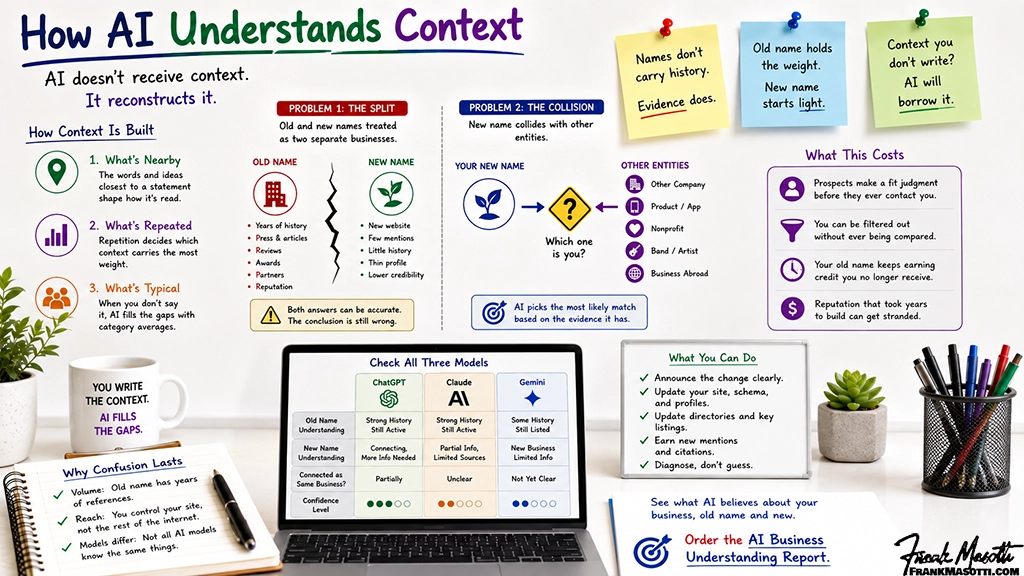
AI does not receive context about your business. It reconstructs it.
When a model reads a statement about your company, it does not arrive already knowing the situation that statement sits inside. It builds that situation from three things: what sits near the statement, what gets repeated most often across sources, and what is typical for businesses that resemble yours. Those three inputs decide what your words are taken to mean.
That last input is the one worth pausing on. Where your material supplies context, the model uses yours. Where your material is silent, the model does not leave the space empty. It fills the space with the category average. Silence does not read as neutral. It reads as ordinary.
This is why two businesses can publish nearly identical service lists and be described very differently, and why a factually correct sentence on your site can still produce a conclusion you would never sign your name to.
The Question Already Carries Context
Before the model reads anything about your business, it has read the question.
A prospect asking for a firm that handles complex commercial work has framed the request in a way that filters everything the model knows about you through that frame. A prospect asking for the cheapest option in your area has framed it differently. Same business, same published material, two different readings, because the question supplied the context first.
This is one reason your own testing feels reassuring. You ask about your company by name, using your terminology, in a question that already assumes what you do. Your prospect asks a category question and never names you. Those two prompts are not testing the same thing, which is part of why asking ChatGPT yourself does not settle the question and why one AI question cannot show you how AI understands your business.
Context Is Built From What Sits Nearby
Within your own pages, the strongest context signal is proximity.
A statement placed beside three sentences about residential projects reads as a residential statement. The same sentence placed beside enterprise language reads as an enterprise statement. Nothing about the sentence changed. What changed is what surrounds it.
This is where a lot of quiet damage happens. A capability you consider central might appear once, in a paragraph mostly about something else, surrounded by language pointing in a different direction. You know the capability is central because you run the company. The model only sees where the words sit. A phrase that depends on the reader supplying the missing frame is already at risk, which is the same underlying mechanism behind ambiguous sentences creating ambiguous AI answers and behind AI taking your words literally.
Repetition Decides Which Context Wins
Your site does not present one context. It presents many, and they are not weighted equally.
If nine pages describe the work you did for a decade and one page describes the direction you moved into last year, the model has ten pieces of context and a clear majority. It is not judging which is current. It is registering which is dominant. Recency is a weak signal compared to repetition, which is also why AI may trust older information about your business long after you consider it retired.
This also explains an outcome that frustrates owners who have invested seriously in publishing. Adding pages adds context, and added context is only helpful if it points the same direction as everything else. Otherwise it dilutes. That is the practical reason more content does not automatically make your business easier for AI to understand.
When You Supply No Context, AI Borrows It
Here is the part most business owners have never considered.
No business describes itself completely. There are always gaps: who you actually serve, what size project fits you, what you deliberately do not take on, where your pricing sits, how you differ from the firm down the street. A model still has to produce a coherent answer with those gaps in place.
So it borrows. It fills the missing context with what is typical for businesses carrying your category label, your vocabulary, and your apparent scale. If most companies described in those terms serve small local clients, that becomes your assumed client. If most work at a certain price tier, that becomes your assumed tier. If most decline the kind of work you specialize in, that becomes your assumed limit.
Every borrowed piece is reasonable on its own and none of them came from you. This is how a description assembled entirely from accurate parts can still arrive somewhere wrong, the same pattern described in how AI can combine accurate facts into an inaccurate conclusion.
Context Does Not Travel With a Fact
A detail published on your site carries its surroundings with it. A detail quoted somewhere else usually does not.
A service listed in a directory arrives without the qualification you wrote beneath it. A location mentioned in an old announcement arrives without the year attached. A description written by a partner arrives framed by that partner’s purpose rather than yours. The facts survive the trip. The context does not.
Once those stripped facts enter the picture, they compete on equal footing with the fully framed version on your own site, and the model has no way to know which version came with its frame intact. It resolves both to the same business and reads them together, which is why what an entity is and why AI cares sits underneath this entire problem. Structured data helps here by restating your facts in an unambiguous form, though it is worth knowing exactly what schema actually does before treating it as a complete answer.
Why This Stays Invisible
Context failures do not produce obvious errors. They produce plausible answers.
The model does not report which parts of its picture you supplied and which parts it inferred from businesses that resemble yours. It writes both in the same steady voice, which is why AI sometimes sounds certain when its understanding is incomplete. Nothing in the output separates your context from borrowed context.
And because each model assembles context differently, checking one tells you about one. Different training data and different weighting mean all AI models do not know the same things, so a clean answer from one model is not evidence about the others.
What This Costs
The cost shows up as a fit judgment made without you.
A prospect asks a question that carries its own frame. The model reads your business through that frame, fills the gaps with category defaults, and decides whether you match. If the borrowed context says you are smaller, more general, or more local than you are, you are quietly filtered out of the answer. No rejection, no inquiry, no record of it happening. Increasingly, your prospect asks AI about you before contacting you, which means that judgment is doing screening work you never observe.
Where the AI Business Understanding Report Fits
You cannot correct borrowed context you have never seen.
The AI Business Understanding Report documents what ChatGPT, Claude, and Gemini currently conclude about your business: what they believe you do, who they believe you serve, where they place you against alternatives, and what those conclusions appear to rest on. Reading the three side by side is what exposes borrowed context, because the assumptions your material never addressed are usually the places the three models disagree. That is the reasoning behind checking three models rather than one, and what you are actually buying lays out the deliverable in plain terms.
The Plain Version
Context is not something AI has about your business. It is something AI assembles, from what sits nearby, what repeats most often, and what is normal for companies that look like yours.
You control the first two. The third fills whatever you leave open. The question worth answering is not whether AI knows your facts. It is how much of the story around those facts you actually wrote.