
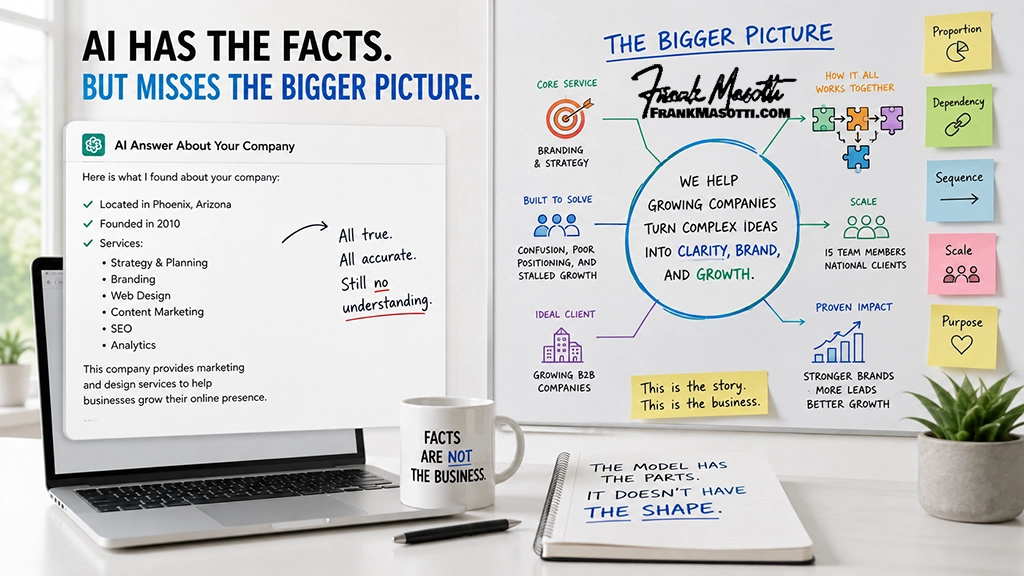
An AI model can name your city correctly, list your services correctly, get your founding year right, and still fail to describe your business. Not because it got something wrong. Because it never assembled what it found into anything.
If you searched for this, you have probably already run the test. You asked ChatGPT or Gemini or Claude about your company, read the answer closely, and went looking for the error. There was not one. Every sentence checked out. And yet the answer read like a directory entry rather than a description of the company you actually run.
That reaction is worth taking seriously. What you noticed was not a mistake. It was the absence of structure. The model had the parts. It did not have the shape.
There is a version of this problem where AI takes accurate information and builds it into the wrong conclusion, which I have written about in how AI can combine accurate facts into an inaccurate conclusion. There is another version where important information never reaches the model at all, covered in what missing information can reveal about AI’s understanding of a business. This is neither. This is the case where the facts are present, the conclusion is not wrong, and the answer is still hollow. It is the hardest of the three to catch, because there is nothing to correct.
Facts Are Independent. A Business Is Not.
A fact is complete by itself. The statement that a company operates in Phoenix does not need any other statement to be true. It stands alone and it can be verified alone.
A business works the opposite way. No single fact about a company means much in isolation. What makes a business a business is the set of relationships between its facts: which service matters most, which one exists to support another, which one is new and which one is history, how big the operation actually is, and what the whole arrangement was built to solve.
AI systems are very good at collecting the first kind of information and structurally weak at the second, and not because the technology is careless. They are weak at it because those relationships are almost never written down anywhere. The model cannot connect what nobody stated. It can only gather what was published and present it in an order.
An accurate list presented in an order is not an understanding. It just looks like one.
What Actually Goes Missing
Five kinds of structure disappear most often, and none of them are facts.
Proportion. AI may know you offer six services. It does not know that one of them is most of your revenue and two of them are courtesies you rarely run. A list carries no weight, because every item in a list is the same size. So a service you kept mostly out of habit sits beside the work you have built the company around, and the reader has no way to tell which is which.
Dependency. AI may know you do two things. It does not know you started doing the second one because customers who bought the first one always needed it next, and that the pairing is the real product. The two appear as unrelated offerings from the same company rather than as one continuous piece of work.
Sequence. AI may know a service was added four years ago. It does not know that was the pivot, that it changed who your customer is, and that everything before it is background rather than current offering. Chronology without significance flattens a turning point into a bullet point.
Scale. AI may know your locations, your years in business, and your service list. It does not usually know whether you are four people or four hundred. That single missing dimension determines what size of job you should plausibly be recommended for, and it is rarely stated anywhere a model can find it.
Purpose. This is the one that costs the most. AI can list what you sell. It usually cannot explain what the combination exists to solve. That explanation is the answer to why a customer should choose you rather than someone with a similar list, and it is the part most likely to be missing entirely.
Why Nobody Ever Wrote Any of This Down
Most websites are built as inventories. The services page lists services. The locations page lists locations. The team page lists people. Each page is accurate and complete on its own terms.
What almost no website contains is the connection between those pages. Owners do not publish sentences like the commercial side is now most of the work, or we added the second service because the first one created the need. That information feels too obvious to say out loud. It is what everyone inside the company already knows, which is exactly why it never gets typed anywhere.
AI cannot infer what was never stated. It reads pages, not rooms. This is part of why AI thinks in entities and why the relationships between those entities have to be made explicit rather than assumed. It is also the limit of structured data. Schema can label what exists on your site, but as I have written in what schema actually does, labeling is not the same as explaining, and a label cannot supply a relationship the site never described.
Why the Owner Almost Never Catches It
Two things hide this problem.
The first is the instinct to fact check. When you read an AI answer about your own company, you scan for things that are false. Nothing here is false, so the review ends. An accurate answer is the most effective disguise a shallow answer can wear.
The second is that you have nothing to compare it to. You see one answer. You do not see the answer a better assembled picture would have produced, so the thinness never registers as thinness. It just registers as a description that was somehow smaller than your business.
There is one signal worth watching, though. Pay attention to what the model leads with. Order in an AI answer reflects what the model treats as central, which is why how AI decides what your business is known for matters more than most owners expect. If your smallest service opens the answer and your primary work appears in the third sentence, you are looking at a proportion failure in plain view.
The Cost Shows Up in Comparison, Not in Description
Customers do not ask AI to describe you. They ask questions with a decision attached. Who should I call for this specific situation. Who handles projects at my scale. Who is actually good at this rather than merely offering it.
Answering that kind of question requires structure, not facts. A model holding an inventory can confirm that you exist and that you offer the thing being asked about. It cannot make a case for you, because making a case requires knowing which of your capabilities is central, how deep it runs, and who it was built for.
So when two companies list the same six services and one of them has a picture attached to those services while the other has only the list, the recommendation goes to the one that can be argued for. Nothing false was ever said about either company. You simply lost a comparison you never knew was happening, and no error appeared anywhere for you to find.
How to Tell Whether AI Has a Picture or a List
Stop asking what your business does. That question can be answered from an inventory, which is why it reveals so little.
Ask questions that cannot be answered without structure. What is this company best at. Would you recommend them for a project of this size. How do they compare to a firm that focuses on something adjacent. Who would be a poor fit for them.
Watch what happens. If the model can hold a consistent picture across those questions, it has one. If it restates the same list in different words, hedges into industry generalities, or contradicts its own emphasis from one answer to the next, then it has parts and no shape. That is also why one AI question cannot show you how AI understands your business. A single answer never puts the picture under enough pressure to find out whether it holds.
Where the AI Business Understanding Report Fits
This is the part of the work that cannot be automated into a score, because there is no error to count. A checklist can verify your address. It cannot tell you that three models are each holding a tidy inventory of your company and none of them can explain what you are for.
I question ChatGPT, Gemini, and Claude by hand, across multiple angles, and read the answers side by side. Facts are the easy part. What I am looking for is whether each model has assembled a coherent picture, where that picture is thinner than it should be, and what part of your business it is failing to hold together. When all three flatten at the same question, that is not a coincidence. That is a structural gap in what the internet says about you, and it points directly at what needs to be made explicit.
Your facts were probably always fine. Facts were never the hard part.
The question is whether anything out there connects them into the business you actually run. If you want to see what ChatGPT, Gemini, and Claude currently believe about your company, and where their understanding stops at a list, order the AI Business Understanding Report.