
Ask ChatGPT, Claude, or Gemini a question about a business and you will almost never hear “I’m not sure.” You get a clean, organized, fully formed answer, delivered in the tone of someone who has done the research. So it is a fair question: what actually makes AI confident in an answer?
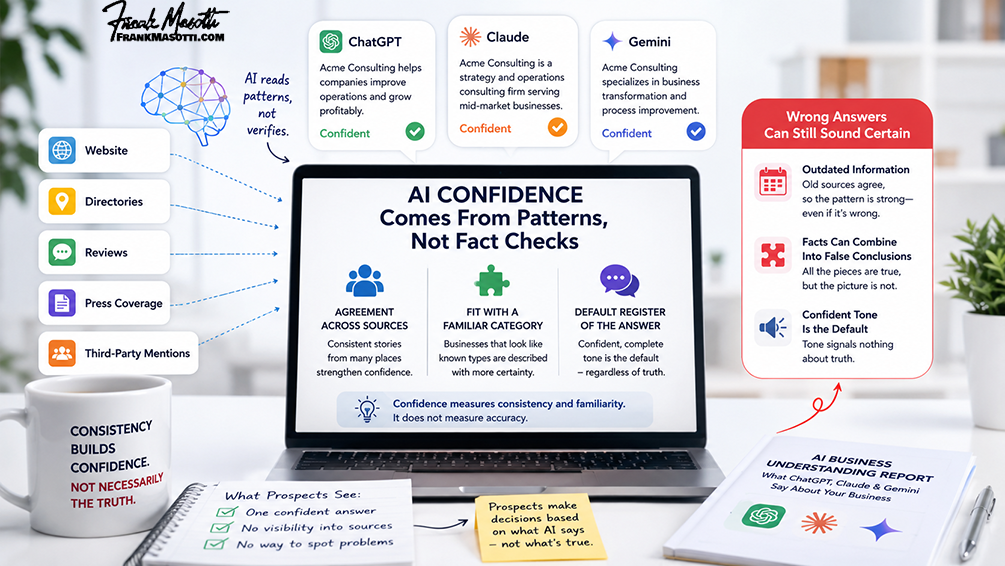
Here is the direct answer. AI confidence comes from the strength of patterns in the information the model has seen, not from any process of verifying that the information is true. When many sources describe something the same way, when the details fit a category the model recognizes, and when nothing in the phrasing forces it to hedge, the AI commits to a specific answer. None of those three conditions is a fact check. They measure how consistent and familiar the information is, which is related to accuracy but is not the same thing.
That gap between consistency and accuracy matters more than most people realize, especially if the answer in question is about your business. The rest of this post explains where AI confidence actually comes from, why wrong answers can pass every confidence test the AI applies, and what that means for anyone whose prospects are asking AI about them.
Confidence Is a Pattern Measurement, Not a Fact Check
When an AI model answers a question, it is not looking up a verified record and reading it back. It is generating a response based on patterns it learned from enormous amounts of text. I cover the mechanics in more detail in How AI Understanding Actually Works, but the piece that matters here is simple: there is no verification step. Nothing in the process pauses to confirm a claim against reality before the answer reaches the person asking.
What the model does have is a sense of how strong a pattern is. If it has encountered a thousand consistent descriptions of what a company does, that pattern is strong, and the model states it plainly. If it has encountered three vague mentions that disagree with each other, the pattern is weak, and the answer may get more general or hedged. So confidence is real, in a sense. It reflects something. It just reflects the consistency of the information environment, not the truth of it.
Think of it like a rumor in a small town. If one person says the hardware store is closing, people shrug. If forty people say it, everyone believes it, and they believe it with conviction. At no point did the number of people repeating the rumor make it true. Repetition created certainty. It did not create accuracy.
The Three Things That Actually Strengthen AI Confidence
Agreement across sources. AI builds its picture of a business from many places at once: your website, directories, reviews, press coverage, and third party mentions. How AI Builds a Picture of Your Business From Information Across the Web walks through this in depth. When those sources tell one consistent story, the model treats that story as settled and describes it without hesitation. When they conflict, the model has to make a silent judgment call, and as I explain in What Happens When AI Finds Conflicting Information About a Business, the result can be one version chosen arbitrarily, or a blend that matches nothing.
Fit with a familiar category. Models are more confident when a business looks like a type of business they have seen thousands of times. A standard dental practice gets described fluently because the model has a deep template for dental practices. A business with an unusual specialty, or one that sits between categories, forces the model to reach, and reaching is where descriptions drift. The model may round your business off to the nearest familiar shape and describe that shape with full confidence.
The default register of the answer itself. This is the part almost nobody accounts for. These systems learned to write from explanatory text, and they are tuned to be helpful and complete. Polished, assured prose is their native voice. The confident tone shows up whether the underlying pattern is strong or weak. That is why tone is such an unreliable signal, a problem I dig into in Why AI Sometimes Sounds Certain When Its Understanding Is Incomplete. The delivery is confident by default. Only the content varies.
Why Wrong Answers Pass Every Confidence Test
Once you see what the confidence signals actually measure, it becomes clear how a wrong answer can score high on all of them.
Outdated information is the cleanest example. Suppose a business dropped a service line two years ago, but that service still appears in old directory listings, an archived press release, and a stale partner page. From the model’s point of view, that is agreement across sources. Multiple independent mentions, all saying the same thing. The pattern is strong, so the answer comes out specific and assured, and it is wrong. The old information does not just linger. It reinforces itself, which is why Why Outdated Information Can Continue Shaping AI’s Understanding remains one of the most common problems I find.
There is a second, subtler failure. Every individual fact the model holds can be correct, and the conclusion assembled from them can still be false. A true detail about your history, a true detail about one service, and a true detail about a location can combine into a description of a business that does not exist. I break that mechanism down in How AI Can Combine Accurate Facts Into an Inaccurate Conclusion. Because each ingredient checks out, nothing in the process flags the finished answer as suspect, and it ships with the same confident tone as everything else.
The Business Problem Hiding Inside a Confident Answer
Here is why this stops being a technical curiosity and becomes a business issue.
Your prospects cannot see pattern strength. They cannot see which sources agreed, which conflicted, or how old the underlying information is. The only signal they receive is the finished answer, and the finished answer always sounds sure of itself. So a prospect asking AI about your business gets one of two things: an accurate description delivered confidently, or an inaccurate one delivered exactly the same way. From their side of the screen, the two are indistinguishable.
And they are asking. Buyers increasingly put their first question to an AI assistant before they ever visit a website or make a call. If the confident answer they receive misses your actual specialty, describes services you no longer offer, or blends you with a similar company, that prospect filters you out and moves on. You never see it happen. Your analytics look normal because they never reached your site. The cost is real, and it is invisible, a dynamic I have written about in The Cost of Contradictory Information.
The uncomfortable summary: AI confidence is a closed loop between the model and its sources. You are the subject of the answer, but nothing in the loop consults you.
How to Find Out What That Confident Voice Is Saying About You
You cannot audit this by asking ChatGPT one question yourself. A single answer shows you one output from one model on one phrasing, and as I explain in One AI Question Cannot Show You How AI Understands Your Business, that tells you almost nothing about the underlying understanding. Different models also hold different information, so a clean answer from one says nothing about the other two.
This is exactly what the AI Business Understanding Report was built to examine. I question ChatGPT, Claude, and Gemini about your business from multiple angles, compare their answers against each other and against reality, and document where the confident descriptions are accurate, where they are outdated, and where they disagree. Where all three models describe you the same way, that tells you something important too, a point I expand on in What Agreement Between ChatGPT, Claude and Gemini Can Tell You. The result is a written report showing you, in plain language, what that confident voice is actually telling your prospects.
Confidence is the one thing AI will always supply on its own. Accuracy is the part that has to be checked. If you have never seen what ChatGPT, Claude, and Gemini say about your business when they sound completely sure of themselves, ordering a report is how you find out whether their confidence is earned.