
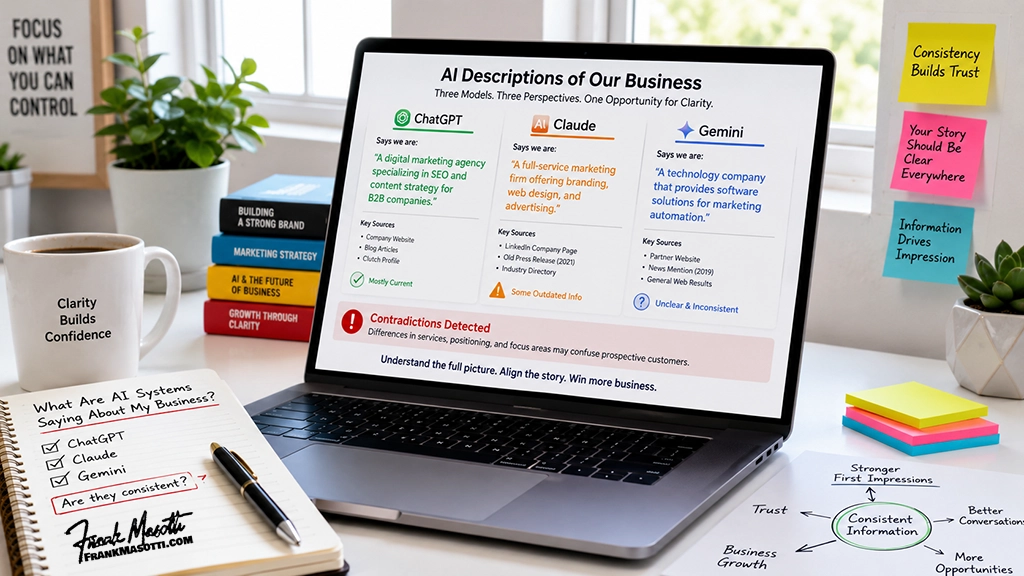
If ChatGPT, Claude, and Gemini describe your business three different ways, the first reaction is usually mild annoyance. It looks like a technical quirk, the kind of thing a person shrugs off because nothing visibly broke. That reaction is the mistake.
Contradictory information has a real cost. It does not show up as a system error, a drop in website traffic, or a customer complaint. It shows up as a prospect who read a confident, complete, and wrong answer about your business, and quietly went somewhere else. You never see that person. You never know they existed. That is what makes this expensive. Not that any single incident costs much, but that it costs something every time, and nothing in your business is set up to notice.
This post is about naming that cost and showing where it actually lands, so it stops being an abstract technical issue and starts being something you can weigh against the price of fixing it.
Why This Cost Never Shows Up on a Report
Every other cost in your business leaves a trace. A slow website shows up in your analytics. A rude employee shows up in a review. A broken contact form gets noticed, eventually, because someone complains or a sales number drops enough to trigger a question.
An AI system giving a prospect a confused or outdated description of your business leaves no trace at all. The prospect does not file a complaint. They do not call to tell you ChatGPT said something inaccurate. They simply form an impression, decide it is not what they need, and move to the next option. Your website analytics stay flat because they never visited. Your phone does not ring because they never called. From inside your business, the day looks completely normal.
That is the real problem with contradictory information. It is not that it is severe. It is that it is invisible by design. Nothing about how this loss happens produces a signal you would recognize as a signal.
Where the Contradiction Actually Comes From
AI systems do not read your website and stop there. They build an understanding of your business from your site, directories, old press coverage, review platforms, partner pages, and anything else that mentions you. When those sources agree, the resulting description is usually solid. When they do not, the AI has to decide what to do with the disagreement, and it does that decision making silently, without telling the person asking.
What Happens When AI Finds Conflicting Information About a Business goes into the mechanics of that decision. The short version is that the AI will pick one version, blend the versions into something that matches neither, or retreat into vague language that avoids committing to specifics. None of those outcomes come with a warning label. They arrive with the same steady, confident tone as an answer built from perfectly consistent sources.
A related pattern shows up specifically when your current site says one thing and older material still online says another. As explained in What Happens When Your Website Says One Thing and Older Sources Say Another, the AI does not automatically trust your newest page just because it is newest. It weighs your site as one input among several, which means an old bio, a discontinued service list, or a press release from three years ago can still be shaping what a prospect hears today.
Three Places the Cost Actually Lands
Before the first conversation
A growing share of buyer research now happens through an AI question instead of a website visit. Your Prospect May Ask AI About You Before Contacting You covers this shift directly. If the answer that prospect receives misrepresents what you actually do, you are filtered out before you ever get the chance to make your own case. This is the most expensive version of the cost, because it removes an otherwise qualified buyer without you ever knowing they existed.
Inside the sales conversation
Some prospects call anyway, working from a partially wrong picture of your business. The first several minutes of that conversation get spent correcting an assumption instead of building a case for why you are the right choice. That is time your sales process is paying for without any way to track it, because nobody reports “I called with the wrong expectation.” It just quietly lowers how well that call converts.
Relative to your competitors
Contradiction does not need to make you look bad in absolute terms to cost you business. It only needs to make a competitor look more consistent by comparison. Why Two Similar Businesses Can Be Understood Very Differently by AI explains how two companies offering nearly identical services can receive very different AI descriptions, simply because one has cleaner, more consistent information across the sources AI is drawing from. When that happens, the business with the clearer picture gets chosen more often, and the other one never learns why.
Why the Cost Compounds Instead of Staying Flat
None of this stays the same size over time. As more buyers start their research with an AI question rather than a search engine, a larger share of your funnel passes through the exact point where contradiction does its damage. The cost you are absorbing today from unclear AI answers is smaller than the cost you will absorb next year if nothing changes, simply because more of your prospects will be routing their first impression through AI before they route it through you.
This is also why the cost is easy to underestimate. It grows quietly in the background while every visible number in your business looks normal.
Making the Invisible Cost Visible
The reason this cost is so easy to ignore is that nobody has looked directly at it. Most business owners have never seen, in one place, what ChatGPT, Claude, and Gemini currently say about their business, let alone where those three descriptions disagree with each other or with reality.
That is what the AI Business Understanding Report is built to show. It compares how all three models describe your business, identifies the specific contradictions, gaps, and outdated details, and lays them out in a written report you can actually read and act on. It does not guess at whether a problem exists. It investigates and shows you exactly what is there. What you do with that evidence is your decision, but you cannot make a good decision about a cost you cannot see.
A contradiction you can see is a problem you can fix. A contradiction you cannot see just keeps costing you, one unnoticed prospect at a time. If you want to know whether that is happening to your business right now, ordering a report is the fastest w