
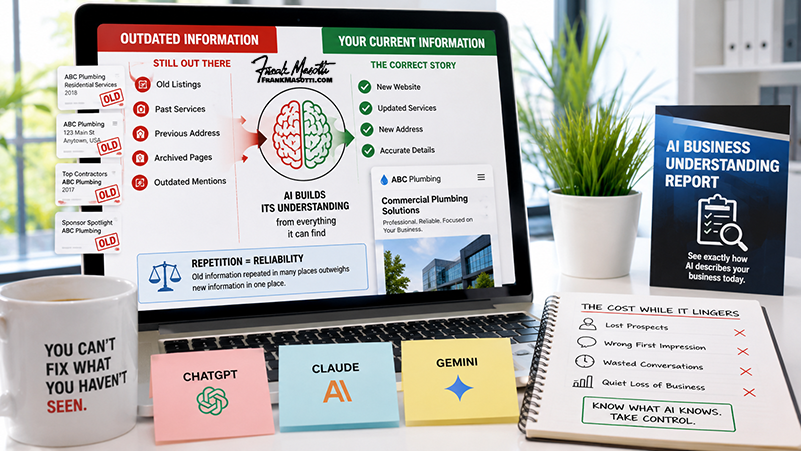
You fixed the problem. The old service got removed from your website, the new address went up, the description got rewritten. Then you asked ChatGPT about your business and heard the old version anyway, sometimes weeks or months after the correction. The natural question is why. You updated the source, so why is the answer still wrong?
The direct answer is that AI systems do not treat your website as the single source of truth about your business, and they do not treat new information as an automatic replacement for old information. An update on your site adds one more voice to a conversation that already includes years of older material. Nothing about publishing the correction removes what came before it. Until the newer version outweighs the older one, the older one keeps shaping the answer.
That is the short version. The rest of this post explains why outdated information is so durable inside AI systems, where it actually lives, and what it quietly costs a business while it lingers.
The Web Has No Expiration Dates
Start with a simple fact about how the internet works: almost nothing on it expires. A directory listing from six years ago, a press mention from a product you discontinued, a partner page describing services you no longer offer, an old bio on a conference site. All of it is still published, still readable, and still available to any system building a picture of your business.
AI systems assemble their understanding from exactly this kind of material. As covered in How AI Builds a Picture of Your Business From Information Across the Web, your website is one input among many, not a master record that overrides the rest. When you update your site, you have corrected one source. The dozens of other pages that describe the old version of your business have not changed at all, and no mechanism exists that tells them to.
This is the first reason outdated information persists. It is not that AI systems prefer old information. It is that old information never leaves the pool they draw from.
Some of the Old Version Is Baked In
There is a second layer that catches most business owners off guard. AI models are trained on large collections of text gathered up to a certain point in time. Whatever the web said about your business when that material was collected becomes part of what the model simply knows, without looking anything up.
If your business changed after that point, the model’s built in knowledge describes the business you used to be, and it will keep describing that business until the model is retrained. No edit to your website reaches into that stored knowledge. AI Might Be Describing the Business You Used to Be looks at this pattern in detail, and it explains why a correction that seems obvious from your side can take a surprisingly long time to show up in AI answers.
Some AI tools do check the live web before answering. But even then, the model’s stored impression does not disappear. It sits underneath the fresh search results, coloring how they get interpreted. A model that already believes you are a residential contractor will read your new commercial services page through that existing belief, and the blended answer can land somewhere between who you were and who you are.
Repetition Reads as Reliability
Here is the part that explains why old information does not just survive but sometimes wins. When an AI system encounters disagreement between sources, one of the strongest signals it leans on is consistency. A fact that appears in many places, phrased in similar ways across independent sites, looks dependable. A fact that appears in one place looks uncertain.
Now consider what your recent update looks like through that lens. The old description of your business has been repeated for years across directories, articles, listings, and archived pages. The new description exists on your website and almost nowhere else. From the AI’s point of view, the outdated version is the well supported one, and your correction is the outlier. Why AI May Trust Old Information About Your Business walks through this weighting problem, and it is the core reason a single website update so often fails to change the answer.
This also means the disagreement itself becomes a problem. Your site now says one thing while older sources say another, and as explained in What Happens When Your Website Says One Thing and Older Sources Say Another, the AI resolves that conflict silently. It may pick the old version, blend the two, or go vague. None of those outcomes tells the person asking that anything was uncertain.
What This Costs While It Lingers
None of this would matter much if AI answers were a curiosity. They are not. Prospects increasingly ask ChatGPT, Claude, or Gemini about a business before they ever visit its website, which means the outdated version of your business is sometimes the first version a buyer meets.
Think about what that looks like in practice. A prospect asks about your business and hears about the location you left, the service you dropped, or the market you moved away from. If the old version does not fit what they need, they move on, and you never learn they existed. If they contact you anyway, the first minutes of the conversation get spent correcting an impression you did not create. Either way, the business you used to be is competing with the business you are now, and it is doing so in a channel you cannot see. The Cost of Contradictory Information covers why this kind of loss never shows up in your analytics or your reports. It simply looks like a quiet week.
The longer the gap between what you do and what AI says you do, the more of these silent mismatches accumulate. And because outdated information decays slowly on its own, waiting is not a strategy. The old version does not fade on a schedule. It fades when the newer version becomes the more consistent, more repeated, more confirmable story, and that only happens when someone knows exactly which outdated details are still circulating.
You Cannot Fix What You Have Not Seen
Most business owners in this situation are guessing. They know something changed, they suspect AI has not caught up, but they do not know which details are stale, which sources are feeding them, or whether ChatGPT, Claude, and Gemini are all telling the same old story or three different ones. Your Business Changed. Did AI Notice? makes the case that this question deserves a real answer, not an assumption.
That is what the AI Business Understanding Report provides. It examines how all three major AI models currently describe your business, then identifies the specific outdated details, contradictions, and gaps in those descriptions. Instead of wondering whether AI is still describing the business you used to be, you see it in writing, detail by detail, with the evidence in front of you.
Outdated information persists because nothing in the system is responsible for retiring it. That job falls to you, and it starts with knowing exactly what is still out there shaping the answers. If your business has changed and you want to know whether AI has noticed, ordering a report is the most direct way to find out.